
Debbie Richens /
13th August 2026
CQC Mock Inspection Case Study: How The Martlets Addressed Gaps Before Achieving Good Across All Five Key Questions

Estimated reading time: 13 minutes
A mock CQC inspection is most useful when it does more than produce a rating. It should show a provider where evidence is weak, where practice is not fully reflected in records, and where practical action is needed before those gaps become regulatory concerns. The Martlets Care Home provides a useful real-world example of that process in action.
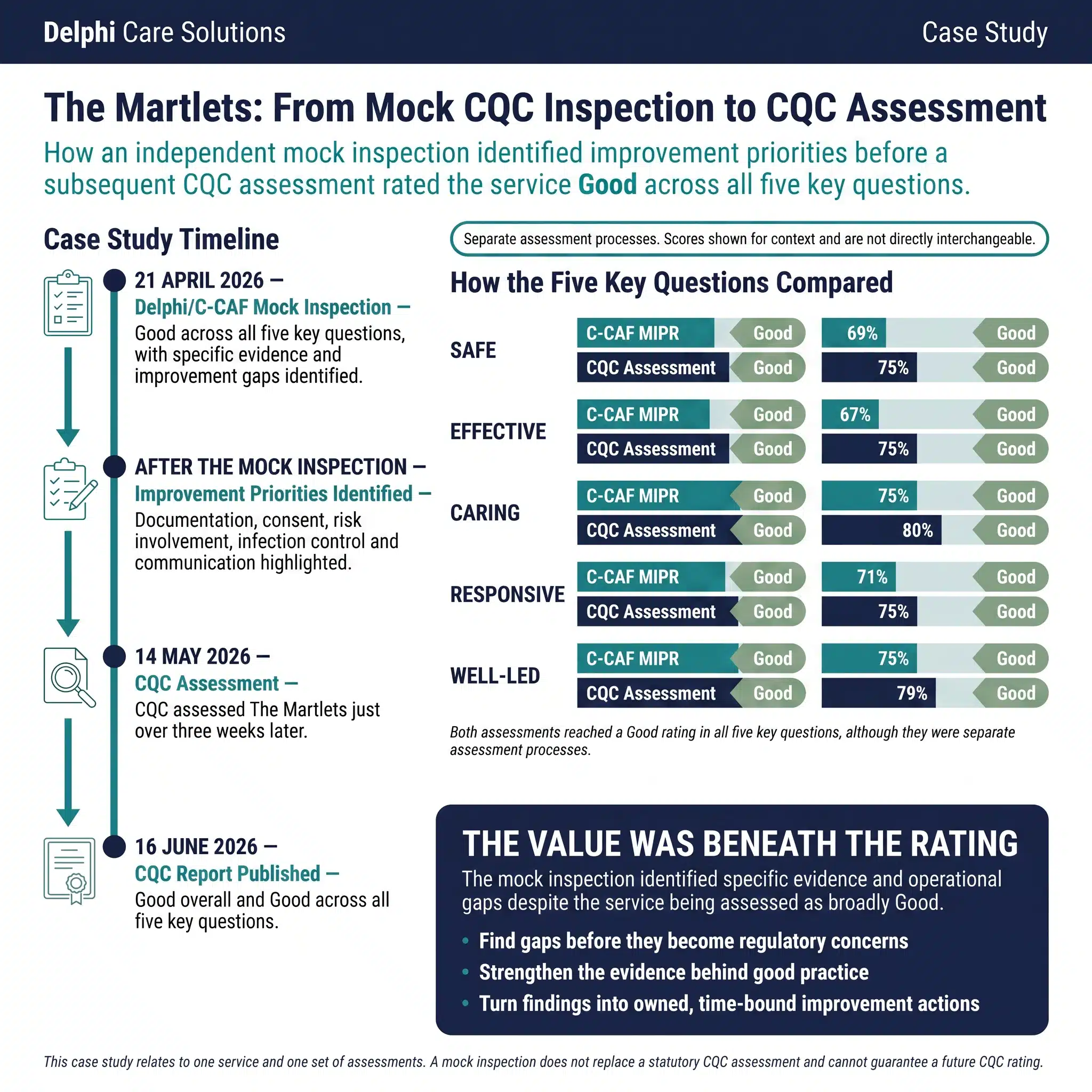
In April 2026, Delphi Care Solutions completed a mock inspection at The Martlets in East Preston, operated by Shaw Healthcare Limited. The inspection was subsequently reviewed through the Care Consultant Accreditation Framework (C-CAF) Mock Inspection Peer Review (MIPR) process. The mock assessment rated the service Good across all five CQC key questions, while also identifying specific areas where documentation, risk evidence, infection control and communication could be strengthened.
CQC assessed The Martlets on 14 May 2026. Its assessment report, published on 16 June 2026, rated the service Good overall and Good for Safe, Effective, Caring, Responsive and Well-led. The official report also confirmed that previous regulatory breaches relating to dignity and respect and person-centred care had been addressed.
Direct answer: what did this case study show?
- The Delphi/C-CAF mock inspection on 21 April 2026 rated The Martlets Good across all five key questions.
- The mock inspection still identified six areas requiring focused attention, including consent records, risk involvement, infection control and communication.
- CQC assessed the service just over three weeks later and subsequently rated all five key questions Good.
- The later CQC findings recorded good standards in the corresponding areas, including person-centred care, consent, risk management, infection prevention and control, and teamwork.
- This is evidence from one case. A mock inspection does not replace a statutory CQC assessment and cannot guarantee a future CQC rating.
| By | Debbie Richens, Executive Manager – Inspections and Assurance, Delphi Care Solutions |
|---|---|
| Last updated | August 2026 |
| Experience | 25+ years’ management experience in health and social care; specialist in service turnaround with a track record of improving CQC ratings from Inadequate, including enforcement notices, to Good across all areas. |
| Editorial note | Updated when CQC regulatory expectations, mock inspection methodology or sector practice changes, to keep this case study practical and decision-ready. |
| Sources | Informed by CQC’s published assessment report for The Martlets, CQC rating and assessment guidance, the C-CAF MIPR process, and Delphi’s mock inspection evidence. |
About the author
Debbie Richens is the Executive Manager – Inspections and Assurance at Delphi Care Solutions, bringing over 25 years of management experience and extensive knowledge of leadership and management within health and social care.
Debbie specialises in the turnaround of care services and has a proven track record of supporting significant service improvement, including improving CQC ratings from Inadequate with enforcement notices to Good across all areas. Her experience is underpinned by a strong focus on quality care, effective leadership and sustainable improvement.
Key takeaways
- A mock inspection can identify meaningful evidence and governance gaps even when the overall service is performing at a Good level.
- At The Martlets, the Delphi/C-CAF mock inspection and the later CQC assessment both rated all five key questions Good, but the scores came from different assessment processes and should not be treated as interchangeable.
- The six improvement areas show why providers should test the evidence trail behind person-centred care, dignity, consent, risk management, infection control and team communication.
- The value of a mock inspection is in what happens next: prioritised actions, clear ownership, deadlines and evidence that improvements have become embedded.
- This case study shows alignment in one service. It does not establish causation and a mock inspection cannot guarantee a future CQC rating.
Table of contents
- Why this case study matters for CQC inspection readiness
- The Martlets assessment timeline
- How the five key question ratings compared
- Six improvement areas highlighted before the CQC assessment
- 1. Person-centred care: good practice needed stronger documentation
- 2. Dignity and respect: improvement needs to remain embedded
- 3. Consent: practice must be supported by a clear decision-making record
- 4. Involving people to manage risks: record the balance between safety and choice
- 5. Infection prevention and control: small environmental gaps can weaken assurance
- 6. Team communication: clinical information has to reach the people delivering care
- What providers can learn from The Martlets case study
- A note on the CQC assessment framework in 2026
- Frequently asked questions about CQC mock inspections
- Using mock inspections as an improvement tool, not a rehearsal
- Next steps: strengthen your CQC readiness
Why this case study matters for CQC inspection readiness
Providers can sometimes deliver good care while still carrying avoidable regulatory risk because the evidence behind that care is incomplete, inconsistent or difficult to demonstrate. The Martlets case is particularly useful because the mock inspection identified several examples where positive practice was present, but the supporting documentation or assurance trail was not as strong as it could have been.
That distinction matters. CQC does not assess a service only on what leaders say happens. It considers evidence about people’s experiences, staff practice, records, governance and outcomes. A provider therefore needs both good practice and a reliable way of demonstrating that practice consistently.
For Registered Managers, Nominated Individuals, operational leaders and quality teams, the practical lesson is straightforward: inspection readiness is not simply about preparing for a visit. It is about identifying where practice, records and governance do not yet tell the same story. For a broader readiness framework, explore Delphi’s CQC Readiness & Improvement support.
The Martlets assessment timeline
| Date | What happened |
|---|---|
| 21 April 2026 | Delphi/C-CAF mock inspection completed at The Martlets. |
| Following the mock inspection | Specific improvement areas were recorded and prioritised for action. |
| 14 May 2026 | CQC assessment date for The Martlets. |
| 16 June 2026 | CQC published the assessment report, rating the service Good overall and Good across all five key questions. |
The timing is important because it allows the mock inspection findings and the subsequent CQC judgement to be compared closely. It does not mean the mock inspection caused the CQC outcome, but it does show whether the areas highlighted during the mock were consistent with the evidence CQC later recorded.
How the five key question ratings compared
The MIPR evaluation and the subsequent CQC assessment reached the same rating in each of the five key questions. The percentage scores were not identical, and they should not be treated as interchangeable because they came from different assessment processes.
| Key question | C-CAF MIPR | CQC assessment |
|---|---|---|
| Safe | 69% – Good | 75% – Good |
| Effective | 67% – Good | 75% – Good |
| Caring | 75% – Good | 80% – Good |
| Responsive | 71% – Good | 75% – Good |
| Well-led | 75% – Good | 79% – Good |
Under CQC’s current scoring approach, a key question percentage between 63% and 87% falls within the Good rating range, subject to CQC’s scoring rules and professional judgement. In this case, CQC recorded Good in every key question.
Six improvement areas highlighted before the CQC assessment
The strongest part of this case study is not that the two assessments both reached Good. It is the detail underneath the ratings. The mock inspection identified six areas where the service could strengthen evidence or practice before the later CQC assessment.
1. Person-centred care: good practice needed stronger documentation
The mock inspection found evidence of personalised care in practice, but it also identified gaps in how some positive outcomes were recorded in care plans. One example concerned the use of a newer blood glucose monitoring device to support a person with diabetes more comfortably. The issue was not simply whether the intervention was helpful, but whether the care record clearly showed the person-centred reasoning and outcome.
When CQC later assessed the Responsive key question, person-centred care scored 3. CQC reported that people were at the centre of their care and treatment choices and confirmed that the provider was no longer in breach of the regulation relating to person-centred care. The Effective findings also recorded that people and relatives were involved in planning and reviewing care and that care plans were informative and clear.
Practical lesson: if a service is achieving a good outcome, the care plan should make the person’s involvement, preferences, risks, decisions and outcomes visible. Good care that is poorly evidenced can create unnecessary inspection risk.
2. Dignity and respect: improvement needs to remain embedded
The mock inspection observed warm and respectful interactions, while also recognising the importance of maintaining vigilance because dignity and respect had previously been an area of regulatory concern at the service.
CQC subsequently rated Caring as Good with a score of 80 out of 100. It confirmed that the previous breach relating to dignity and respect had been addressed. Under kindness, compassion and dignity, CQC recorded a score of 3 and found that people’s privacy, dignity and choices were being upheld.
Practical lesson: resolving a historical breach is not only about correcting a single incident. Providers need to show that the improved standard is embedded in day-to-day practice, staff behaviour and oversight.
3. Consent: practice must be supported by a clear decision-making record
The mock inspection identified a documentation risk around consent. In particular, it highlighted the need for clearer written evidence of consent and resident involvement where people had capacity to make decisions about their care.
CQC later scored Consent to care and treatment at 3. Its report recorded that people had been assessed for capacity where required and that, where a person lacked capacity for a specific decision, best-interest decisions were documented with the people involved and the reasoning behind the decision.
Practical lesson: consent is not a one-off signature. Records should demonstrate how consent, capacity and involvement are considered for the specific decisions that affect each person.
4. Involving people to manage risks: record the balance between safety and choice
The mock inspection found examples of staff managing risk in practice, but it identified limited written evidence showing that some risk decisions had been discussed and agreed with the person or their family. This can leave a gap between what the team is doing and what the record demonstrates.
In the subsequent CQC assessment, Involving people to manage risks scored 3. CQC reported that risks to health and welfare were assessed and reviewed regularly and that care was delivered in a way that supported people to do the things that mattered to them.
Practical lesson: risk assessments should not read as restrictions imposed on people. They should show how the service has involved the person, considered what matters to them and reached a proportionate balance between safety, independence and choice.
5. Infection prevention and control: small environmental gaps can weaken assurance
The mock inspection recorded practical infection-control issues, including waste-bin arrangements and incomplete cleaning records. These were relatively specific findings, but they mattered because visible environmental controls and completed audit records are part of the evidence that infection risks are being managed consistently.
CQC later scored Infection prevention and control at 3. Inspectors found the environment clean, observed appropriate use of personal protective equipment and recorded that regular infection prevention and control audits covered the environment, equipment and staff practice.
Practical lesson: inspection readiness includes the details. A strong policy is not enough if routine environmental controls, cleaning records or audit trails are incomplete.
6. Team communication: clinical information has to reach the people delivering care
Feedback considered during the mock inspection highlighted a risk that clinical instructions and information were not always filtering consistently from leadership or visiting professionals to front-line care staff.
CQC later scored How staff, teams and services work together at 3. The report described good communication and joint working between the service and professionals, with records showing collaborative information sharing. CQC also found a positive staff culture, including opportunities for staff to speak openly through team meetings, supervision and handovers.
Practical lesson: governance is only effective when information moves reliably from assessment and professional advice into care plans, handovers and day-to-day staff practice.
What providers can learn from The Martlets case study
This case highlights five practical principles that can strengthen CQC inspection readiness:
- Look beyond the headline rating. A service can be broadly Good while still carrying specific evidence or operational risks that need action.
- Test the evidence trail. Check whether care plans, risk assessments, consent records, audits and handovers consistently demonstrate what staff say happens in practice.
- Prioritise findings by risk and impact. Small administrative gaps and significant regulatory concerns should not be treated as if they are the same.
- Use the period after a mock inspection actively. Assign actions, owners and deadlines, then verify that changes have become embedded rather than simply completed on paper.
- Keep improvement continuous. CQC readiness should be part of normal governance, not a short-term exercise that begins only when an assessment is expected.
A note on the CQC assessment framework in 2026
The Martlets assessment took place under CQC’s current provider assessment approach, which is structured around the five key questions of Safe, Effective, Caring, Responsive and Well-led, with quality statements under each key question.
As of August 2026, CQC is piloting and testing draft sector-specific assessment frameworks. Its March 2026 update confirmed that the five key questions remain fundamental, while its June 2026 update set out the piloting, testing and evaluation programme for the new assessment method. Providers should therefore check current CQC guidance when preparing for future assessments rather than relying on a static checklist.
Frequently asked questions about CQC mock inspections
What is a CQC mock inspection?
A CQC mock inspection is an independent review designed to test how a service’s current practice, evidence and governance compare with the areas CQC is likely to assess. It can help providers identify strengths, gaps and improvement priorities before a statutory assessment. It is not a CQC inspection and does not carry regulatory authority.
Can a mock CQC inspection guarantee a Good rating?
No. A mock inspection can help identify risk and improve readiness, but it cannot guarantee or predict the outcome of a future CQC assessment. CQC makes its own independent judgements using the evidence available to it at the time of assessment.
What should a provider do after a mock inspection?
Providers should turn findings into a prioritised improvement plan, assign clear owners and deadlines, address higher-risk issues first, and then check that changes are embedded through audit, observation, staff discussion and record review. The goal is not simply to close actions, but to strengthen the evidence that good practice is consistent and sustainable.
Using mock inspections as an improvement tool, not a rehearsal
The Martlets case demonstrates the value of looking beneath a headline rating. The mock inspection identified areas that warranted attention even though its overall assessment was Good. The subsequent CQC report also rated all five key questions Good and recorded improvement in areas that had previously attracted regulatory concern.
For providers, the most useful question is therefore not “What rating would we get today?” It is “What evidence, practice or governance gap could create risk if we do not address it?” A robust mock inspection should help answer that question and give leaders a practical route from finding to action.
Next steps: strengthen your CQC readiness
If this case study reflects questions you are asking about your own service, choose the next step that best matches your current position.
Option 1: Test your service with a mock CQC inspection
Use an independent review to identify strengths, evidence gaps and practical improvement priorities before regulatory scrutiny. Explore Delphi’s Mock CQC Inspection service.
Option 2: Strengthen readiness and improvement
If you already know where some of the pressure points sit, focus on action planning, governance, leadership oversight and embedding improvement. Explore CQC Readiness & Improvement support.
Option 3: Speak to the Delphi team
If you are unsure which level of support is most appropriate, contact the Delphi Care Solutions team to discuss your service, current risks and inspection-readiness priorities.
Case study note: This case study relates to one service and one set of assessments. C-CAF is an independent professional accrediting body and is not a regulatory authority. A mock inspection or MIPR does not replace a statutory CQC assessment and cannot guarantee a future CQC rating.



If you would like to chat with one of our consultants, then why not book a meeting now.
We look forward to hearing from you!
Book your meeting now