
Sophie Lawrence /
19th August 2026
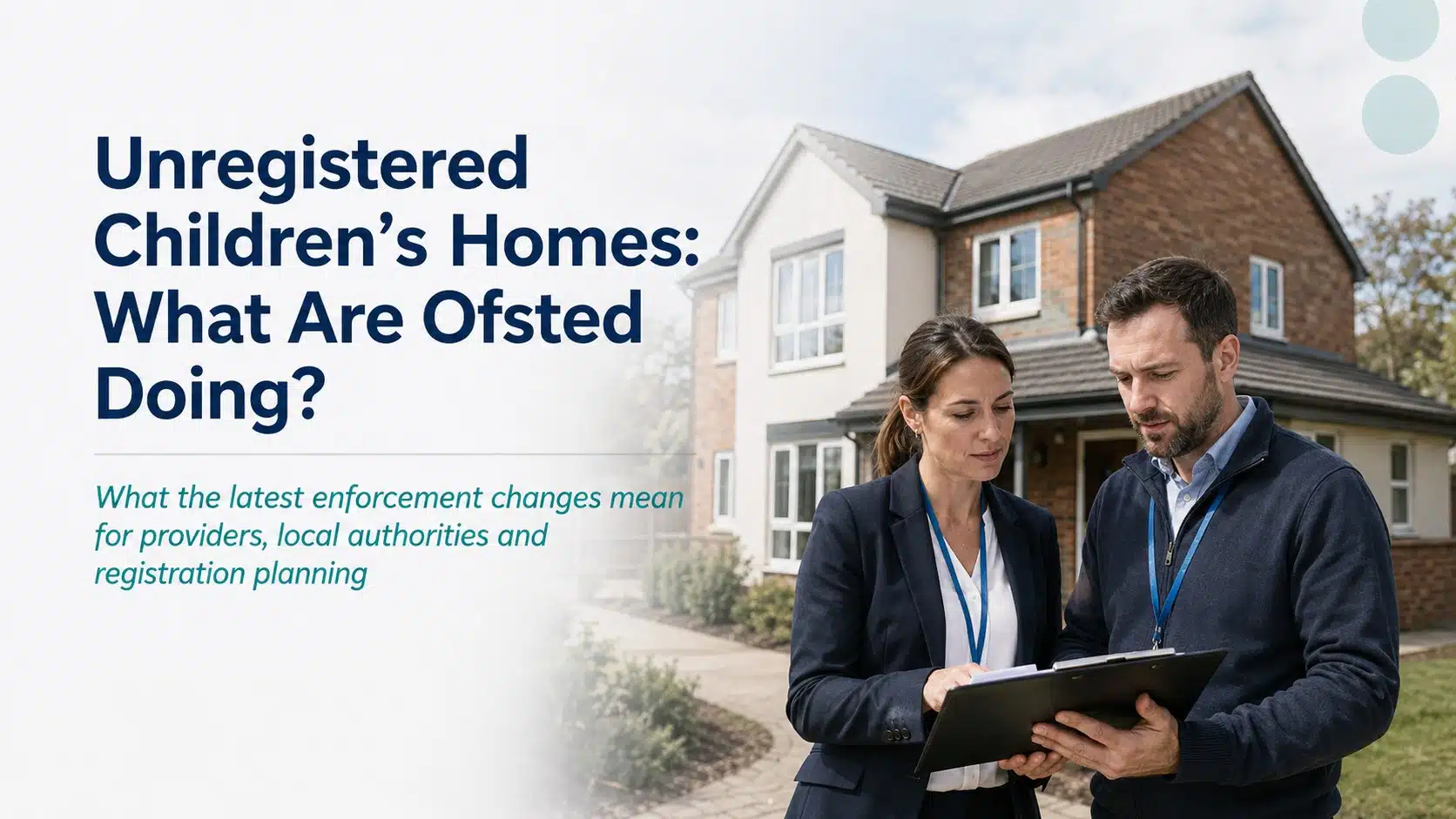
Unregistered Children’s Homes: What Ofsted’s 2026 Crackdown Means for Providers
Estimated reading time: 13 minutes
Unregistered children’s homes have moved rapidly up Ofsted’s enforcement agenda in 2026. For providers, Responsible Individuals, Registered Managers and local authority commissioners, the issue is no longer only about whether an application is in progress. Ofsted is combining tougher enforcement with a more targeted approach to registration. It now places greater emphasis on safeguarding, local sufficiency and whether new homes are genuinely needed in the right places.
This article explains what changed in July and August 2026, what the latest Ofsted data shows, why the first successful prosecution matters, and what providers should do before opening or submitting a registration application.
What does Ofsted’s 2026 crackdown mean for providers?
Direct answer
An unregistered children’s home is a setting providing care and accommodation to a child that legally requires Ofsted registration but is operating without it. Operating or managing a children’s home without the required registration is a criminal offence. In 2026, Ofsted has intensified its approach through criminal investigations, prosecution, an expanded Unregistered Social Care team, tighter scrutiny of local authority commissioning and new civil-penalty powers created by the Children’s Wellbeing and Schools Act 2026. Ofsted has also revised how it prioritises registration applications, with priority increasingly focused on homes that meet urgent sufficiency needs.
Key takeaways
- Operating or managing a children’s home without the required Ofsted registration is a criminal offence.
- Ofsted’s 2025–26 annual report says investigators identified 710 unregistered children’s homes during the year.
- Ofsted’s July 2026 approach combines criminal investigations and prosecution with closer work with local authorities and police where safeguarding or criminal concerns arise.
- The Children’s Wellbeing and Schools Act 2026 creates civil-penalty powers that Ofsted says will allow it to fine people operating illegal provisions.
- On 5 August 2026, Ofsted announced its first successful prosecution of an illegal children’s home provider. The court fined the company and two directors £92,400, with additional victim surcharges and costs.
- Ofsted generally aims to decide priority applications within six months when they meet its criteria and are complete and ready. Non-priority applications may remain on a waiting list with no stated timeframe.
- Providers should engage early with the host local authority and evidence local need. They should also submit accurate SC1 and SC2 information and avoid operating before Ofsted grants registration.
Table of contents
- What is an unregistered children’s home?
- Why Ofsted has intensified its response in 2026
- What changed in Ofsted’s approach in July 2026?
- The first successful prosecution: why it matters
- What the 2026 registration changes mean for new providers
- What providers should do now
- What local authorities and professionals should do
- Frequently asked questions
- Practical next steps
- Next steps
What is an unregistered children’s home?
Ofsted’s published position is straightforward: unregistered children’s homes are illegal. If a setting provides both care and accommodation to a child, the law may require registration as a children’s home. Operating without that registration is an offence under the Care Standards Act 2000.
This is different from using “unregulated” as a loose description. In practice, providers and commissioners need to establish the service they actually deliver. They should determine whether it includes both care and accommodation and whether it meets the legal threshold for children’s home registration. The label given to a service does not remove the underlying registration requirement.
That distinction matters because an application in progress is not the same as registration. A provider must not begin operating a children’s home simply because it has submitted the paperwork or Ofsted has acknowledged the application.
Why Ofsted has intensified its response in 2026
Ofsted’s tougher approach sits within a wider problem of placement sufficiency. Local authorities are responsible for securing enough suitable places for looked-after children, but Ofsted says the challenge is not simply the total number of homes. Some areas have too much of the wrong provision, while other areas lack homes able to meet children’s needs, particularly for children with complex needs.
In its 2025–26 annual report, Ofsted said investigators identified 710 unregistered children’s homes during the year. It also reported the highest number of applications to register children’s homes in its history, while still concluding that there were not enough of the right homes in the right places.
The scale and safeguarding risk
Earlier Ofsted analysis provides useful context. Between April 2023 and March 2024, Ofsted recorded 1,056 reported cases of potential unregistered settings and identified 931 unregistered children’s homes. Ofsted’s published analysis also found that 12% of children placed in the unregistered settings it investigated during that period were subject to a Deprivation of Liberty Order.
For children with complex needs, the safeguarding concern is obvious. An illegal home operates outside normal independent regulatory oversight. That oversight tests staff suitability, safeguarding arrangements, leadership, the premises and the quality of care.
Criminality, profiteering and excessive fees
Ofsted has also publicly described allegations involving criminal operations, drug smuggling, money laundering and county lines, while warning about profiteering in parts of the illegal market. Its July 2026 commentary stated that some unregistered placements had charged local authorities up to £30,000 per week per child. Ofsted has said that these concerns are one reason it is shifting towards a more assertive investigative model.
These examples do not mean that every unregistered setting is linked to criminality. However, operating outside registration removes important safeguards and can make poor practice, exploitation or criminal activity harder to identify and challenge.
What changed in Ofsted’s approach in July 2026?
On 2 July 2026, Ofsted announced a change in its approach to unregistered children’s homes. The direction is clear: stronger enforcement against illegal providers, closer multi-agency safeguarding action and a registration system that gives priority to homes that address urgent local and regional sufficiency needs.

Faster enforcement where safety concerns arise
Where Ofsted has concerns about the safety of children in an unregistered home, it says its actions can include starting a criminal investigation, visiting the home as soon as possible, gathering evidence and prosecuting those responsible for operating or managing the home. When Ofsted identifies safeguarding concerns or evidence of other criminal activity, it says it will involve partners such as the local authority or police. Those partners can then take action to protect children.
New civil penalty powers
The Children’s Wellbeing and Schools Act 2026 received Royal Assent in April 2026 and creates additional enforcement powers for Ofsted. As of July and August 2026, Ofsted describes these powers as ones that will allow it to impose civil financial penalties on people carrying on or managing illegal children’s homes.
This is important because prosecution can be complex and resource-intensive. A civil-penalty route gives the regulator an additional enforcement option, while criminal prosecution remains available for serious cases.
A larger Unregistered Social Care team
Ofsted is also expanding its Unregistered Social Care team, bringing more investigative work into a central function with increased legal and policy support. The intention is to identify illegal provision earlier, investigate more effectively, and pursue enforcement action where necessary.
More scrutiny of local authority use
Ofsted does not focus its response only on providers. Its 2026 consultation on local authority children’s services proposes making the use of illegal placements a limiting factor when assessing local authority leadership and sufficiency. The proposal aims to increase accountability where local authorities commission illegal provision and take no clear action to reduce reliance on it.
The first successful prosecution: why it matters
On 5 August 2026, Ofsted announced its first successful prosecution of an illegal children’s home provider. Catalyst Care Limited and two directors had pleaded guilty at Croydon Magistrates’ Court to offences connected with operating three unregistered homes in Kent between October 2022 and April 2025.
The court fined the company and directors a total of £92,400. It also ordered them to pay victim surcharges totaling £2,960 and costs of £17,250. The court disqualified the two directors from carrying on or managing, or having a financial interest in, a children’s home.
The three homes were located in Kent, with proceedings heard at Croydon Magistrates’ Court. The case is significant because it turns a long-standing regulatory warning into a clear enforcement outcome. Providers should see it as confirmation that operating without the required registration can result in criminal consequences, financial penalties and restrictions on future involvement in children’s homes.
What the 2026 registration changes mean for new providers
The enforcement changes are only one side of the 2026 picture. Ofsted is also changing how it manages the very high volume of registration applications. This affects legitimate new providers who may have no intention of operating unlawfully but need to understand how Ofsted now determines application priority.
Priority applications are increasingly tied to sufficiency
Ofsted’s updated priority-registration guidance says it is likely to prioritise applications that meet defined criteria, including certain homes needed in exceptional circumstances where there is extremely high demand and insufficient placement choice, or homes offering highly specialist care for children with complex needs.
For private and voluntary providers seeking priority, Ofsted expects engagement with the host local authority. The local authority should confirm that it has discussed the application, that the proposed home fulfils a clear local need and what its view is on the proposal.
What priority does and does not mean
Priority does not reduce the regulatory threshold. Ofsted states that it will not relax the Care Standards Act or associated regulatory requirements and will not register providers, premises or individuals it does not consider suitable. A priority application still has to demonstrate readiness, suitability and compliance.
Equally, a provider should not treat priority status as permission to open. Ofsted’s guidance is explicit that providers must not operate while awaiting a registration decision.
Current registration timeframes
Registration timeframes can vary significantly depending on the circumstances and readiness of the application. Ofsted’s current guidance states that where a priority application meets the relevant criteria, the applicant provides the right information at the right time and the home is fully prepared and ready to open, a decision will generally be made within six months.
For applications that do not meet the priority criteria, Ofsted says it will keep them on a waiting list and process them when capacity allows. It does not currently give a timeframe for those applications. That makes early planning, local-authority engagement and application quality more important than relying on a single predicted opening date.
What providers should do now
For a provider planning a new children’s home, the practical response is not to rush the application. It is to make the proposition, people, premises and documentation coherent before the regulatory clock starts.
1. Confirm whether the provision requires Ofsted registration
Start with the legal nature of the service. If you intend to provide care and accommodation in a way that falls within the children’s home registration regime, do not assume a different description of the service removes the requirement to register. Where the position is genuinely unclear, obtain appropriate regulatory or legal advice before operating.
2. Engage with the host local authority before applying
Understand local and regional sufficiency. Speak to the host local authority about the children who need placements and the gaps in existing provision. Discuss the location, complexity and the type of home you propose. For a priority application, this engagement is not simply good market research. Ofsted expects applicants to provide this evidence.
3. Prepare complete and consistent evidence
Ofsted’s current application guide requires the SC1 application and supporting material such as the Statement of Purpose, evidence of planning permission, children’s guide, safeguarding and behaviour policies, complaints procedure, location assessment and financial-viability evidence. Relevant individuals, including managers and responsible individuals, also need to complete the required SC2 process.
Accuracy and consistency matter. A strong application should tell one coherent story about who the home is for and why the location is suitable. It should also explain how the provider will manage risks, lead the workforce and meet the regulatory requirements in practice.
4. Do not open before Ofsted grants registration
This is the clearest risk-control point in the whole process. A submitted application, a priority request or an urgent commercial need does not authorise operation. If the service requires children’s home registration, wait for the regulatory decision before beginning to carry on or manage the home.
5. Get specialist support where gaps could create delay or risk
Registration can involve interconnected work across SC1 and SC2 forms, leadership suitability, the Statement of Purpose, policies, location assessment, workforce planning and home readiness. Delphi Care Solutions provides Ofsted Registration Support for children’s home providers, including application guidance, documentation review, pre-registration preparation and practical readiness support.
Specialist support can help identify gaps early, align evidence across the application and help providers demonstrate that the proposed service is genuinely prepared to operate safely and lawfully.
What local authorities and professionals should do
The sector response cannot sit with providers alone. Local authorities need strong oversight of the legality and suitability of placements, clear sufficiency planning and a determined approach to reducing reliance on illegal provision. Professionals who identify a setting that may be operating unlawfully should use the appropriate safeguarding and regulatory reporting routes rather than assuming another agency will act.
At the same time, better sufficiency planning matters. Ofsted’s own position is that the answer is not simply “more homes”. The system needs the right homes, in the right places, with the right workforce and service model for the children who need them.
Frequently asked questions
Is it illegal to run an unregistered children’s home?
Yes, where the law requires the setting to register as a children’s home. Carrying on or managing a children’s home without the required registration is a criminal offence. The precise legal position depends on the service being provided, so providers should establish the registration requirement before opening.
How many unregistered children’s homes are there?
The exact national number is not known. Ofsted says local authorities are not legally required to notify it every time they place a child in an unregistered home. Its latest annual report states that investigators identified 710 unregistered children’s homes in 2025–26. Earlier 2023–24 data recorded 931 identified unregistered children’s homes.
What can Ofsted do when it identifies an illegal home?
Depending on the circumstances, Ofsted may investigate, visit the setting, gather evidence, issue warning correspondence, work with local authorities or police on safeguarding concerns and pursue prosecution. The 2026 Act also creates civil-penalty powers that Ofsted says will soon add fines as a further enforcement option.
How long does Ofsted registration take in 2026?
For applications meeting the current priority criteria, Ofsted says it will generally make a decision within six months when applicants supply the right information at the right time and are fully prepared and ready to open. For non-priority applications, Ofsted currently gives no timeframe. It says it will keep them on a waiting list until capacity allows processing.
Can a provider operate while waiting for registration?
No, not where the provision requires registration as a children’s home. Ofsted’s priority guidance explicitly states that providers must not operate while awaiting a registration decision.
Practical next steps
The 2026 changes make the direction of travel clear. Ofsted is increasing the consequences for illegal operation while becoming more selective about which new registration applications it processes first. For legitimate providers, the strongest response is to plan around local need, prepare the service properly and treat registration as a readiness test rather than a paperwork exercise.




If you would like to chat with one of our consultants, then why not book a meeting now.
We look forward to hearing from you!
Book your meeting now