
25th May 2026
Ofsted Inspection Framework Step-by-Step for Children’s Homes (2026)
Estimated reading time: 19 minutes
If you run or oversee a children’s home, Ofsted inspection can feel unpredictable. The process is high pressure because a single visit can test safeguarding, leadership, evidence quality, children’s lived experiences and the credibility of the home’s overall story. The framework behind inspection, however, is more structured than it can first appear.
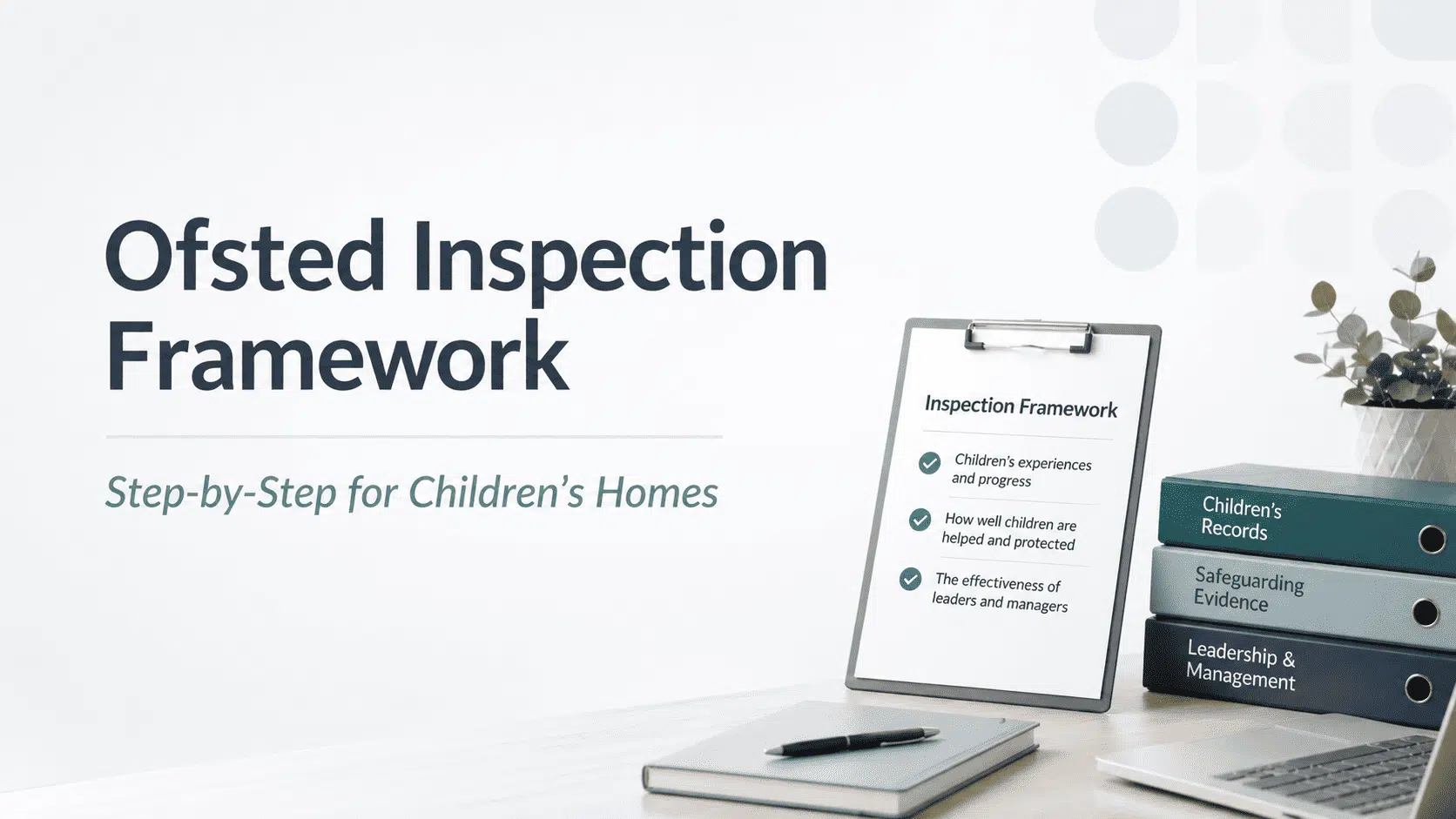
For children’s homes, the key official inspection framework is the Social Care Common Inspection Framework (SCCIF). The SCCIF underpins Ofsted’s process for inspecting children’s homes and keeps the experiences and progress of children at the centre of inspection. The guidance also makes clear that inspectors spend less time on policies and procedures and more time on the impact of services on children’s lives.
This guide explains the framework in plain English. It covers what SCCIF is, how it relates to what many providers call the “Ofsted handbook”, what happens before, during and after inspection, how inspectors gather evidence, how judgements are formed, and what Registered Managers and Responsible Individuals should be ready to explain.
If you want the practical self-audit version, start with the Ofsted inspection checklist for children’s homes: what you need before the visit. That is the best next step once you understand the inspection process itself.
| By | Sophie Lawrence, Ofsted Registrations & Compliance Manager (Ofsted projects), Delphi Care Solutions |
| Last updated | May 2026 |
| Experience | Former Children’s Home Manager (High-risk and complex-needs), BA (Hons) Youth Justice (NTU) |
| Editorial note | Updated when Ofsted guidance or forms change to keep this guide inspection-ready. |
| Sources | Based on Ofsted SCCIF guidance, Children’s Homes (England) Regulations 2015, Quality Standards, and current Annex A forms. |
About the author
Sophie Lawrence is the Ofsted Registrations and Compliance Manager (Ofsted projects) at Delphi Care Solutions, supporting regulated services across social care to prepare for inspection, strengthen governance, and embed inspection-led improvement.
Sophie brings frontline and leadership experience in children’s services, including nearly five years managing a high risk, complex-needs children’s home, where she led on regulatory compliance, safeguarding, and service stability. She holds a BA (Hons) in Youth Justice from Nottingham Trent University.
Key Takeaways
- For children’s homes, the main official Ofsted inspection framework is the Social Care Common Inspection Framework.
- The framework focuses on children’s experiences and progress, how well children are helped and protected, and the effectiveness of leaders and managers.
- Inspection is not a paperwork exercise. Inspectors test whether records, staff practice, leadership oversight, and children’s lived experiences tell the same story.
- The children’s homes SCCIF guidance was updated on 1 April 2026, with children’s experiences and progress remaining central to inspection.
- Annex A information should be accurate, current, and consistent before inspection pressure rises.
- Safeguarding can limit the overall inspection outcome if children are not helped and protected well enough.
- Registered Managers and Responsible Individuals should be able to explain risks, themes, actions, and impact using clear evidence.
- The strongest preparation is ongoing inspection readiness, not last-minute document tidying.
2026 update
Ofsted’s SCCIF guidance for children’s homes was updated on 1 April 2026. The central inspection logic remains clear: children’s experiences and progress sit at the heart of inspection, supported by evidence about help and protection and the effectiveness of leaders and managers.
Ofsted’s 2024 to 2025 annual report also highlighted a significant growth in the children’s homes sector. Ofsted reported a 15% increase in registrations over the last year, with the total number of children’s homes in England now topping 4,000. This wider sector growth makes strong leadership grip, suitability, evidence of quality and day-to-day readiness even more important for providers.
The practical implication is simple. Children’s homes need to move away from inspection preparation as a one-off event and towards a live, everyday readiness model. That means accurate records, evidence of impact, confident staff, clear safeguarding trails, and leaders who can explain the home’s current position without delay.
Table of contents
- 2026 update
- Why understanding the framework matters
- What is the Ofsted inspection framework?
- What is SCCIF and how does it relate to the “Ofsted handbook”?
- What changed in 2026 and why it matters
- What inspectors are really trying to evaluate
- The inspection journey at a glance
- Step-by-step: what happens before inspectors arrive
- Step-by-step: what happens on day one
- How inspectors gather evidence
- What evidence inspectors may look for in children’s homes
- How Ofsted judgements are formed
- How evidence is weighed
- How the framework connects to safeguarding and multi-agency working
- What happens at the end of the visit
- Practical readiness checklist for Registered Managers and RIs
- Edge cases where the framework needs extra care
- FAQs: Children’s home mock inspections
- Next steps
- Option 1: Download the Children’s Homes Inspection Readiness Checklist
- Option 2: Book a Mock Ofsted Inspection plus Action Plan
Why understanding the framework matters
Many providers only engage deeply with the framework when inspection feels close. That is risky. The value of understanding the SCCIF is that it reduces uncertainty before that point and helps leaders build business-as-usual readiness instead of relying on last-minute preparation.
Ofsted is not simply checking whether a home has the right documents. The framework is designed to help inspectors evaluate whether children are safe, supported, listened to and making progress, and whether leaders can evidence this clearly through records, practice, oversight and improvement activity.
For Registered Managers, Responsible Individuals, deputies, quality leads and providers, a clear grasp of the framework makes inspection feel less like a mystery. It helps you understand what inspectors are likely to test, what good evidence looks like and why some homes appear stronger or weaker than leaders expected on inspection day.
The main benefit is confidence. Not confidence because everything is perfect, but confidence because the home knows its strengths, understands its risks and can evidence what is being done to improve outcomes for children.
What is the Ofsted inspection framework?
In day-to-day search behaviour, people often use phrases such as “Ofsted inspection framework”, “Ofsted handbook” or “Ofsted inspection process”. For children’s homes, the correct official starting point is SCCIF, which applies to inspections of children’s homes and sets out the inspection process, evidence base and judgement structure.
Ofsted also makes clear that SCCIF is not a one-size-fits-all framework. It uses a consistent judgement structure across social care settings, but it reflects the distinct nature of each type of provision, including children’s homes.
In plain English, the framework helps inspectors decide:
- what they need to look at
- which lines of enquiry to follow
- which records, conversations and observations matter most
- how to balance evidence
- how to form judgements
For children’s homes, that means inspectors are not looking only at compliance. They are looking at children’s actual experiences, the impact of care, how risks are managed and how well leaders know and improve the service.
What is SCCIF and how does it relate to the “Ofsted handbook”?
Many providers use “Ofsted handbook” as a shorthand phrase for the guidance that explains inspection expectations. For children’s homes, it is better to be more precise. There is not one simple all-purpose handbook that covers everything.
The main inspection framework is the SCCIF. It is supported by the legal and regulatory context Ofsted uses when inspecting children’s homes. This includes the Care Standards Act 2000, The Children’s Homes (England) Regulations 2015, the Guide to the children’s homes regulations, including the Quality Standards, and relevant statutory guidance from the Department for Education.
So, when providers talk about the “Ofsted handbook”, they usually mean the wider set of inspection guidance, judgement criteria and process documents. For practical purposes, SCCIF is the key framework to understand first.
A useful way to think about it is this: SCCIF explains how inspection works and how judgements are formed. The regulations and Quality Standards explain the duties and expectations the home must meet. Your evidence should connect both.
What changed in 2026 and why it matters
The children’s homes SCCIF guidance was updated on 1 April 2026. This does not mean that the whole judgement structure has been reinvented. The consistent thread remains that inspection focuses on the impact of care and support on children’s experiences and progress.
Ofsted says inspectors spend less time looking at policies and procedures and more time looking at the impact of services on children’s lives. It also says inspections are given minimum notice so providers are seen on a day-to-day basis.
That matters in practice because it pushes homes away from “inspection performance” and towards embedded readiness. If records are only tidy the day before inspection, if action tracking is inconsistent, or if leaders cannot explain recent improvements without searching through multiple files, the home is more exposed than providers may realise.
The wider sector context also matters. With the number of children’s homes in England now above 4,000, providers need to be able to show that their homes are suitable, well led and genuinely improving outcomes for children, not simply operating with policies in place.
What inspectors are really trying to evaluate
A common misunderstanding is that inspection is mainly a test of compliance folders. The framework points somewhere more practical. Ofsted uses professional evaluation to judge the effectiveness and impact of care and support on the experiences and progress of children, and says the judgement is not derived from a checklist alone.
In practical terms, inspectors are trying to understand questions such as:
- Are children safer, more settled and making progress?
- Is care individualised, relational and consistent?
- Do children feel listened to, respected and involved in decisions?
- Do records match what children, staff and leaders say?
- Can leaders explain what has improved, what still needs work and why?
- Is safeguarding active in practice, not just described in policy?
A useful way to think about this is that inspectors are testing whether the home’s story is coherent. If leaders say one thing, staff describe something else and the records show a third version, confidence can fall quickly, even where care is more positive than the paperwork suggests.
Weak evidence trail
A weak evidence trail might show that a behaviour incident took place, but not what happened next. There may be no clear child’s voice, no follow-up reflection, no updated plan and no evidence that the home learned anything or that risk reduced afterwards.
Strong evidence trail
A stronger evidence trail shows the incident, immediate response, child’s perspective, staff reflection, leadership oversight, changes to planning and what improved after that point. That is much closer to the kind of impact-based evidence the framework is trying to draw out.
The inspection journey at a glance
Inspection timing can feel unpredictable, but the inspection process itself follows a clearer logic than many people expect. Inspectors build context, test evidence, evaluate impact, weigh professional judgement and then provide feedback.
A typical inspection journey can be understood in seven stages:
- Pre-inspection context and planning.
- Notification or scheduling, where relevant.
- Arrival and initial discussion.
- Evidence gathering through records, observations, interviews and conversations.
- Sampling, case tracking and testing lines of enquiry.
- Judgement building and leadership discussion.
- Feedback, report process and next steps.
The more clearly leaders understand this journey, the easier it becomes to prepare in a practical way. Good readiness is not about predicting exactly when Ofsted will arrive. It is about ensuring the home can evidence safe, stable and well-led practice whenever inspectors visit.
Step-by-step: what happens before inspectors arrive
Good readiness starts long before notice is given. Ofsted says inspections are given minimum notice so inspectors can see settings as they are on a day-to-day basis and so providers spend less time preparing specifically for inspection.
That means always-on readiness usually matters more than last-minute tidying. In practical terms, this looks like clear records, consistent management oversight, regular review of risk, action tracking that actually closes the loop, and leaders who know the service well enough to explain current strengths and weaknesses without scrambling.
Before inspection, inspectors may also use a broad range of information to shape their lines of enquiry. This may include previous inspection history, notifications, Regulation 44 and Regulation 45 reports, concerns, complaints and wider intelligence.
For leaders, this is where the Registered Manager and RI role becomes critical. They should understand current risks, recent incidents, patterns, known pressure points, what has improved over the past three to six months and where evidence is still weaker than they would like.
Start with the Ofsted inspection checklist for children’s homes.
Step-by-step: what happens on day one
On arrival, the inspection usually begins with introductions, practical arrangements, and an early discussion about the scope of the visit. The first leadership conversation is often important because it gives inspectors an initial sense of the home’s children, current risks, staffing picture, recent incidents, improvement priorities and leadership grip.
Inspectors may ask to see key records early on. These may include children’s plans, safeguarding logs, incident patterns, staff records, supervision, training, notifications, and leadership oversight evidence. That matches the framework’s focus on impact, protection, and leadership effectiveness.
In practice, day one is usually busy, detailed, and evidence led. The strongest leadership approach is calm, factual, transparent, and child focused. Defensive, over-rehearsed or vague answers can make inspection more difficult, especially if they are not supported by evidence.
How inspectors gather evidence
One useful way to understand inspection is through an evidence triangle. Inspectors are not relying on one document, one interview, or one observation. They are looking for consistency across what people say, what people do, and what records show.
1. What people say
Inspectors may speak with children, staff, leaders, placing authorities, and other professionals. The key issue is whether accounts are consistent and whether children’s experiences are properly understood.
2. What people do
Observed practice matters. Inspectors will be interested in how staff interact with children, how routines operate, how boundaries are maintained, how children are listened to, and how care is delivered day to day.
3. What records show
Records should show a clear evidence trial. In practical terms, that usually means concern, decision, action, review, learning, and outcome.
When records, practice and leadership narrative all support each other, the service is easier to understand and trust. When they do not align, inspectors may question whether leadership has an accurate view of the home.
What evidence inspectors may look for in children’s homes
The framework gives specific areas of evidence for the overall experiences and progress of children. These include the quality of individualised care, relationships, belonging and stability, health, education, emotional wellbeing, children’s views, day-to-day experiences, future planning, move planning and access to specialist services.
Inspectors may look for evidence about:
- children’s starting points, needs and individual progress
- quality of relationships between children, staff and professionals
- stability, belonging and emotional security
- health, education and emotional wellbeing
- children’s views, wishes, rights and participation
- day-to-day lived experience in the home
- planning for moves into and out of the home
- access to specialist services and partner support
- leadership oversight, challenge and action closure
This evidence does not need to sit in one artificial “inspection folder”. In many cases, the strongest evidence already exists in normal operational records. The issue is whether it is accurate, easy to navigate, and clearly connected to impact.
Mini example: stronger evidence
A stronger example might be a missing-from-care record that links the incident to updated risk planning, return home information, leadership review, staff discussion, and a later reduction in recurrence.
Mini example: weaker evidence
A weaker example might be a missing episode that is logged correctly but has no clear follow-up, no evidence of management analysis, and no indication of what changed afterwards.
How Ofsted judgements are formed
Ofsted inspections use a four-point judgement scale under the SCCIF: Outstanding, Good, Requires Improvement to be Good, and Inadequate. It also says the main overall judgement is the overall experiences and progress of children, taking into account how well children are helped and protected and the effectiveness of leaders and managers.
Overall experiences and progress of children
This is central to the inspection picture. Required evidence includes individualised care, the impact of the home on children’s experiences and progress, relationships, belonging, health, education, children’s views, day-to-day experiences, and future planning.
The practical question is whether the home can show that children are safer, more settled, better supported, and making progress from their starting points because of the care they receive.
How well children are helped and protected
This area is critical. The SCCIF says the judgement on how well children are helped and protected is a limiting judgement. If this area is judged inadequate, the overall effectiveness judgement for the home will be inadequate.
That is why safeguarding weakness carries such weight. Inspectors look at how well risks are understood and responded to, how the provider responds to children who may go missing or be at risk of harm, how behaviour is managed, and whether safeguarding arrangements meet statutory requirements.
Effectiveness of leaders and managers
Leadership is also a graded judgement with significant influence on the overall picture. If leadership and management are judged inadequate, that is likely to lead to an overall judgement of inadequate, and certainly no more than requires improvement, for overall experiences and progress.
The required evidence includes whether leaders know the home’s strengths and weaknesses, act effectively on shortfalls, provide effective supervision and training, understand children’s experiences and progress, challenge other agencies when needed and ensure the home achieves its aims and objectives.
How evidence is weighed
Ofsted says the judgement is not derived from a checklist, and that inspectors use professional judgement when weighing evidence. That means one weak document is not usually the deciding factor in an inspection on its own.
What matters more is the pattern. Inspectors are likely to consider whether evidence is credible, whether children’s experiences are positive, whether risks are understood and reduced, and whether leaders can demonstrate improvement over time.
This is why inspection readiness should focus on evidence of quality, not document quantity. A smaller amount of coherent evidence is usually stronger than a large file of disconnected records.
How the framework connects to safeguarding and multi-agency working
Children’s home inspections do not happen in isolation from the wider children’s social care system. Working Together to Safeguard Children was updated in March 2026 and remains statutory guidance on multi-agency working to help, support and protect children.
For a Registered Manager, the practical question is simple: can the home evidence not just that a concern was logged, but that relevant people were informed, the response was followed up, challenge was made where needed, and the child’s safety or support improved as a result?
That is much stronger than an evidence trail that stops at “email sent”. Strong safeguarding evidence should show professional curiosity, decision-making, escalation where needed, and clear outcomes for the child.
What happens at the end of the visit
At the end of the visit, leaders should expect feedback about the inspection findings and likely themes. This is a moment to listen carefully, capture actions, and clarify factual misunderstandings appropriately.
It is usually better not to wait passively for the final report before taking obvious improvement action. If the inspection has exposed a safeguarding weakness, an evidence gap or an action-tracking problem, leaders should begin addressing it immediately with owners, deadlines, and evidence of closure.
A simple post-visit action plan should cover:
- what issue was identified
- who owns the response
- what action is required
- when the action must be completed
- what evidence will show the action is complete
- how leaders will check impact
Practical readiness checklist for Registered Managers and RIs
Use this checklist as a quick self-audit before moving to a fuller inspection checklist. If several answers are “not consistently” or “not yet”, it is better to act now than wait for inspection pressure.
- Can you explain the needs, risks, progress and lived experience of every child in the home?
- Do key records show concern, action, review, learning and outcome?
- Do safeguarding records match incident logs, chronologies and leadership oversight?
- Are Regulation 44 and Regulation 45 actions tracked, owned, closed and evidenced?
- Can staff explain safeguarding, escalation, behaviour support and children’s plans consistently?
- Can the RI evidence challenge, oversight and follow-up?
- Are staff training, supervision and competency records current and meaningful?
- Can leaders explain what has improved in the last three to six months?
- Is there a clear evidence pack or navigation structure for inspection day?
If several answers are unclear, the next best step is a practical inspection readiness review or checklist, rather than trying to fix everything at short notice.
Edge cases where the framework needs extra care
New providers
New providers may need more emphasis on understanding the framework and building systems from scratch, rather than refining an existing evidence base. Early inspection readiness should start from registration onwards, not once the first inspection feels close.
Homes with recent leadership change
Homes with recent leadership change may need a stronger focus on handover, oversight, management grip and evidence continuity. Inspectors may look closely at whether leaders understand current risks and whether improvement work has been sustained through the change.
Homes already dealing with enforcement or serious safeguarding concerns
Homes already dealing with enforcement, serious safeguarding escalation or legal dispute may need specialist support alongside or before general readiness work. A generic checklist is unlikely to be enough where immediate risk, enforcement action or legal advice is already involved.
Multi-building homes
Multi-building homes need to remember that Ofsted makes one overall judgement for the registered children’s home. Shortfalls in care for children in one building can affect the overall judgement for the registered home as a whole.
FAQs: Children’s home mock inspections
What is the Ofsted inspection framework for children’s homes?
It is the guidance inspectors use to inspect services and form judgements. For children’s homes, the main official framework is the Social Care Common Inspection Framework.
What is SCCIF?
SCCIF stands for the Social Care Common Inspection Framework. It sets out Ofsted’s process for inspecting children’s homes and other social care settings, including how inspectors gather evidence and form judgements.
What does “Ofsted handbook” mean for children’s homes?
Providers often use the phrase informally to mean the inspection guidance and process documents. For children’s homes, the key official framework is the SCCIF rather than one single all-purpose handbook.
Are Ofsted inspections unannounced for children’s homes?
Ofsted gives minimum notice so settings can be seen as they are on a day-to-day basis. Providers should therefore operate on an always-ready basis rather than relying on last-minute preparation.
What happens on day one of an Ofsted inspection?
There is usually an initial leadership discussion, early record requests, practical arrangements and the start of evidence gathering through conversations, records, observation and case tracking.
What do inspectors focus on most during inspection?
Children’s experiences and progress are central, alongside how well children are helped and protected and the effectiveness of leaders and managers.
How do inspectors gather evidence?
Inspectors combine what children, staff, and leaders say with what they observe in practice and what records show. The goal is to see whether evidence is consistent and demonstrates impact.
What is sampling or case tracking?
Sampling or case tracking means following selected children’s experiences, records and decisions in detail so inspectors can test whether care, safeguarding and leadership oversight are working in practice.
How are Ofsted judgements formed?
Ofsted uses professional judgement rather than a simple checklist. Inspectors weigh evidence across children’s experiences and progress, help and protection, and leadership and management.
Why is safeguarding so important to the overall judgement?
Because the judgement on how well children are helped and protected is a limiting judgement. If this area is judged inadequate, the overall experiences and progress judgement will always be inadequate.
What should a Registered Manager be ready to explain?
The Registered Manager should be ready to explain the current children, risks, recent incidents, what has improved, where concerns remain, how the home knows this, and what evidence shows the impact of care.
What should a Responsible Individual be ready to evidence?
The Responsible Individual should be ready to evidence oversight, challenge, governance follow-up, awareness of strengths and weaknesses, and confidence that actions are tracked and closed properly.
What happens after the inspection visit?
Leaders receive feedback, then need to capture key points, address immediate risks and prepare to respond through structured action planning rather than waiting passively for the final report.
What is the quickest way to improve inspection readiness?
Understand the framework first, then use a practical self-audit to test whether records, staff answers, safeguarding evidence and leadership oversight all tell the same story.
Next steps
The Ofsted inspection framework for children’s homes becomes much clearer once you understand SCCIF in practical terms: evidence, impact, children’s experiences, safeguarding and leadership oversight. The process may still feel stressful, but it is less opaque when you can see how inspectors gather evidence and how judgements are built.
Good readiness is not about panic paperwork. It is about consistent practice, clear evidence trails, strong safeguarding, honest leadership grip and visible improvement over time.
Option 1: Download the Children’s Homes Inspection Readiness Checklist
Start with a concise, Ofsted-aligned checklist covering safeguarding, leadership oversight, quality improvement, records, Regulation 44 and 45 outputs, Annex A readiness and children’s outcomes.
It is designed for Registered Managers and Responsible Individuals to use monthly, so inspection readiness becomes part of routine governance rather than a last-minute scramble.
Best if: you want a practical self-audit tool before requesting external support.
Download the Children’s Homes Inspection Readiness Checklist
Option 2: Book a Mock Ofsted Inspection plus Action Plan
Commission a full SCCIF-aligned mock inspection delivered in an Ofsted-style format, including evidence review, case tracking, staff discussions, leadership interviews and a practical action plan.
You will receive a clear view of strengths, risks and pressure points, with a risk-rated action plan you can begin implementing immediately.
Best if: inspection feels likely, you have known risks, you need independent challenge, or you want a realistic view of how your home may stand up to Ofsted scrutiny.





If you would like to chat with one of our consultants, then why not book a meeting now.
We look forward to hearing from you!
Book your meeting now