
Debbie Richens /
12th August 2026
End of Life Care in Care Homes: What CQC Looks for and How to Evidence It
13–20 minutes
End of life care is one of the clearest tests of whether a care home can turn compassion into consistent, well-governed practice. Registered Managers may know that staff provide sensitive support, involve families, and work closely with health professionals. The challenge is proving that this happens reliably for every person and that the evidence is visible in care plans, daily records, governance, and learning.
A policy is important, but it is not enough on its own. CQC will look at what people experience, how decisions are made, whether risks and changes are acted on, how staff are supported, and whether leaders can show that the service learns and improves.
This guide is written for residential and nursing care homes in England. It focuses on governance, regulatory expectations, and evidence. It does not replace clinical advice, local pathways, or professional decision-making.
What does CQC look for in end-of-life care?
Direct answer
Under CQC’s published assessment framework in August 2026, end of life care is most directly addressed through the Planning for the future quality statement under the Responsive key question. However, good evidence also reaches across Safe, Effective, Caring and Well-led. A care home should be able to show personalised planning, lawful decision-making, safe escalation, coordinated working, compassionate communication, accurate records and learning after deaths.
| By | Debbie Richens, Executive Manager – Inspections and Assurance, Delphi Care Solutions |
| Last updated | August 2026 |
| Experience | 25+ years’ management experience in health and social care; specialist in service turnaround with a track record of improving CQC ratings from Inadequate, including enforcement notices, to Good across all areas. |
| Editorial note | Updated when CQC regulatory expectations, end-of-life care guidance or sector practice changes, to keep this guidance practical and decision-ready. |
| Sources | Informed by the CQC assessment framework and regulations, NICE end-of-life care guidance, national medical examiner requirements, and recognised sector guidance referenced within this article. |
About the author
Debbie Richens is the Executive Manager – Inspections and Assurance at Delphi Care Solutions, bringing over 25 years of management experience and extensive knowledge of leadership and management within health and social care.
Debbie specialises in the turnaround of care services and has a proven track record of supporting significant service improvement, including improving CQC ratings from Inadequate with enforcement notices to Good across all areas. Her experience is underpinned by a strong focus on quality care, effective leadership and sustainable improvement.
Key takeaways
- End of life care is not judged through one policy or one record. CQC considers the person’s experience and the systems supporting it.
- Planning for the future is the current quality statement most directly linked to end-of-life care, DNACPR and ReSPECT.
- Advance care planning must be voluntary, person-centred and kept under review. It should record what matters to the person, not simply whether forms exist.
- Staff confidence grows through supervision, reflective discussion, debriefs and practical support, not training certificates alone.
- Strong governance makes good care visible through accurate records, audits, death reviews, family feedback and actions that lead to improvement.
Table of contents
- What does CQC look for in end-of-life care?
- How end of life care is assessed under the CQC framework
- What good end of life care evidence looks like
- Care plans and advance care planning records
- Capacity, ADRT, DNACPR and emergency care plans
- Daily records and communication with families
- Partnership working and out-of-hours escalation
- Using the Gold Standards Framework to strengthen practice
- Staff confidence beyond training completion
- What happens after a death
- A practical end of life care self-audit for Registered Managers
- How to measure improvement without reducing care to a target
- What is changing in 2026?
- Frequently asked questions
- Strong end of life care should be compassionate, coordinated and visible
- Next steps: strengthen your end of life care evidence
How end of life care is assessed under the CQC framework
As of August 2026, CQC’s published provider guidance describes an assessment framework built around five key questions: Safe, Effective, Caring, Responsive, and Well-led. Each is supported by quality statements.
CQC consulted earlier in 2026 on revised sector-specific frameworks that would retain the five key questions and replace the current quality statements with key lines of enquiry. Those proposals should not be presented as the implemented framework. Providers should use CQC’s current published guidance and check for updates before an assessment.
For a broader explanation of the structure, see Delphi’s guide to the five CQC key questions.
Responsive and Planning for the future
Responsive is a key question, not a quality statement. The current quality statement most directly concerned with end-of-life care is Planning for the future. CQC lists end-of-life care, palliative care, DNACPR and ReSPECT, complex care needs and decision-making among its subtopics.
In practice, this means a service should be able to show that people are supported to discuss important life changes and future care in a way that respects choice. Some people will want detailed conversations and plans. Others may not want to discuss the subject at a particular time. A good record shows that the conversation was offered sensitively, that the person’s response was respected, and that the opportunity was revisited when appropriate.
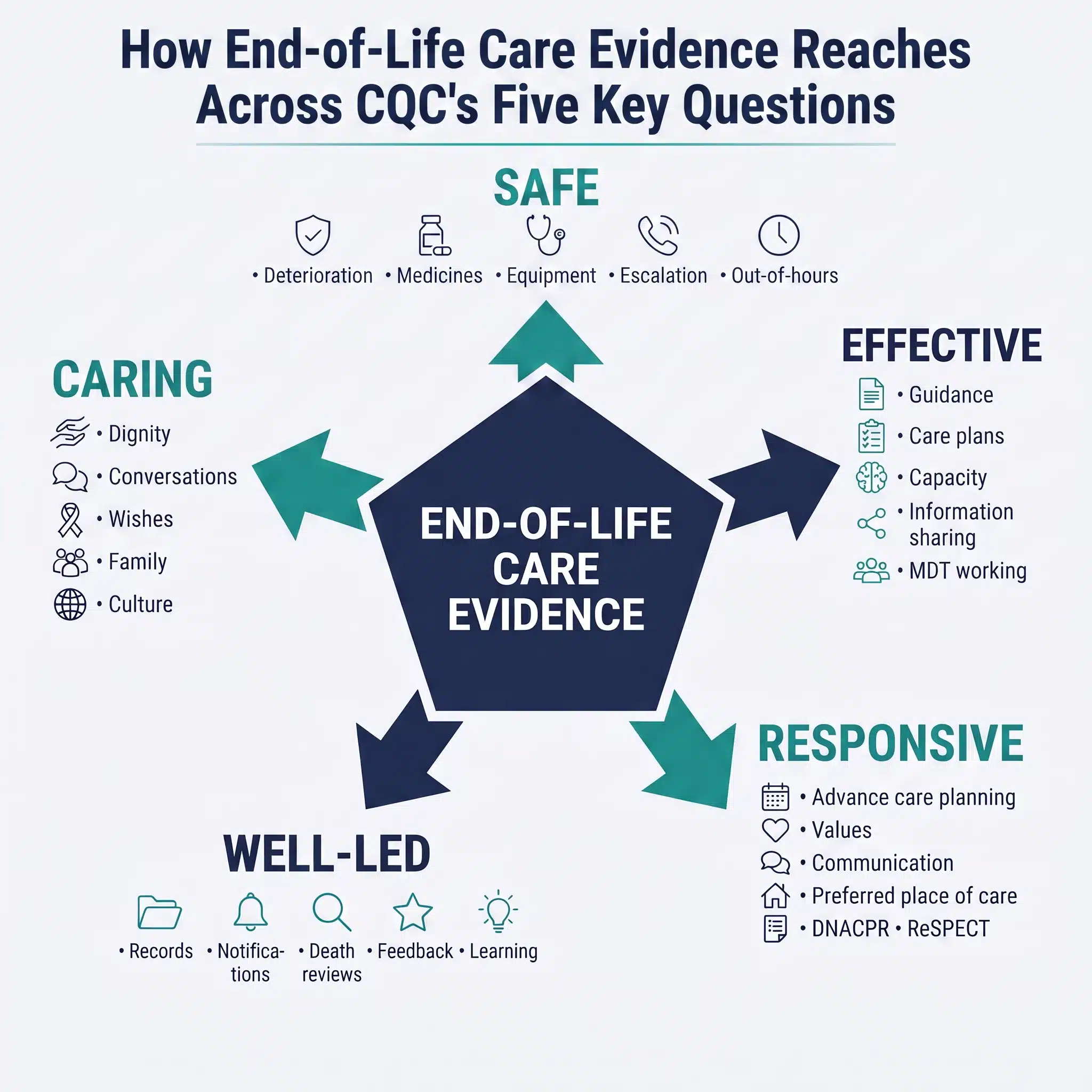
How the evidence reaches across all five key questions
The map below is a practical interpretation of how end-of-life care evidence can connect to CQC’s five key questions. It is not a separate CQC checklist.
| Key question | What strong evidence can show |
|---|---|
| Safe | Changes in condition are recognised and escalated through the agreed clinical route. Medicines, equipment and out-of-hours arrangements are governed safely. Staff know what to do and whom to contact. |
| Effective | Care is informed by current guidance and professional input. Plans are reviewed when needs change, and information follows the person across services. |
| Caring | The person is treated with dignity, privacy, and compassion. Communication is sensitive, and the people important to them are involved with consent or lawful authority. |
| Responsive | Care reflects the person’s wishes, values, culture, faith, communication needs, and preferred place of care where these are known. Advance care planning is offered and reviewed. |
| Well-led | Leaders oversee training, records, audits, notifications, partnership arrangements, feedback, and learning after deaths. Identified gaps lead to action and measurable improvement. |
The regulations and guidance behind the evidence
Several legal duties commonly sit behind the evidence:
- Regulation 9: Requires person-centred care that meets the person’s needs and reflects their preferences.
- Regulation 10: Requires dignity and respect, including privacy and support for autonomy.
- Regulation 11: Requires care and treatment with consent, with the Mental Capacity Act 2005 applied where a person cannot make a particular decision.
- Regulation 12: Requires safe care and treatment, including appropriate assessment of risk, competent staff and safe management of medicines.
- Regulation 17: Requires effective governance, accurate and contemporaneous records, assessment of quality and risk, and action to improve.
After a death, a separate notification duty may apply under Regulation 16 of the Care Quality Commission (Registration) Regulations 2009. This is often referred to as a statutory notification. It is not the same as Regulation 16 of the 2014 Regulated Activities Regulations, which concerns complaints. Care homes should make sure the registered person knows which notification is required and submits it without delay where the regulation applies.
Recognised national guidance includes NICE NG142 on end-of-life care service delivery, NICE NG31 on care in the last days of life, and the related quality standards QS13 and QS144. NICE guidance is not legislation, but it is an important reference point for evidence-based practice and quality improvement.
What good end of life care evidence looks like
Evidence should form a clear line from what matters to the person, through the care delivered to management oversight. It should be possible for a reviewer to understand what was discussed, what was decided, who was involved, how changes were managed, and what the service learned.
Care plans and advance care planning records
Advance care planning is a voluntary, person-centred process. It should help the person discuss and record what matters to them, who they want involved, and how they would prefer to be supported if their health changes.
A useful care plan is specific enough to guide staff. Depending on the person’s wishes and circumstances, it may cover preferred place of care, important relationships, cultural or spiritual needs, communication, comfort, priorities, emergency contacts and when professional advice should be sought. It should also show when the plan was reviewed and what changed.
Do not treat completion of a form as the outcome. The stronger evidence is that staff understand the plan, relevant professionals can access the right information and the person’s current wishes guide care.
Capacity, ADRT, DNACPR and emergency care plans
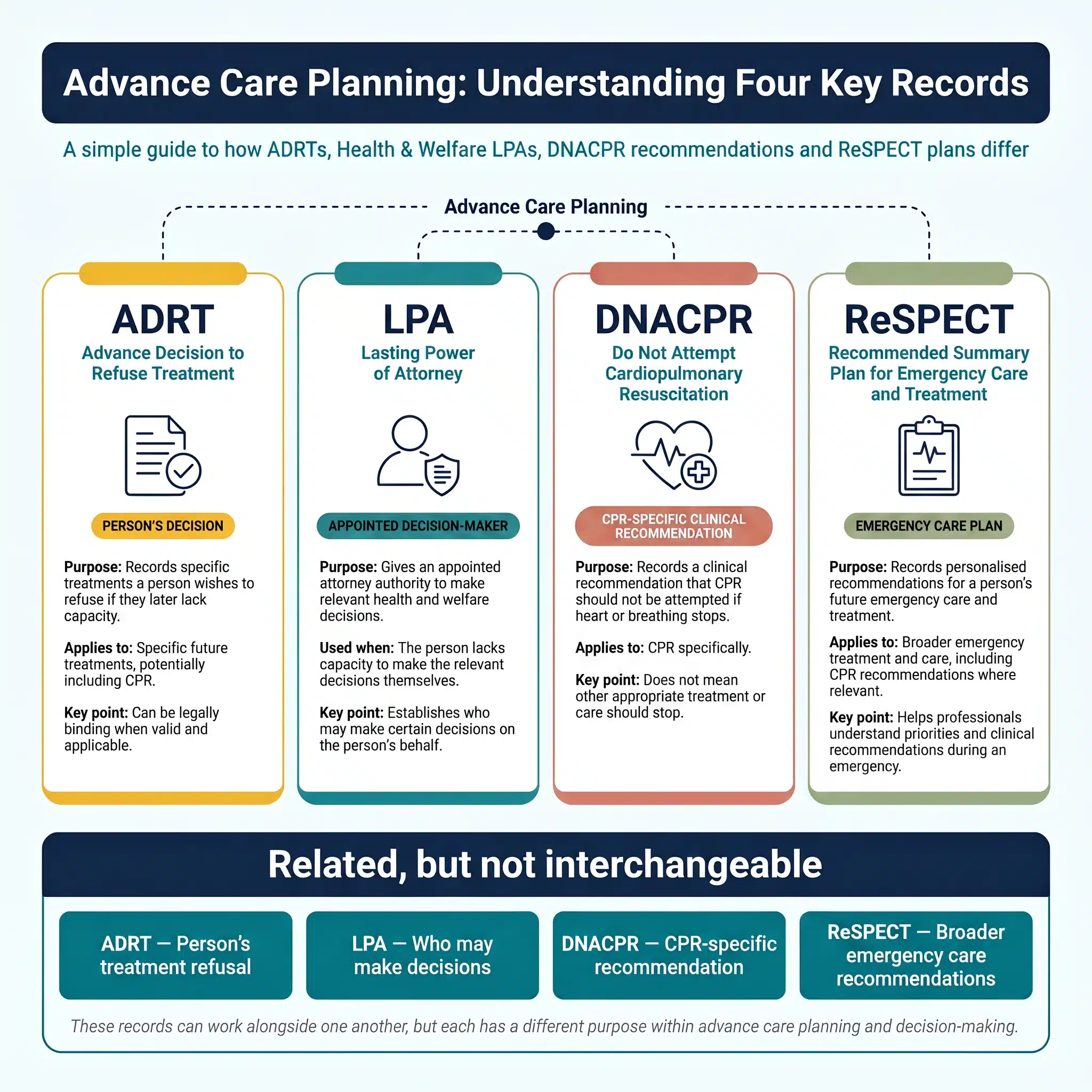
Advance care planning, an advance decision to refuse treatment, a health and welfare lasting power of attorney, a DNACPR decision and a ReSPECT plan are not interchangeable.
- An advance decision to refuse treatment records a person’s decision to refuse specified treatment in future circumstances. A valid and applicable decision can be legally binding.
- A health and welfare lasting power of attorney gives an appointed attorney authority to make relevant decisions when the person lacks capacity, within the scope of the legal document.
- A DNACPR decision relates specifically to cardiopulmonary resuscitation. It is not a decision to withhold all treatment, care or escalation.
- ReSPECT is a voluntary process for recording personalised recommendations about emergency care and treatment. It is used only where it has been adopted locally, and another local emergency care plan may be used instead.
Care homes do not make clinical decisions outside their competence. Their role is to make sure documents are current, clearly recorded, readily available to the right people, consistent across records and escalated to the appropriate clinician when there is uncertainty or a change.
Daily records and communication with families
Daily records should demonstrate that the plan is being followed in practice. They should record meaningful changes, action taken, professional advice, communication with the person and family, and any review of risk or care.
Family communication also needs structure. Agree who should receive updates, how often and by what method. Record significant conversations, questions, concerns, and responses. This is not only evidence for assessment. It reduces confusion and helps families feel informed during an emotionally difficult time.
Partnership working and out-of-hours escalation
High-quality end of life care depends on coordinated working between the care home, GP, community nursing team, pharmacist, hospice and specialist palliative care services. Responsibilities should be clearer than assumed.
Registered Managers should test whether staff know the escalation route during the day, overnight and at weekends. They should know where current contact details are held, what information must be shared and what to do if a response is delayed. Nursing and residential homes will have different clinical arrangements, but both need a reliable system that reflects their service model and local pathway.
Where anticipatory medicines are prescribed, governance should show that prescribing instructions, supply, storage, administration, monitoring, escalation and disposal are managed safely by the professionals responsible. CQC’s medicines guidance for end of life care provides a useful governance reference. This article does not provide clinical or medicines advice.
Using the Gold Standards Framework to strengthen practice
The Gold Standards Framework (GSF) provides training and accreditation for care homes to support proactive, person-centred and coordinated end-of-life care. Its care home programme focuses on earlier identification, advance care planning, communication, team working and continuous improvement.
GSF is not a CQC requirement and does not replace the regulations, clinical guidance or local pathways. Used appropriately, it can give care homes a structured quality-improvement approach that supports consistent practice and helps teams make their end-of-life care processes more visible and reviewable.
Staff confidence beyond training completion
Completing training is only the beginning. Staff may understand a module but still feel anxious about recognising deterioration, speaking with relatives, or knowing when specialist help is needed.
Confidence develops through supervision, observed practice, reflective discussion, debriefing, and opportunities to learn from real situations. Managers should ask staff what they would do, not only whether they completed training. Records of supervision, competency checks, team discussions and actions following a death can show how learning is embedded.
What happens after a death
Since 9 September 2024, deaths in England and Wales that are not investigated by a coroner are independently reviewed through the statutory medical examiner system. Local arrangements vary, so care homes should maintain an up-to-date process for contacting the relevant clinician or medical examiner office and supporting the required information flow.
CQC notification is a separate responsibility. Where a notification is required, it should be submitted without delay under the correct regulation. Providers should also consider whether other duties are engaged, including safeguarding, duty of candour, incident reporting or a coroner referral, based on the circumstances and professional advice.
A proportionate governance review after every death is strong practice. It can examine whether the person’s wishes were understood, whether care was coordinated, whether records were complete, whether the family was supported, whether escalation worked and whether any action is needed. The purpose is learning, not blame.
A practical end of life care self-audit for Registered Managers
Use these questions during a care-plan audit, governance meeting or preparation for an external review:
- Can staff quickly locate the current care plan, advance care planning record and any emergency care document?
- Do records show that conversations were offered sensitively and that a person’s choice not to discuss future care was respected?
- Are mental capacity, consent, legal authority and best-interest processes clear for each relevant decision?
- Are DNACPR, ReSPECT or local emergency care documents current, consistent and available to the right professionals?
- Do staff know the escalation route during normal hours and out of hours, including who to contact if needs change?
- Can the service show coordinated working with GPs, community nurses, pharmacists, hospices and specialist teams?
- Do supervision, competency checks and reflective learning demonstrate staff confidence beyond course completion?
- Are deaths, notifications, family feedback and learning reviewed through governance, with actions tracked to completion?
How to measure improvement without reducing care to a target
Measurement should support learning without reducing a deeply personal experience to a target. A balanced dashboard can combine process, experience and outcome measures.
- the proportion of people offered advance care planning
- the proportion with a preferred place of care recorded where they wish to state one
- evidence that plans are reviewed when needs or wishes change
- unplanned hospital admissions in the final 30 or 90 days
- the proportion of deaths reviewed through governance
- staff confidence and competency findings
- family compliments, concerns and complaints
- evidence of regular multidisciplinary working
Preferred place of death should be interpreted carefully. Circumstances and wishes can change, and a hospital admission may be clinically necessary. The measure should prompt review and understanding, not pressure staff or clinicians to pursue a target at the expense of safe, person-centred decisions.
The most important question is whether data led to action. If audits identify gaps in documentation, staff confidence or out-of-hours escalation, leaders should be able to show what changed, who was responsible, when it was reviewed and whether the change improved practice.
What is changing in 2026?
The national direction is moving towards earlier identification, more coordinated community support and clearer commissioning of palliative and end of life care.
The Government’s June 2026 response on hospice sustainability stated that the Palliative Care and End-of-Life Care Modern Service Framework was planned for autumn 2026. The March 2026 Neighbourhood Health Framework also identifies people receiving end of life care and care home residents as priority cohorts.
These developments may shape future commissioning and service expectations, but care homes do not need to wait for a new framework to improve. The core priorities are already clear: person-centred planning, lawful decision-making, reliable partnership working, confident staff, safe escalation and evidence that leaders learn from what happens.
Frequently asked questions
Which CQC quality statement covers end of life care?
Under CQC’s published framework in August 2026, Planning for the future sits under the Responsive key question and is the quality statement most directly linked to end of life care, palliative care, DNACPR and ReSPECT.
Does a care home need a standalone end of life care policy?
The regulations do not create a simple test based on whether one named policy exists. A clear policy can support consistency, but CQC will also look at people’s experience, care plans, consent and capacity, safe systems, staff competence, records, governance and learning.
What should an end of life care record show?
It should show what matters to the person, who was involved, relevant consent or capacity decisions, current plans and documents, professional input, changes in need, action taken, family communication, reviews and any learning.
What should a care home do after a resident dies?
Follow the service’s current local process, obtain professional guidance, support the family, preserve accurate records, complete any required CQC or other notifications, work with the medical examiner or coroner route as applicable, and complete a proportionate governance review. Providers should already have an appropriate policy and local process in place. If this is missing or needs updating, Delphi can support with policy review and development.
Strong end of life care should be compassionate, coordinated and visible
Good end of life care is not defined by a policy alone. It is seen in the compassion shown, the dignity protected, the wishes respected, the confidence of staff and the reliability of the systems around them.
For Registered Managers, the practical priority is to make sure good care is both consistent and visible. Review the care plans, ask staff how they would respond, test the out-of-hours pathway, check the legal and emergency care documents, examine recent death reviews and make sure improvement actions are closed.
Next steps: strengthen your end of life care evidence
Option 1: Test your evidence with a mock CQC inspection
If you want an independent view of how clearly your service can evidence safe, person-centred and well-governed end of life care, explore Delphi’s mock CQC inspection support.
Option 2: Review quality systems and policies
If the gap is in governance, auditing, policy quality or evidence consistency, Delphi’s quality audits and policies support can help you identify weaknesses and turn findings into practical actions.
Option 3: Speak to the Delphi team
If you are unsure which type of support fits your current position, speak to the Delphi team about the service, evidence or governance issues you want to review.



If you would like to chat with one of our consultants, then why not book a meeting now.
We look forward to hearing from you!
Book your meeting now