5th November 2026
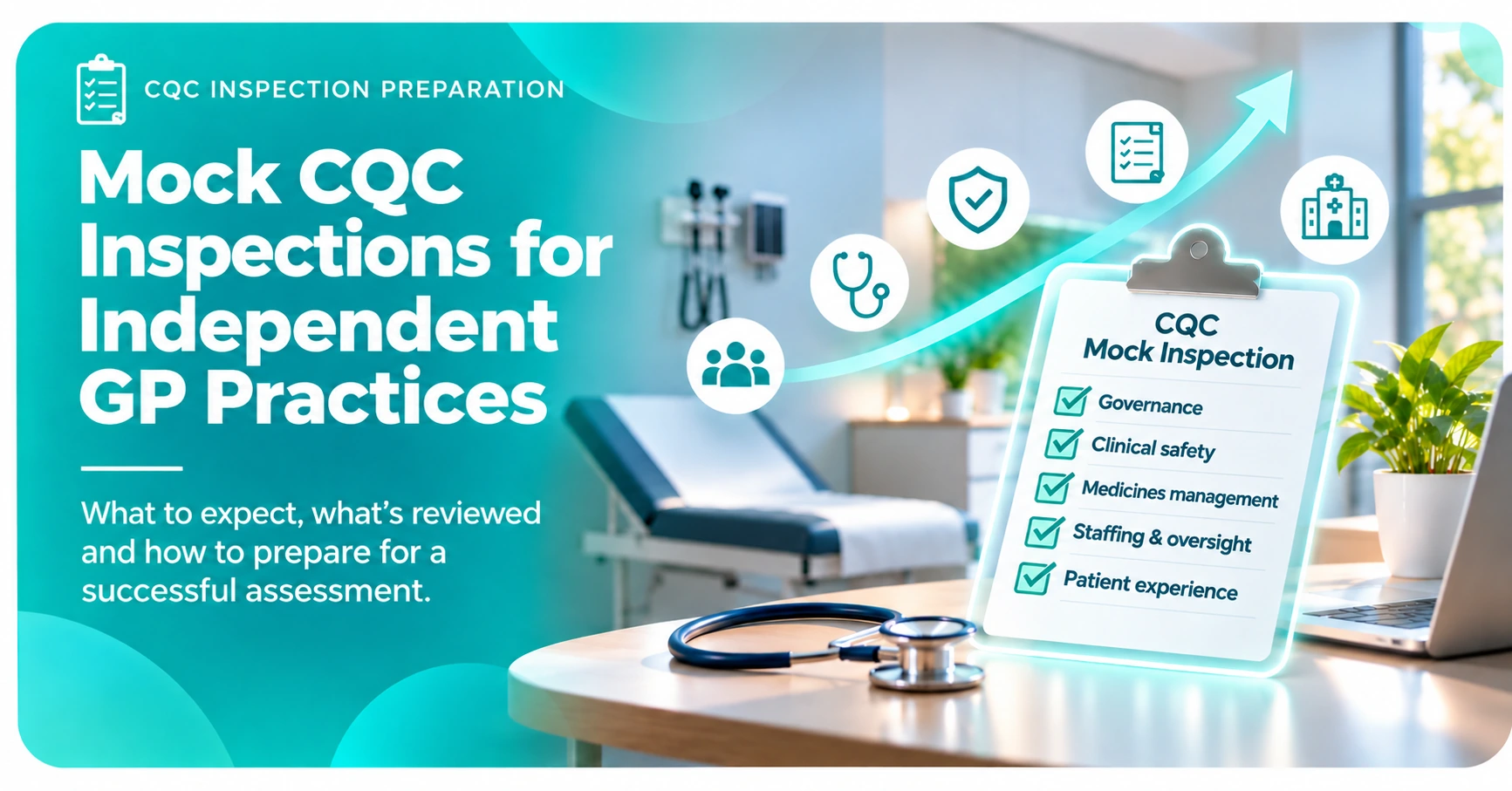
Mock CQC Inspections for Independent GP Practices: What to Expect and How to Prepare
Estimated reading time: 11 minutes
For an independent GP provider, being ready for CQC scrutiny is about more than having policies, training records and an organised folder of documents. Leaders also need to know whether the way their service operates every day is safe, consistent and supported by reliable evidence.
That can be difficult when a practice combines private consultations with travel health, screening, occupational health or other clinical services. As the organisation develops, governance arrangements must keep pace with the people, locations and activities it is responsible for. A well-scoped mock CQC inspection provides an opportunity to test those arrangements before weaknesses become harder to address.
What is a mock CQC inspection for an independent GP practice?
Direct answer
A mock CQC inspection is an independent, structured review of a practice’s clinical governance, safety, staffing, patient experience, records and leadership oversight. It examines whether the evidence matches what happens in practice and identifies improvements to prioritise. It is not an official CQC assessment, cannot determine a regulatory rating and should be tailored to the provider’s actual services and registered activities.
Key Takeaways
- A useful mock inspection checks practice as well as paperwork, including whether clinicians and managers can explain how risks are managed.
- Independent GP services need an appropriate scope. Face-to-face clinics, additional activities and standalone online services do not always follow identical CQC guidance.
- Strong preparation looks at governance, staffing, clinical safety, medicines, patient feedback and accessible evidence together.
- The most valuable output is a prioritised action plan with clear accountability and follow-up, not a speculative rating.
- CQC is developing sector-specific assessment methods in 2026, so providers should confirm which published guidance applies when a review takes place.
Table of Contents
- Why independent GP practices need a tailored mock inspection
- What should a mock CQC inspection cover?
- Common inspection-readiness gaps in independent GP services
- What happens before, during and after a mock inspection?
- How CQC’s assessment approach is evolving in 2026
- How to stay inspection-ready throughout the year
- Frequently asked questions
- Official CQC guidance and related resources
- How Delphi Care Solutions can help your GP practice
- Next steps
Why independent GP practices need a tailored mock inspection
Independent GP and clinic providers operate in varied settings. One organisation may offer consultations and vaccinations in a single location; another may provide services across several clinics or use both in-person and remote pathways. The same generic checklist will not properly test every model.
CQC’s guidance for independent doctor and clinic services covers private GP and relevant non-NHS primary medical services. It also identifies separate guidance for NHS GP practices, standalone online primary care and other service types. This distinction matters when deciding the scope of a mock review. The applicable legal requirements depend on the activities and services actually provided.
As a service grows, recurring questions include: Who has clinical oversight of locums? How are medicines and high-risk prescribing monitored? Are incidents reviewed and learning shared? Can managers demonstrate that an identified risk resulted in a practical change? These are operational questions, not simply document requests.
An independent review gives owners, Registered Managers and clinical leaders a chance to challenge assumptions and identify where the organisation’s systems may not yet reflect its size or complexity.
What should a mock CQC inspection cover?
A useful review should be based on the service’s registered activities, clinical model, risks and current CQC guidance. Rather than treating a mock inspection as a standardised paperwork audit, it should bring together the main areas below.

Governance and leadership
The reviewer should explore who is accountable for safety and quality, how decisions are recorded, and whether the leadership team receives enough information to identify deteriorating performance. This includes governance meetings, risk registers, audit schedules, escalation routes and evidence that actions have been followed through.
CQC Regulation 17: Good governance requires effective systems to assess, monitor and improve quality and safety, manage risks and maintain appropriate records. The important question is whether these systems operate effectively, not whether a policy says they exist.
Staffing and clinician oversight
For independent GP services, staffing assurance must extend beyond a list of professional names. A review may consider recruitment and DBS arrangements where applicable, professional registration checks, induction, role-specific training, supervision, appraisal and how locum or contracted clinicians are overseen.
A relevant line of enquiry is whether a clinical director or manager can explain how the service knows its clinicians are working within their competence and how concerns about practice are escalated. CQC’s staffing guidance emphasises suitably qualified staff, appropriate support and professional development.
Clinical governance, medicines and patient safety
This is where a GP-specific mock inspection differs most clearly from a general care-service audit. Depending on the services provided, reviewers may examine clinical audit programmes, significant event analysis, safeguarding arrangements, prescribing governance, medicines storage, infection prevention, referral processes and arrangements for clinical emergencies.
CQC Regulation 12: Safe care and treatment addresses safe care, risk assessment, medicines management, infection prevention and coordination when care is shared. For a practice, evidence should show how these obligations translate into reliable clinical processes and appropriate oversight.
For example, a clinic providing both video and face-to-face consultations might examine how concerns identified remotely are escalated, documented and handed over for further assessment. The relevant checks should be agreed against its actual operating model.
Patient experience, access and duty of candour
Inspection readiness also depends on how patients experience the service. A mock review can explore complaint handling, patient feedback, accessibility, informed consent, continuity of care and whether concerns lead to learning.
It should also consider how the provider approaches its duty of candour. CQC’s Regulation 20 guidance explains the general expectation of openness and the additional requirements arising from qualifying notifiable safety incidents.
Patient experience should be tested through credible evidence and appropriate engagement, not inferred solely from a satisfaction score or a completed complaints log.
Documentation and evidence
A recurring practical problem is that good activity may take place without leaving a strong evidence trail. A useful review therefore considers whether current policies, the Statement of Purpose, service information, staff files, audit records, risk assessments, notifications and improvement logs are complete, consistent and retrievable.
There is a difference between having records and being able to show how those records inform decisions. For example, minutes showing that an incident was discussed are stronger when they also identify the action agreed, who owns it and how completion was checked.
Common inspection-readiness gaps in independent GP services
The following are sensible areas to test, not findings about any particular GP provider:
- Policies that are formally present but are outdated or do not reflect current clinical activity.
- Recruitment, registration or locum oversight records that are incomplete or inconsistently checked.
- Clinical audits that are carried out but do not demonstrate what changed as a result.
- Significant events recorded without a clear learning and follow-up trail.
- Medicines governance or safeguarding arrangements that are difficult for staff to explain.
- Risk assessments, governance meetings or third-party responsibilities that lack clear accountability.
- Patient feedback and complaints data that are collected but not used systematically to improve services.
The concern is not always that care is poor. Sometimes the immediate problem is that leaders cannot demonstrate consistently what they believe is happening. A mock review should help distinguish between a gap in documentation, a gap in practice and a more serious safety or governance concern. Those findings should not all receive the same priority.
What happens before, during and after a mock inspection?
Before the review: agree the scope
Start by confirming the practice’s locations, registered activities, patient groups, clinical pathways and main concerns. A well-defined scope makes the exercise more useful and avoids applying requirements from a different service type. Agree what records and people may be involved, how sensitive information will be handled and what outputs are expected.
During the review: test evidence against practice
A mock inspection may combine document sampling, discussions with leaders and staff, observations and examination of clinical governance evidence, as appropriate to the agreed scope. Reviewers should look for consistency: do the written arrangements match what people say and what the reviewer can observe?
The exercise should be constructive. The purpose is not to catch individuals out, but to identify strengths, risks and practical opportunities for improvement while the practice continues operating.
After the review: prioritise and follow up
The findings should become a manageable action plan. For each significant issue, identify the risk, the required change, the person accountable, the target date and how the team will verify that improvement has been embedded.
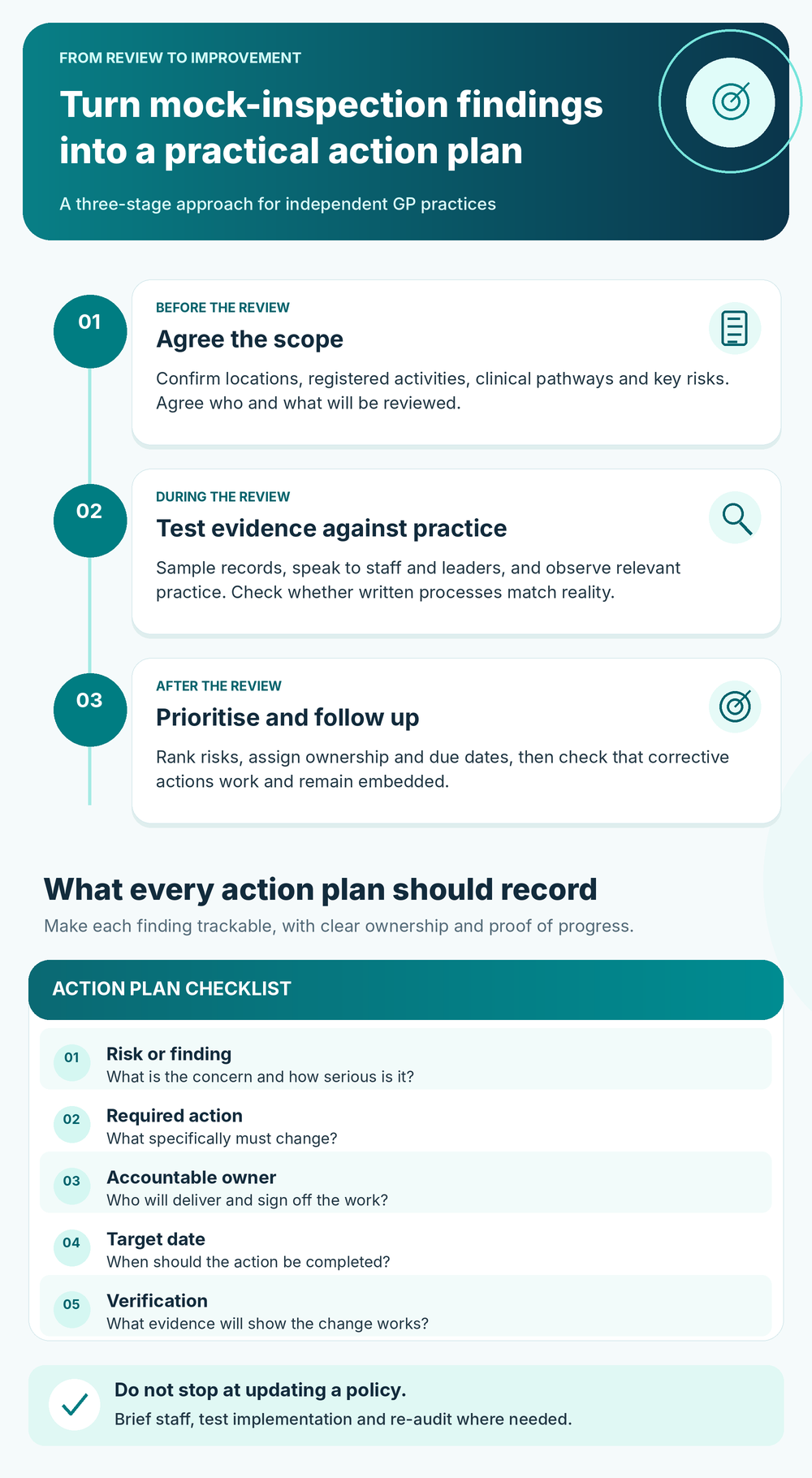
For example, rewriting a medicines policy is not enough if staff have not been trained on the revised procedure or a subsequent audit has not tested its use. Leadership should review progress and escalate overdue or high-risk actions. The goal is sustained improvement rather than a short-term preparation exercise.
How CQC’s assessment approach is evolving in 2026
CQC’s five key questions remain Safe, Effective, Caring, Responsive and Well-led. Its published assessment guidance describes the use of quality statements and evidence to assess providers.
CQC is also changing its approach. In March 2026, it outlined draft sector-specific frameworks, including one for primary care and community services, while retaining the five key questions. In June 2026, it said it would pilot and test the proposed methods between June and October, with evaluation in November. Proposed changes should not be presented as the final rules until CQC confirms their implementation.
This means a sensible mock inspection should be grounded in the published framework and regulations applicable at the time, with sufficient flexibility to reflect future confirmed changes. Providers should be cautious about using old key lines of enquiry or an unapproved draft as if either were the only current assessment method.
How to stay inspection-ready throughout the year
A mock inspection is most valuable when it reinforces continuous quality improvement rather than becoming an annual box-ticking event. Independent GP providers can build a more reliable routine by:
- Reviewing clinical risks, incidents and safeguarding concerns through an agreed governance rhythm.
- Completing scheduled audits and recording the actions and learning that follow.
- Checking the currency of policies, registrations, staff evidence and service information.
- Asking clinicians and managers to explain how everyday decisions are escalated and documented.
- Reviewing feedback, complaints and accessibility issues alongside clinical quality information.
- Rechecking whether completed actions have produced the intended improvement.
A periodic independent view can complement those internal systems. Its frequency should reflect the size, complexity, risk profile, leadership changes and findings of earlier reviews, rather than an assumed statutory requirement to commission one every year.
Frequently asked questions
How often should an independent GP practice commission a mock inspection?
There is no universal CQC requirement for every independent GP practice to purchase an annual mock inspection. A practice may choose periodic independent assurance based on its risk profile, growth, changes to leadership, previous findings or upcoming scrutiny. The priority is maintaining effective governance throughout the year.
Can a mock inspection predict a CQC rating?
No. An independent mock inspection can identify issues that deserve attention, but it is not an official CQC assessment and cannot determine or guarantee the regulator’s future findings or rating. Its practical value lies in the quality of the review and the action taken afterwards.
What evidence should a practice prepare in advance?
The starting point is an agreed, proportionate sample: clinical and governance audits, incident-learning records, policies, staff and professional-registration evidence, risk assessments, medicines processes, safeguarding arrangements, patient feedback, complaints handling and previous improvement actions. The exact list should match the practice’s regulated activities and review scope.
Can a mock inspection include remote consultations or additional clinics?
Potentially, where those activities are within the agreed engagement and the reviewer has the relevant expertise. CQC publishes distinct guidance for standalone online primary care and different provider types, so a mixed-service organisation should establish which requirements apply to each part of its model before the review begins.
Official CQC guidance and related resources
For the latest regulatory position, refer to the following original sources:
- CQC: Independent doctor and clinic services – confirms the settings and services covered by this guidance.
- CQC: Assessing quality and performance – explains the published assessment approach and five key questions.
- CQC: Regulation 17, Good governance – sets out expectations for governance, audits, oversight and records.
- CQC: Regulation 12, Safe care and treatment – covers practical safety and clinical risk requirements.
How Delphi Care Solutions can help your GP practice
At Delphi Care Solutions, we believe a mock inspection should go beyond a checklist exercise. Our Mock CQC Inspections service offers a structured, independent review informed by current regulations, CQC guidance and the needs of the service being assessed.
Depending on the scope agreed, our reviewers can examine governance, evidence, records and day-to-day practice, then provide candid findings and prioritised recommendations. Where needed, Delphi can also discuss support with improvement planning after the review.
For an example of how a mock inspection can identify actionable evidence gaps, read our published case study of The Martlets. This example concerns a care home rather than a GP practice, so it illustrates the approach to assurance, not a predicted result for independent primary care.




If you would like to chat with one of our consultants, then why not book a meeting now.
We look forward to hearing from you!
Book your meeting now