19th October 2026
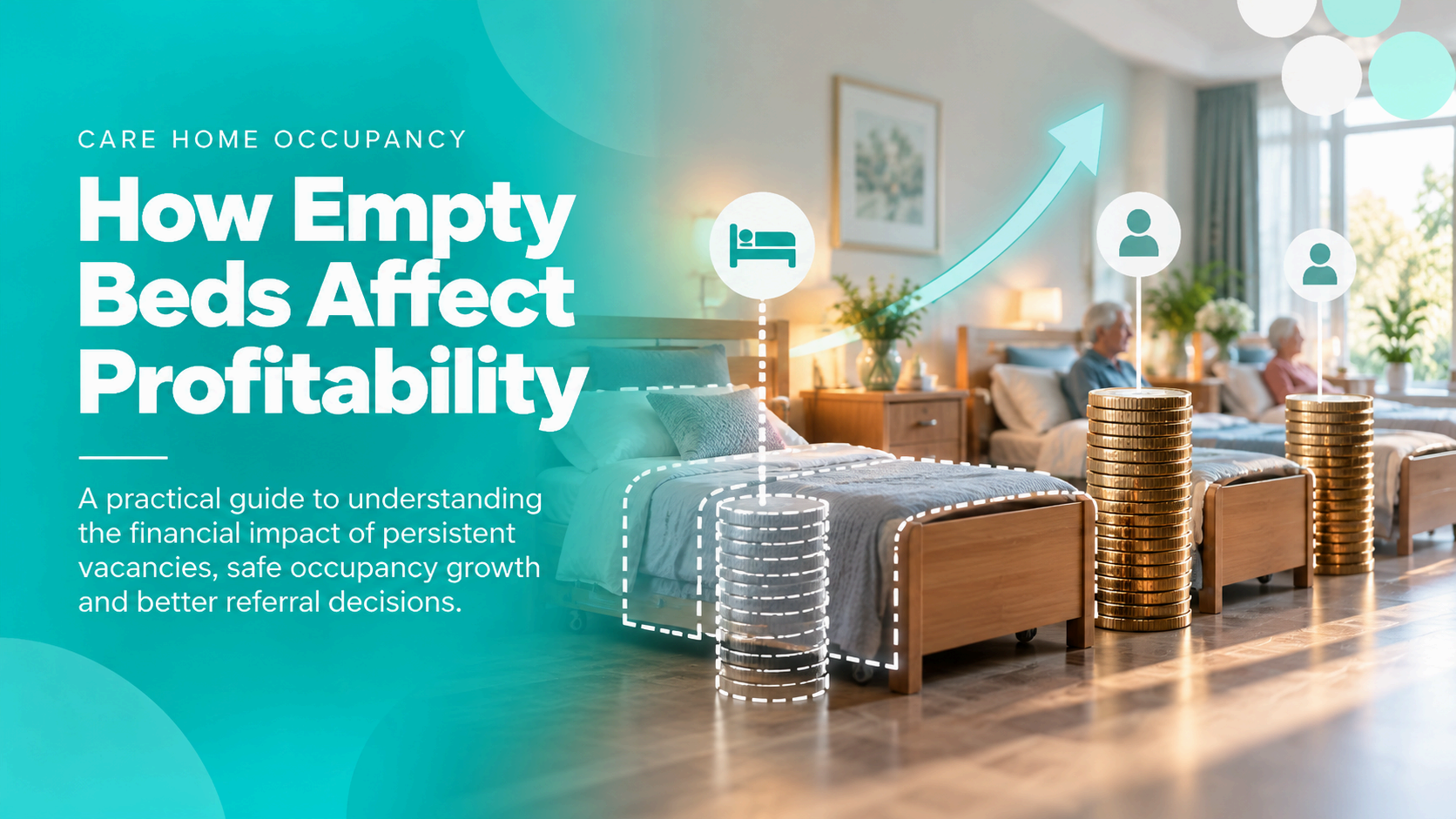
Care Home Occupancy: How Empty Beds Affect Profitability
Estimated reading time: 16 minutes
Your care home may be busy. Your team may be working hard, most rooms may be occupied, and day to day operations may feel close to capacity. Yet a small number of persistent vacancies could still be making a significant difference to your financial performance.
Improving occupancy is not simply about reaching a percentage on a management report. It is about making better use of the home, workforce and services in which you have already invested, while ensuring every admission remains safe, appropriate and person centred.
When approached responsibly, sustainable occupancy growth can strengthen the financial foundations that support good care, workforce development, service improvement and long term stability.
How do empty beds affect profitability in care homes?
DIRECT ANSWER
Empty care home beds can reduce profitability because many property, management, staffing and compliance costs continue even when rooms are unoccupied. Filling an appropriate vacancy may add fee income while much of the operating infrastructure is already in place. However, the extra weekly fee is revenue, not pure profit: providers must subtract the additional care, staffing and other costs of meeting the person’s assessed needs before judging financial contribution.
Key Takeaways
- A small number of persistent vacancies can materially affect a care home’s finances even when occupancy looks relatively high.
- Fixed and largely fixed costs continue during vacancies, but an additional admission also brings care and staffing costs.
- At an illustrative weekly fee of £1,200, three rooms occupied for a full 52 weeks generate £187,200 in gross annual fee revenue, not profit.
- National figures distinguish occupied beds, vacant beds currently available for admission and beds not currently admittable.
- Persistent vacancies can reflect marketing, referral quality, slow responses, assessment bottlenecks or a mismatch between needs and capability.
- Occupancy growth must remain person centred, financially sensible and supported by safe staffing and appropriate admissions.
Table of Contents
- Why the final few available rooms matter
- Revenue is not the same as profit
- How much revenue could empty rooms represent?
- What persistent vacancies may be telling you
- A better referral pathway, not simply more leads
- Suitable placements must remain the priority
- How Delphi can support occupancy and growth
- Seven practical questions for care providers
- Frequently asked questions
- Sources and further reading
- Next steps
Why the final few available rooms matter
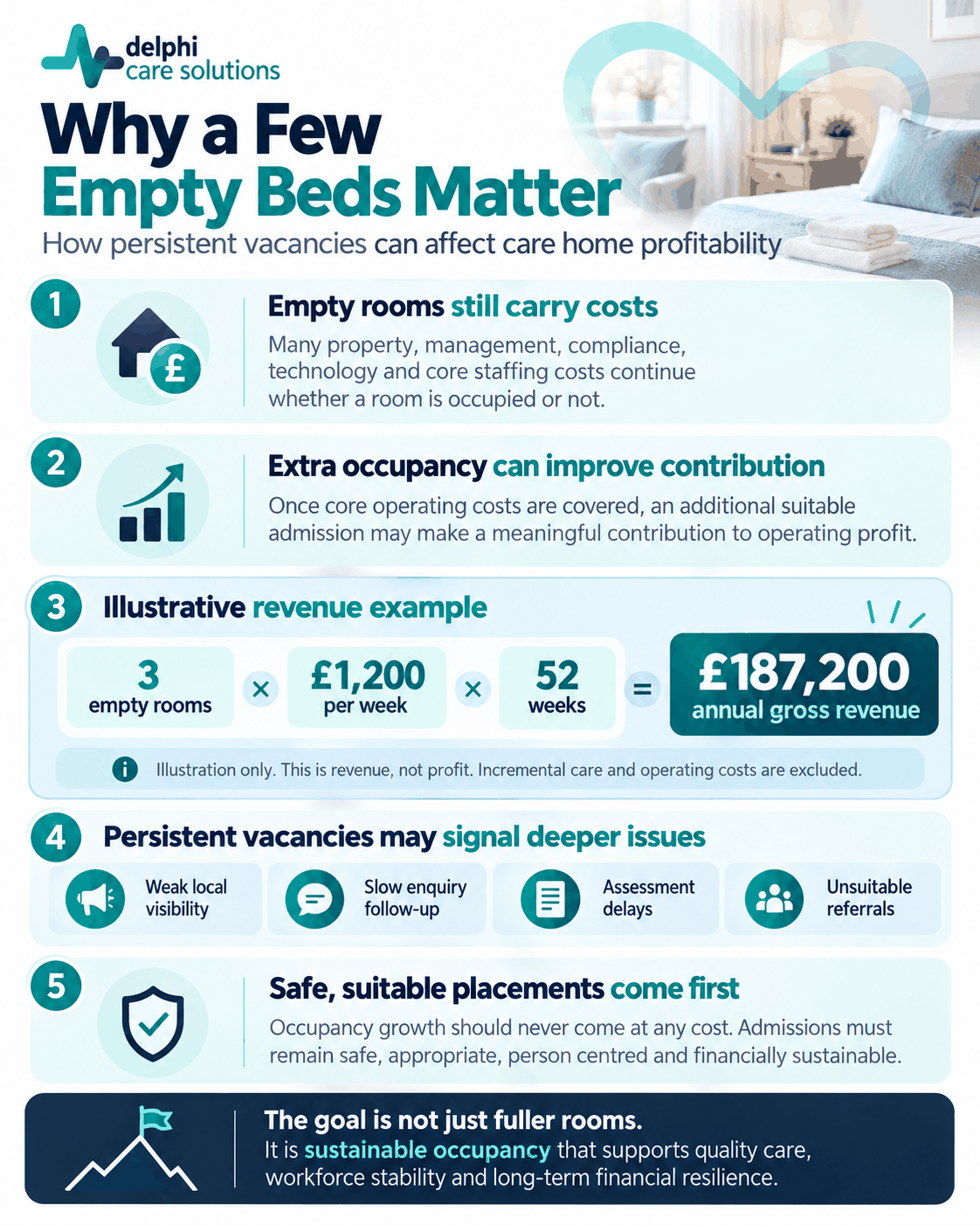
Many of the costs associated with running a care home continue whether every room is occupied or not.
Property costs, insurance, utilities, management salaries, administrative functions, technology, training, and core compliance systems do not disappear when a room becomes vacant. The same may be true of significant elements of the staffing structure, particularly where the home must maintain safe leadership, supervision and clinical capacity regardless of small changes in occupancy.
This means that the financial impact of an available room is not limited to the absence of one resident’s weekly fee. The home is still carrying much of the infrastructure required to operate that room and support the wider service.
As occupancy improves, these underlying costs are spread across a greater number of occupied rooms. Once the home has covered its operating costs, the income from an additional admission, after allowing for the extra costs of delivering that person’s care, may make a substantial contribution to operating profit.
This is why moving from “nearly full” towards sustainable full occupancy can have a greater financial effect than the change in the headline occupancy percentage might suggest.
A move from 90% to 95% occupancy may appear modest when viewed only as a percentage. From a financial perspective, however, it can represent several new weekly fees being received while many of the home’s underlying costs remain broadly unchanged.
Official data reinforces the scale of the issue. In the week ending 14 August 2026, the Department of Health and Social Care reported that 86.8% of care home beds in England were occupied, while 10.2% were vacant and admittable and 3.0% were vacant and non admittable. The national figures do not determine the position of an individual home, but they show that usable vacant capacity remains material across the sector. View the official statistics.
Care home bed occupancy in England, week ending 14 August 2026. Source: Department of Health and Social Care, Capacity Tracker.
The national rate describes reported capacity, not a recommended occupancy target for an individual home. The practical question is which rooms a service can admit into safely and sustain over time.
Revenue is not the same as profit
It is important not to overstate the opportunity.
An additional weekly fee is not pure profit. Every admission brings responsibilities and costs. These may include food, laundry, utilities, personal care supplies, continence products, equipment, activities, transport and other consumables.
Depending on the person’s assessed needs, the home may also require additional care hours, registered nursing input, specialist training, one to one support, environmental adaptations or external clinical support. Acuity can also affect supervision, management time and overnight staffing.
The true contribution of an admission therefore depends on several factors:
- the agreed weekly fee;
- the person’s assessed care and support needs;
- the direct costs associated with meeting those needs;
- the staffing capacity and skill mix already available;
- any additional equipment or environmental requirements;
- the likely sustainability of the placement; and
- the relevant contractual and funding arrangements.
The objective should never be occupancy growth at any cost. It should be sustainable occupancy growth, based on suitable placements, transparent fees, safe staffing and the home’s ability to deliver consistently good care.
National guidance on NHS Continuing Healthcare similarly places assessed need and person centred care planning at the centre of decision making. It states that care planning should be based on an assessment of the individual’s needs and that a commissioned care package should meet those assessed needs.
Understand the contribution of each appropriate admission
A useful starting point is the additional weekly fee less the additional costs required to provide that person’s care. The result indicates potential contribution towards shared operating costs and profit. It is not automatically net profit, and costs may increase in steps if an admission requires extra staffing, specialist resources or other changes to the operating model.
How much revenue could empty rooms represent?
Consider a simple illustration.
If a care home had three available rooms and each was occupied at an assumed weekly fee of £1,200, the additional annual revenue would be:
3 rooms × £1,200 × 52 weeks = £187,200
That figure is revenue, not profit. It does not take account of the additional staffing, care, equipment, consumables or support that each person might require. It is also an illustration, not a suggested market rate or forecast.
Illustration only. The assumed fee of £1,200 per week is not a market benchmark or forecast. Incremental care and operating costs are excluded.
| Additional occupied rooms | Illustrative annual fee income |
|---|---|
| 1 room | £62,400 |
| 2 rooms | £124,800 |
| 3 rooms | £187,200 |
Nevertheless, it demonstrates why a few longstanding vacancies deserve focused management attention. Even after allowing for the incremental costs of providing care, additional suitable admissions may make a meaningful contribution to financial performance.
The opportunity will differ between homes. A residential service with staffing capacity already in place may have a different cost profile from a nursing home admitting a person with complex clinical needs. A short term commissioned placement will have different financial and operational implications from a permanent self funded admission.
Providers should therefore model each opportunity carefully rather than relying only on a headline weekly fee.
The Competition and Markets Authority’s care homes market study also underlined the importance of financial sustainability, concluding that the market must allow efficient providers to continue operating and invest to meet future need. Although the study predates current fee levels and cost pressures, its central principle remains relevant: occupancy, fees, quality and long term viability should be considered together rather than in isolation. Read the CMA summary.
These illustrations assume every additional room remains occupied for the full 52 weeks. A partial year, a different fee, changes in funding or additional staffing requirements will change the outcome. Assess the actual contribution of each placement rather than treating gross income as cash available to the business.
What persistent vacancies may be telling you
A vacancy is not always simply a marketing problem. Persistent vacancies can reveal weaknesses at several points in the enquiry and referral journey.
For example, there may be limited awareness of the home among local families, social workers, brokerage teams, discharge professionals or other referral partners. The home’s website and marketing materials may not clearly explain its strengths, environment, care specialisms or current availability.
In other cases, enquiries may be arriving but not progressing. Calls might not be returned quickly enough; responsibilities may be unclear or prospective residents and families may not receive the information they need to make a confident decision.
Assessment capacity may also be a factor. If the right person is unavailable to review a referral, arrange an assessment or confirm whether needs can be met, an otherwise suitable opportunity may be delayed or lost.
The reasons may also be strategic. A home might be receiving referrals that do not match its service model, registration, environment or workforce capability. This creates activity for the team without producing appropriate admissions.
External evidence suggests that vacancies should be considered alongside both demand and deliverability. The Care Quality Commission reported that new requests for local authority funded adult social care were 4% higher in 2023/24 than in the previous year and 8% higher than in 2019/20. At the same time, workforce constraints remain relevant: Skills for Care reported a 7% vacancy rate across adult social care in 2024/25, around three times the wider economy. This supports a balanced approach in which providers strengthen referral pathways while testing whether staffing and capability can safely support each placement. Read the CQC evidence and view the Skills for Care findings.
Understanding the cause starts with accurate information. Providers should know:
- how many enquiries they receive;
- where those enquiries originate;
- whether they match the service offered;
- how quickly the team responds;
- how many progress to assessment;
- how many assessments lead to an offer;
- why offers are accepted or declined; and
- why suitable enquiries sometimes fail to progress.
This creates a clearer picture of whether the priority should be visibility, referral relationships, response times, assessment processes, fee discussions or service positioning.
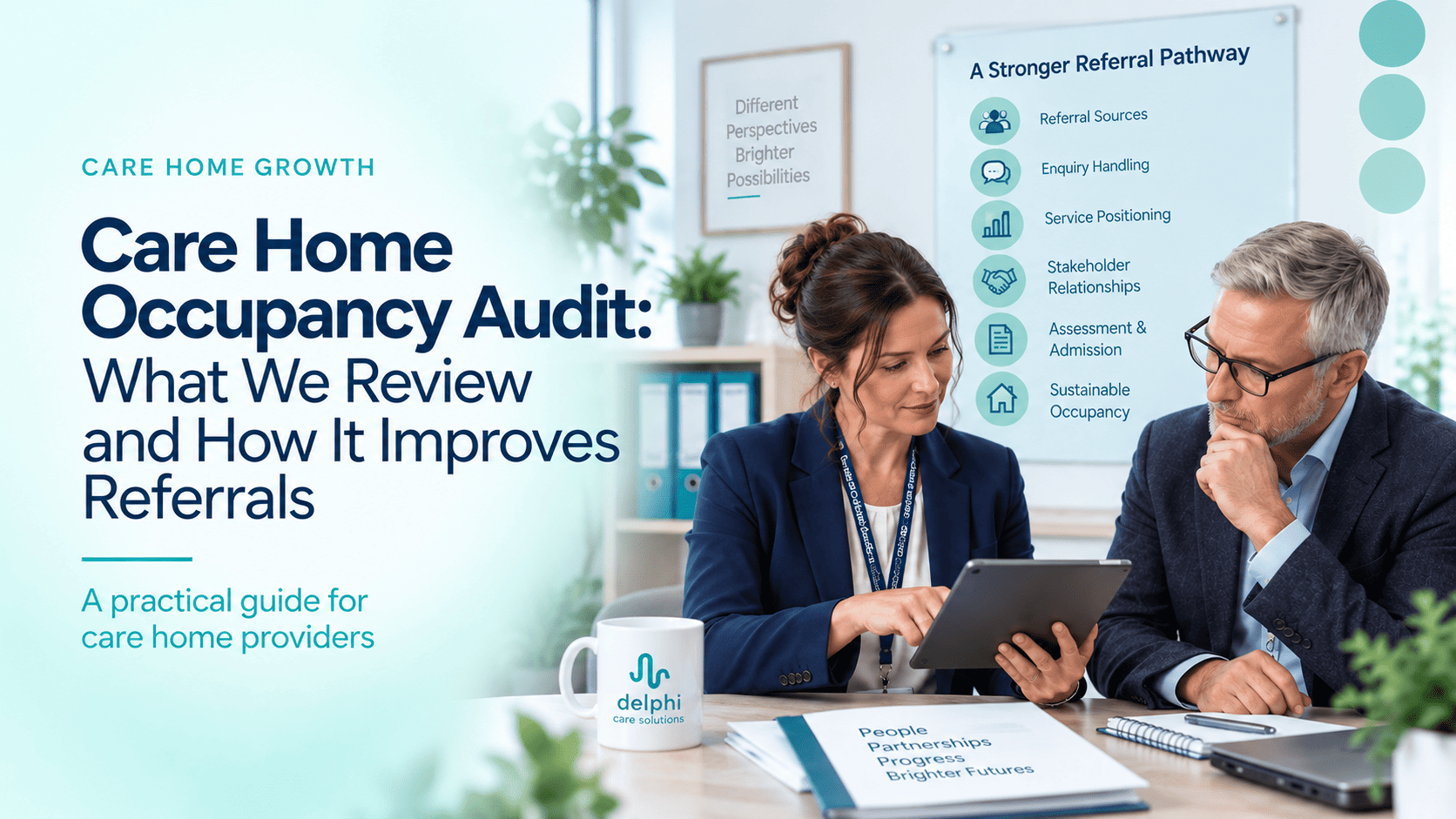
Delphi’s guide to the care home occupancy audit explains how to examine the full referral and admissions journey to identify where suitable opportunities are delayed or lost.
A better referral pathway, not simply more leads
Generating more enquiries is useful only when those enquiries are relevant and the home can respond effectively.
A sustainable approach brings together marketing, referral pathway development and operational follow up. It ensures that families and professionals understand what the home provides and that suitable enquiries receive a timely, well managed response.
This matters because the wider health and care system increasingly emphasises coordination, personalisation and continuity. NHS England guidance supports streamlined access to the right care, more responsive follow up and referral pathways that operate smoothly for people and carers.
For a care provider, that means making the admission journey clear and dependable. Referral partners should be able to understand the people the home can support, the information required for an assessment, who to contact and how quickly the provider will respond.
Families should receive clear, accessible and accurate information. They should have opportunities to ask questions, understand fees and explore whether the home can meet their relative’s needs without pressure.
A well managed pathway benefits everyone. It reduces uncertainty for families, unnecessary administration for referral partners and avoidable delays for the provider.
A practical way to review the pathway is to measure qualified enquiries, time to first response, assessments arranged, accepted placements and reasons for declined or unsuitable referrals. These stages reveal where a home needs stronger visibility and where it needs operational improvement.
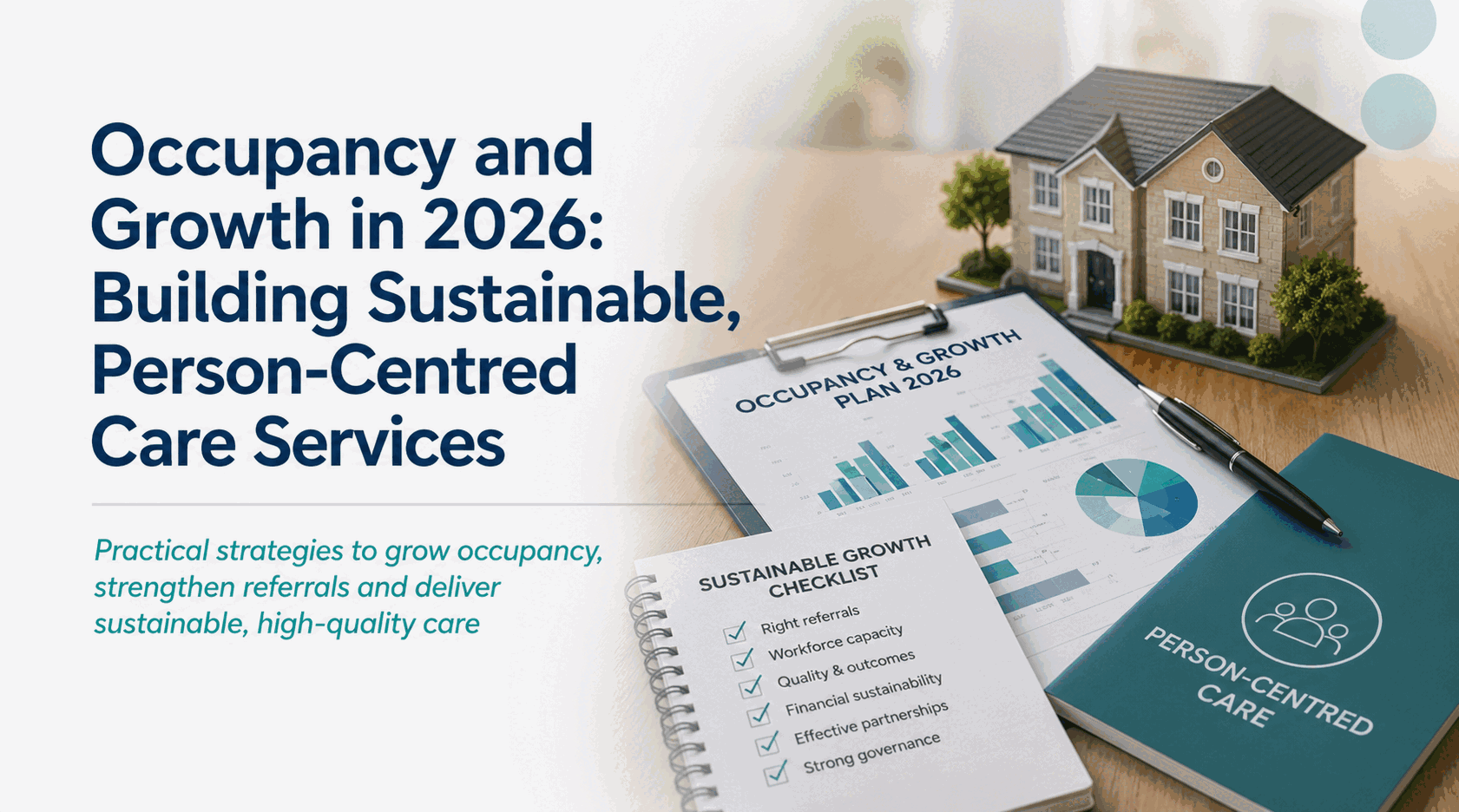
For a wider strategic view, see Delphi’s article on occupancy and growth in 2026, which connects referrals, quality and readiness rather than focusing on the number of enquiries alone.
Suitable placements must remain the priority
Commercial pressure must never override safe admission decisions.
The final available rooms should be occupied only by people whose assessed needs the home can meet safely and sustainably. The provider must consider its environment, registration, staffing levels, skills, equipment, existing resident group and access to external professional support.
Person centred planning requires people and, where appropriate, their families or representatives to be involved in decisions. Relevant guidance highlights personalisation, choice, flexibility and care planning that responds to each person’s strengths, needs and aspirations.
An unsuitable admission can create distress for the person and their family. It may also place significant pressure on other residents and staff, increase safeguarding or quality risks and lead to an avoidable placement breakdown.
A suitable admission, by contrast, can provide stability for the individual and a sustainable contribution to the home. Ethical growth and commercial discipline therefore support each other when admission decisions are based on reliable information, appropriate assessment and transparent fee discussions.
CQC guidance on person centred care and staffing requires providers to assess people’s needs and preferences and deploy enough suitably skilled and experienced staff. The financial case for an admission must never be separated from the service’s ability to deliver safe, appropriate care.
How Delphi can support occupancy and growth
Delphi’s Occupancy and Growth team supports care providers to develop a stronger, more consistent flow of suitable enquiries and improve the journey from initial contact to admission.
Our support can bring together four connected areas.
Targeted marketing
We help providers communicate what makes their service distinctive, including the care provided, environment, location, team expertise and types of needs the home may be able to support.
Clear positioning can help families and professionals determine whether the service may be suitable before making an enquiry. This can improve the relevance of incoming opportunities and reduce time spent processing referrals that do not match the home’s offer.
Referral pathway development
We help identify relevant local authority, Integrated Care Board and wider health and social care stakeholders, while supporting structured and appropriate engagement around the service.
The aim is not preferential access or guaranteed referrals. It is to make sure relevant professionals have accurate information about the home, its available capacity and the process for discussing a potential placement.
Strong local relationships are increasingly important. NHS England guidance identifies partnership working, local demand and capacity planning, workforce capability and smooth referral pathways as important components of coordinated care.
Enquiry and occupancy support
We help teams examine how enquiries are received, recorded, followed up and progressed.
This may include clarifying responsibilities, reviewing response times, identifying recurring delays and examining the reasons enquiries do or do not lead to admissions. The objective is to create a responsive process without rushing assessment or compromising governance.
A focused growth plan
We bring priorities, responsibilities, measures and follow up actions into a practical plan.
This can include reviewing target audiences, referral sources, marketing activity, enquiry handling, local relationships and management information. Regular review helps occupancy remain a consistent priority rather than becoming an urgent concern only when vacancies have already persisted for several months.
We work alongside the provider’s leadership and management teams. Admission decisions remain with the provider, and each person’s needs, preferences, safety and suitability must come first.
Seven practical questions for care providers
Providers seeking to improve occupancy can begin with seven practical questions:
What capacity can we safely operate?
Distinguish registered capacity from the rooms that can be supported with the current workforce, environment and skill mix.
Which needs can we meet confidently?
Define the service clearly without overstating specialist capability.
Who needs to know about our availability?
Consider families, community professionals, local authority teams, Integrated Care Board contacts and other relevant partners.
How quickly do we respond?
Review the time from first contact to acknowledgement, assessment and decision.
Why do suitable enquiries fail to progress?
Record reasons consistently, including timing, location, fees, changing needs and family choice.
Are our fees aligned with the care required?
Ensure proposed fees reflect assessed needs, delivery costs and the resources required to sustain the placement.
Who owns the growth plan?
Give named people responsibility for actions, reporting and follow up.
A useful management dashboard should distinguish registered beds, rooms that can safely accept a resident, enquiries under assessment and confirmed admissions. That makes the commercial picture clearer without implying that every vacant room is available to fill.
Frequently asked questions
How do empty beds affect a care home’s profitability?
They remove potential fee income while many underlying property, management, staffing and compliance costs continue. The net effect depends on the costs that are genuinely avoidable when the room is empty and the incremental costs required for a suitable new admission.
How much revenue does one empty bed represent?
At an illustrative fee of £1,200 per week, a room occupied throughout a 52 week year would generate £62,400 in gross fee income. An empty room does not necessarily represent £62,400 in lost profit, because care costs and actual occupancy periods vary.
What is a good occupancy rate for a care home?
There is no universal percentage that guarantees quality or profitability. The right operating level depends on staffing, care needs, registered capacity, available rooms, fees and costs. National occupancy statistics provide context, not a target for an individual service.
Why do some care homes have persistent vacancies?
Possible reasons include weak local visibility, unclear service positioning, unsuitable enquiries, slow responses, assessment delays, staffing limits, price differences or the needs of local people not matching the home’s current capability.
Does filling every vacant room always improve profit?
No. A new placement may require additional staff, equipment or specialist support that substantially changes the financial calculation. An admission must also be safe, appropriate and consistent with the person’s assessed needs.
How can a care home improve occupancy responsibly?
Review which rooms can safely accept residents, clarify the service offer, strengthen relevant local referral relationships, respond promptly to suitable enquiries and track progression through assessment. Measure quality and safe outcomes alongside occupancy.
Sources and further reading
- Department of Health and Social Care, Adult social care provider statistics: quarterly update to August 2026 (3 September 2026)
- Care Quality Commission, State of Care 2024/25: Adult social care (24 October 2025)
- Skills for Care, The state of the adult social care sector and workforce in England, 2025
- Competition and Markets Authority, Care homes market study: summary of final report (30 November 2017)
- Department of Health and Social Care, National framework for NHS continuing healthcare and NHS funded nursing care (updated 14 July 2023)
- NHS England, Neighbourhood health guidelines 2025/26 (updated 25 March 2025)
- NHS England, Working in partnership with people and communities: statutory guidance (updated 21 May 2026)
- Care Quality Commission, Regulation 9: Person centred care (updated 16 May 2025)
- Care Quality Commission, Regulation 18: Staffing (updated 16 May 2025)

If you would like to chat with one of our consultants, then why not book a meeting now.
We look forward to hearing from you!
Book your meeting now