16th October 2026
Care Home Turnaround Strategy: Why Compliance Alone Isn’t Enough
Estimated reading time: 12 minutes
A care home can have completed policies, regular audits and a detailed improvement tracker, yet still struggle with exhausted staff, falling confidence, empty rooms or an unsustainable cost base. Closing documentation gaps matters, but it does not automatically restore the health of the service.
A credible care home turnaround strategy must therefore look beyond inspection readiness. It needs to make care better for residents, give the workforce the conditions to perform well and restore the operational and commercial foundations needed for lasting improvement.
For owners, Registered Managers and provider boards, the challenge is to improve these areas together without treating safety or regulatory responsibilities as negotiable.
What is a care home turnaround strategy?
DIRECT ANSWER
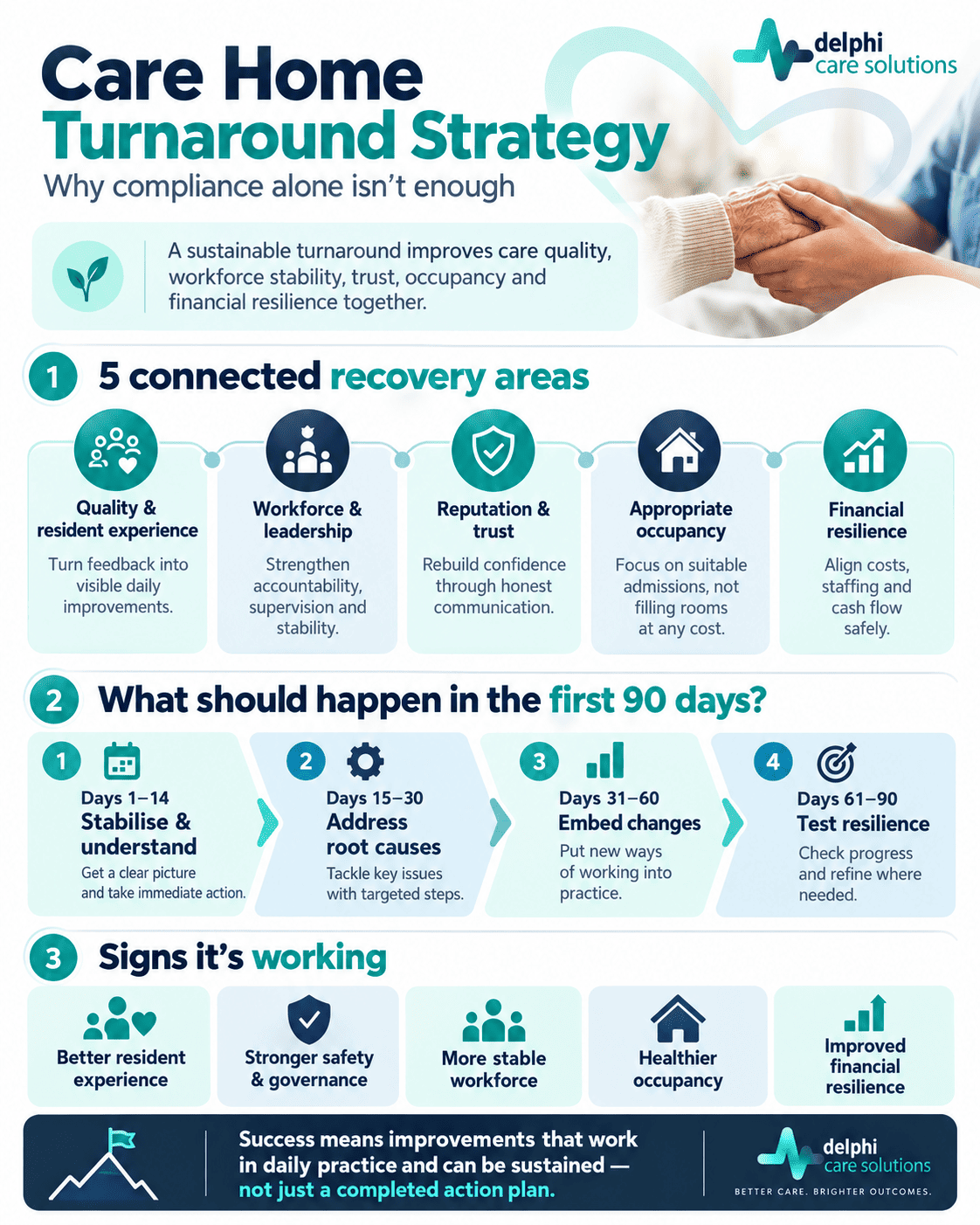
A care home turnaround strategy is a prioritised recovery plan for a service experiencing quality, leadership, operational or financial pressure. It protects residents and addresses urgent regulatory risks first, then strengthens care delivery, staffing, reputation, suitable occupancy and financial sustainability. Success means that improvements work in daily practice and can be maintained, not simply that an action plan has been completed.
Key Takeaways
- Regulatory compliance is essential, but a completed action tracker is not proof of a stable, effective service.
- Resident experience and workforce stability should lead the turnaround, rather than follow a commercial recovery target.
- Reputation and occupancy are consequences of what a service can consistently deliver, not just its marketing.
- Financial recovery must account for true staffing costs, appropriate admissions and the cost of recurring service failure.
- One accountable recovery plan should track quality, people, confidence, occupancy and finances together.
Table of Contents
- Why is compliance alone insufficient for a sustainable turnaround?
- How do you improve care quality and resident experience?
- How can a turnaround support an effective workforce?
- How do you rebuild a care home’s reputation?
- What role does occupancy play in a turnaround?
- How can financial performance improve without compromising care?
- How do quality, people, reputation, occupancy and finances connect?
- What should happen in the first 90 days?
- Which measures show whether a turnaround is working?
- When is independent turnaround support useful?
- Frequently asked questions
- Next steps
Why is compliance alone insufficient for a sustainable turnaround?
Compliance provides a non-negotiable foundation. A service must meet applicable legal duties and act quickly where residents are exposed to harm. However, there is a difference between completing a corrective action and proving that it has improved everyday care.
For example, a provider might update its falls policy, deliver training and close the action. The real test is whether staff understand changing risks, apply the guidance consistently, learn from incidents and involve residents in decisions. The same distinction applies to medicines, complaints, safeguarding and care planning.
This is not an argument that regulation ignores quality. The CQC guidance on Regulation 17 explicitly requires providers to assess, monitor and improve quality, safety and the experience of people using services. The CQC also assesses care against five key questions: safe, effective, caring, responsive and well led. CQC five key questions
The strategic point is that an audit or inspection response should be one part of a wider operational recovery. Where a service appears broadly compliant but its workforce, resident experience or finances are deteriorating, leaders should investigate those risks before they become more serious.
How do you improve care quality and resident experience?
Quality improvement starts with what residents experience each day. Recovery plans should test whether the service is delivering individualised care in practice, rather than relying only on documentation or management reports.
Listen to the people who receive care
Bring together residents’ views, feedback from families and representatives where appropriate, complaints, compliments, observations of daily routines and patterns in incidents. Ask whether people feel safe, listened to, respected and able to make meaningful choices.
Translate feedback into observable changes
- Review care plans with residents or those lawfully acting on their behalf and check they reflect current needs and preferences.
- Observe how dignity, communication, activities, nutrition and responsiveness are experienced across different shifts.
- Examine incident themes and make improvements that can be evidenced in practice.
- Give each priority a named owner, an agreed review date and a way to test whether the change worked.
These actions reflect the intent of the CQC Regulation 9 guidance on person centred care, which emphasises needs, preferences and involvement in decisions. Good quality assurance should capture people’s experiences alongside records and audit results.
How can a turnaround support an effective workforce?
Workforce instability is both a symptom of poor performance and a potential cause of further decline. Repeated agency cover, unclear management decisions, missed supervision or a lack of confidence to raise concerns can disrupt relationships and consistency of care.
The CQC guidance on Regulation 18 requires suitable staffing levels and appropriate training, support, supervision and professional development. A turnaround should meet these obligations while also asking what will make the service a place where capable people can do their jobs well.
Rebuild leadership and day to day confidence
- Confirm who is accountable for safeguarding, clinical escalation, rota decisions and improvement delivery.
- Review skill mix and deployment against residents’ actual needs, not only the number of people on shift.
- Give frontline teams clear briefings, reliable supervision, coaching and a route to raise concerns safely.
- Review avoidable agency reliance, recruitment delays, sickness patterns and reasons staff leave.
- Protect time for leaders to follow through on improvement while normal care continues.
Where a leadership vacancy is part of the problem, temporary expert capacity may be appropriate. Delphi Interim Care Management is designed to provide practical oversight and continuity during periods of instability.
How do you rebuild a care home’s reputation?
Reputation is shaped by more than a public rating. Residents, relatives, commissioners, referrers and local professionals form judgements through their direct interactions with a service. Confidence may decline when communication is slow, concerns are minimised or promises do not match the care being delivered.
The first step is not a new promotional campaign. It is to make improvements credible. Explain clearly what has changed, respond promptly to concerns and give stakeholders appropriate opportunities to see progress for themselves.
Make trust a measurable part of recovery
- Close the feedback loop by telling residents and families what changed in response to concerns.
- Ensure information given to prospective residents and referrers accurately represents the service’s capabilities.
- Review complaint themes and response quality, rather than measuring complaints only by volume.
- Communicate improvements factually, without promising a future CQC rating or disclosing personal information.
Trust often takes longer to rebuild than a policy or process. Consistency across months matters more than a single announcement.
What role does occupancy play in a turnaround?
Low occupancy can create pressure on cash flow and investment in the service. Yet increasing admissions before quality, staffing and admission suitability are under control may create new risks. The right objective is sustainable occupancy with appropriate residents, not full capacity at any cost.
Review three connected questions: Is the service suitable for the needs of people being referred? Is it responding effectively to appropriate enquiries? Can it maintain safe care as occupancy changes?
Examine the whole referral pathway
- Measure enquiries, suitable referrals, visits, offers, admissions and reasons suitable placements do not proceed.
- Check that the home’s service description and communication reflect its actual strengths and limitations.
- Build constructive relationships with relevant discharge teams, local authorities and other referrers where appropriate.
- Review workforce capacity, environment and risk assessment before every admission decision.
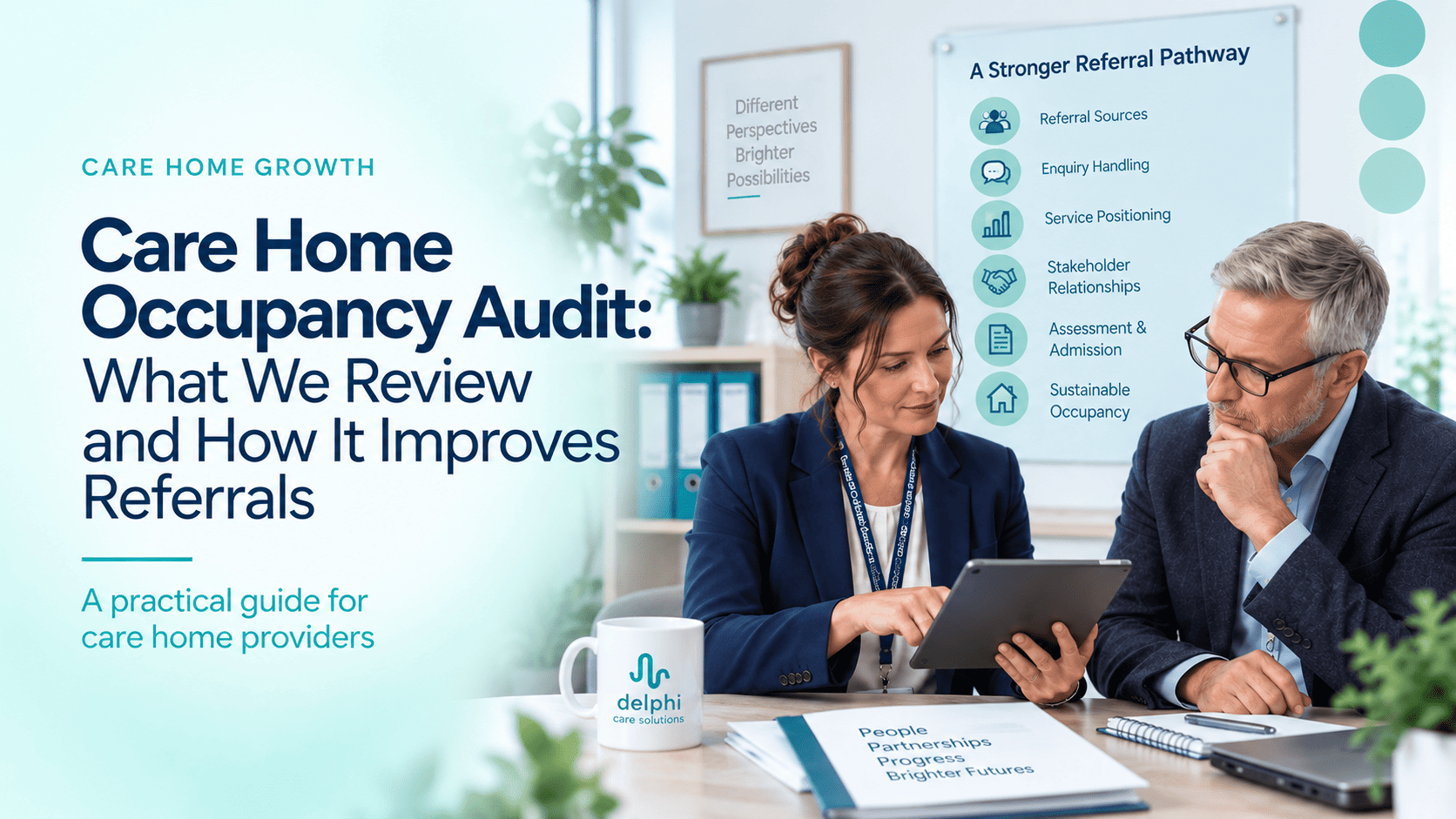
An occupancy strategy should sit alongside quality and operational improvement. See Delphi Occupancy & Growth Support and the practical guide to care home occupancy and growth in 2026.
How can financial performance improve without compromising care?
Financial turnaround is not simply a programme of cuts. A service must understand why income, costs and working capital are under pressure, and which changes can improve resilience without undermining residents’ needs or statutory responsibilities.
Start with a realistic picture of the home’s occupancy, fee mix, payroll, agency usage, sickness cover, property costs, maintenance needs, supplier spend and cash flow. Separate unavoidable costs of safe care from avoidable waste, duplication or repeated operational failure.
Prioritise sustainable decisions
- Build a staffing and cost model linked to assessed care needs and realistic occupancy scenarios.
- Identify whether high agency spend reflects vacancies, absence, poor rostering or leadership instability.
- Assess fees and contract terms against the actual support required, with appropriate commercial and professional advice.
- Retain investment in training, maintenance, equipment and quality systems where needed for safe care.
- Monitor cash flow and the financial implications of delayed or unsuitable admissions.
A smaller but safely staffed service can be more resilient than a fuller home whose admissions exceed its capability. Financial targets should never override safe admission decisions, workforce needs or resident outcomes.
How do quality, people, reputation, occupancy and finances connect?
These are not five independent projects. Poor staffing can affect resident experience. Weak experiences can undermine trust and referral confidence. Lower suitable occupancy can intensify financial pressure, making it harder to stabilise staffing and invest in quality.
The opposite is also possible: clearer leadership supports a confident workforce; consistent care provides credible evidence of improvement; stronger trust supports suitable enquiries; and a more stable commercial position creates room to sustain quality.
| Recovery area | Early evidence that change is working | Risk if treated in isolation |
|---|---|---|
| Quality and resident experience | Feedback leads to visible improvements; recurring incidents are reviewed | A closed audit action may not change lived experience |
| Workforce and leadership | Safer deployment, stronger supervision, improved stability | Vacancies and low confidence undermine delivery |
| Reputation and trust | Better communication and credible stakeholder feedback | Marketing promises outpace actual care |
| Appropriate occupancy | More suitable enquiries progress to safe admissions | Pressure to fill rooms creates avoidable risk |
| Financial resilience | Cash flow, staffing costs and service capacity are reviewed together | Short term cuts weaken quality and long term sustainability |
This is why a care home turnaround strategy needs shared governance. The board, operational leaders and Registered Manager should be able to see one coherent picture of service quality and viability, rather than separate reports that never meet.
What should happen in the first 90 days?
The sequence will vary according to immediate safeguarding issues, enforcement action and the complexity of the service. The following is an illustrative management framework, not a regulatory timetable or a fixed Delphi engagement model.
Days 1 to 14: Stabilise and understand
- Act immediately on any safeguarding or safety risks and meet applicable reporting or regulatory duties.
- Establish clear leadership ownership and a reliable route for escalating concerns.
- Review recent incidents, staffing, feedback, occupancy, costs and available audit evidence.
- Agree the few highest priority problems, with named owners and review dates.
Days 15 to 30: Address root causes
- Test whether apparent compliance gaps reflect inconsistent practice, staffing constraints or weak governance.
- Set realistic improvement measures for quality, people and finance.
- Engage staff, residents and relevant representatives in changes that affect them.
Days 31 to 60: Embed changes
- Review actual outcomes from care, staffing and feedback changes.
- Strengthen management routines and consistent communication with referrers.
- Assess admission capability and financial forecasts against the updated operating model.
Days 61 to 90: Test resilience
- Use independent challenge or targeted assurance where useful.
- Check whether improvements hold across shifts, teams and different resident needs.
- Reset priorities for the next quarter and ensure permanent ownership of the plan.
Which measures show whether a turnaround is working?
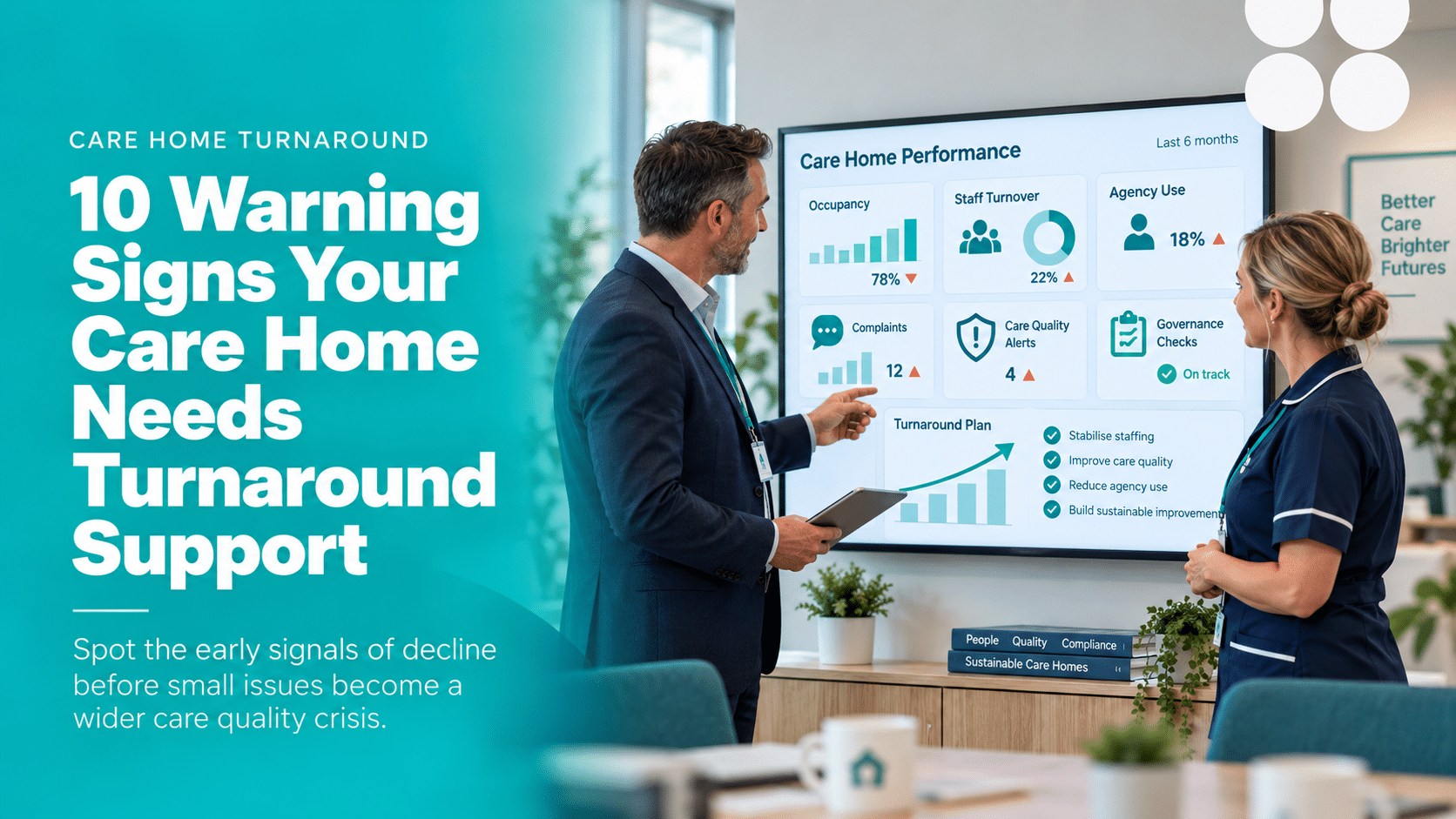
A useful dashboard shows both leading indicators and outcomes. Set a baseline and review trends; avoid interpreting one week of change as proof of a successful recovery.
| Area | Practical measures to review |
|---|---|
| Resident experience | Care plan review quality, themes in feedback, complaints resolved, observed care experience |
| Safety and governance | Open high risk actions, recurring incidents, action completion with effectiveness checks |
| Workforce | Sickness, vacancies, agency hours, supervision completion, staff feedback |
| Trust and reputation | Complaint themes, stakeholder feedback, referral conversations |
| Occupancy | Suitable referrals, enquiry to admission progression, occupied operational beds |
| Financial performance | Cash flow, staffing cost against acuity, agency costs, revenue against realistic capacity |
The aim is not to report more numbers. It is to identify whether the actions being taken are making the home safer, more effective and more sustainable for the people who rely on it.
When is independent turnaround support useful?
Independent support can be particularly valuable when performance concerns are recurring, board members lack a consistent view of the risks, leadership capacity is stretched or an action plan is not producing improvement in practice.
Delphi Care Solutions’ turnaround support focuses on diagnosing underlying issues, reviewing operational and regulatory pressures, prioritising recovery actions and supporting implementation where required. Depending on the need, this may connect with independent service evaluations, interim leadership or occupancy support.
A useful starting conversation should identify what has changed, where residents or the service may be at risk, what the team has already tried and what outcomes matter most. The agreed scope should match the evidence, not assume every underperforming home needs the same intervention.
Frequently asked questions
Can a care home be compliant but still need a turnaround?
Yes. A service may be meeting its identified regulatory obligations while experiencing workforce instability, poor communication, weak referral confidence or financial pressure. However, compliance must not be reduced to having documents in place: regulatory expectations also cover how quality is delivered and improved.
What comes first in a care home turnaround?
Immediate resident safety and safeguarding concerns come first, alongside any required regulatory action. Leaders should then establish accountability, understand the root causes of underperformance and sequence operational and commercial improvements without compromising safe care.
Does a better CQC rating automatically increase occupancy?
No. A rating can contribute to how stakeholders assess a service, but occupancy also depends on local need, suitability, workforce capacity, fees, referrals and the experience of people considering a placement. No rating or occupancy outcome can be guaranteed.
How long does a care home turnaround take?
There is no universal timetable. Urgent risks require immediate action, while changing workforce culture, rebuilding trust and establishing financial resilience can take considerably longer. The first 90 days can establish priorities and test progress, but the appropriate duration depends on the service’s starting point.


Adrian has over 20 years of experience in quality assurance, performance management and improvement across health and social care, including six years as a CQC Inspector. His experience also includes coaching staff and teams to improve outcomes.
We look forward to hearing from you!
Book your meeting now