22nd October 2026
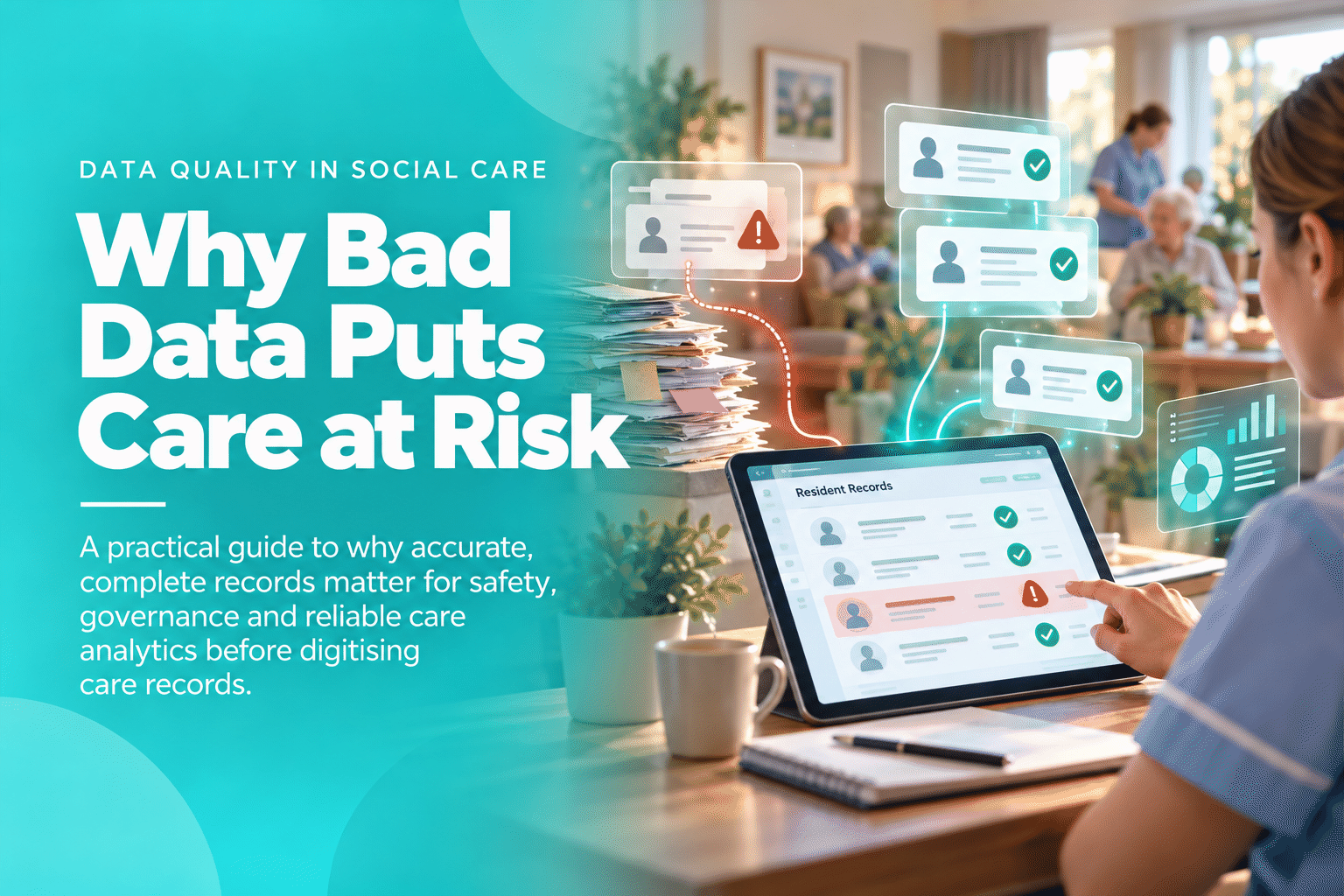
Data Quality in Social Care: Why Bad Data Puts Care at Risk
Estimated reading time: 12 minutes
Your board has approved a major digitisation programme. New care record systems are on the way, staff will be able to find information more easily and the filing cabinets may finally disappear. So your documentation problems are over, right? Not quite.
Digitising care records can transform how a care home works. Information becomes easier to access, patterns become easier to spot and staff can have important details at their fingertips. But a digital system cannot reliably tell whether the information entered into it is correct, outdated or dangerously incomplete.
If inaccurate assessments, duplicated records, vague care plans or unchecked information move into the new system unchanged, the problem has not been removed. It has been digitised. In social care, that is more than an administrative inconvenience. It can become a risk to people receiving care.
What is data quality in social care?
Direct answer
Data quality in social care means that information used to plan, deliver and oversee care is accurate, complete, current, consistent, relevant and traceable to a trustworthy source. Reliable records help staff understand people’s needs and help leaders make decisions based on evidence rather than assumptions. Digitising a record does not, by itself, make that record accurate.
Key takeaways
- Moving a poor-quality paper record into software does not resolve the underlying error.
- Inaccurate care data can influence decisions about medicines, mobility, nutrition, staffing and safeguarding.
- Connected systems may spread one incorrect entry into reports, workflows and management dashboards.
- The quality of person-centred care depends on records that reflect the individual, not copied generic text.
- Before migration, providers should validate high-risk information, document sources and establish clear responsibility for corrections.
- A useful dashboard requires trustworthy underlying data as well as good technology.
Table of contents
- Why data quality matters in social care
- Digitisation does not automatically improve data quality
- How inaccurate care records can put people at risk
- Why connected systems can amplify an error
- Person-centred care depends on trustworthy information
- How to improve data quality before migrating care records
- A practical data quality checklist for care leaders
- From reliable records to reliable care intelligence
- Frequently asked questions
- Next steps: challenge the data before you move it
Why data quality matters in social care
Care records describe people, not simply transactions. They may include diagnoses, allergies, medicines, mobility needs, nutrition, communication preferences, capacity assessments, safeguarding considerations and the interventions that matter to each individual. A single record can influence decisions made by several members of staff across different shifts.
That information can accumulate over months or years. Risk levels change, clinical advice is updated, preferences evolve and care plans are reviewed. A record is not necessarily reliable just because it has existed for a long time or appears in the organisation’s official system.
CQC’s guidance on Regulation 17 requires relevant records to be accurate, complete and contemporaneous. Its guidance on digital social care records makes clear that these expectations apply to both paper and digital information. The UK GDPR accuracy principle also requires reasonable steps to ensure personal data is accurate and, where necessary, kept up to date.
Digitisation does not automatically improve data quality
When a care home moves from paper records, spreadsheets or legacy software into a new system, the project can easily become centred on IT milestones. How quickly can the records be migrated? When can staff be trained? When can the system go live?
Those questions matter, but there is a more important one: what exactly are we putting into the new system? A new interface, mandatory fields and tidy dashboards can make information look more authoritative without checking whether its substance is right.
Common weaknesses include duplicated records, outdated assessments, contradictory instructions, incomplete fields and text copied forward from previous documents. Terminology can vary between teams. A change to one risk assessment may not have been reflected in related care plans or daily instructions.
These issues are not usually evidence that staff are deliberately careless. Care settings are busy; entries may be completed after a shift, different professionals may use different language and software fields may not prompt the information people need. Digitisation creates an opportunity to address those weaknesses, but only if providers build validation into the project.
How inaccurate care records can put people at risk
“Rubbish in, rubbish out” has been a familiar computing principle for decades. In a care environment, however, its consequences can extend beyond an inaccurate spreadsheet. The information may be used to make decisions that directly affect a person’s day.
An incorrect mobility assessment can change care decisions
Imagine that a resident’s mobility status has changed but the old status remains in their digital care plan. Staff may rely on it when planning moving and handling, selecting equipment or considering how many colleagues are needed to provide support. The original documentation error can affect several subsequent decisions if nobody checks whether the assessment is current.
Outdated allergy or medicines information can travel further
The same risk arises from an out-of-date dietary requirement, incorrectly recorded allergy or historic medicines instruction. If that information is treated as current and displayed in more than one system, staff can encounter a misleading picture in multiple places. These are illustrative scenarios, not reports of specific incidents.
Poor information does not automatically cause harm. It does, however, weaken the basis on which safe, person-specific decisions are made. That is why data quality must be treated as a quality and governance issue, not simply an administrative or technical one.
Why connected systems can amplify an error
The more connected a care organisation becomes, the more valuable reliable information is. Care planning data may feed oversight reports. Medicines and incident systems may contribute to reviews of practice. Workforce and quality information may be combined to help management teams identify patterns.
A single inaccurate entry can therefore travel further than the colleague who first recorded it could have anticipated. A dashboard might be beautifully designed and mathematically correct while still offering a misleading picture because the underlying information is incomplete or wrong.
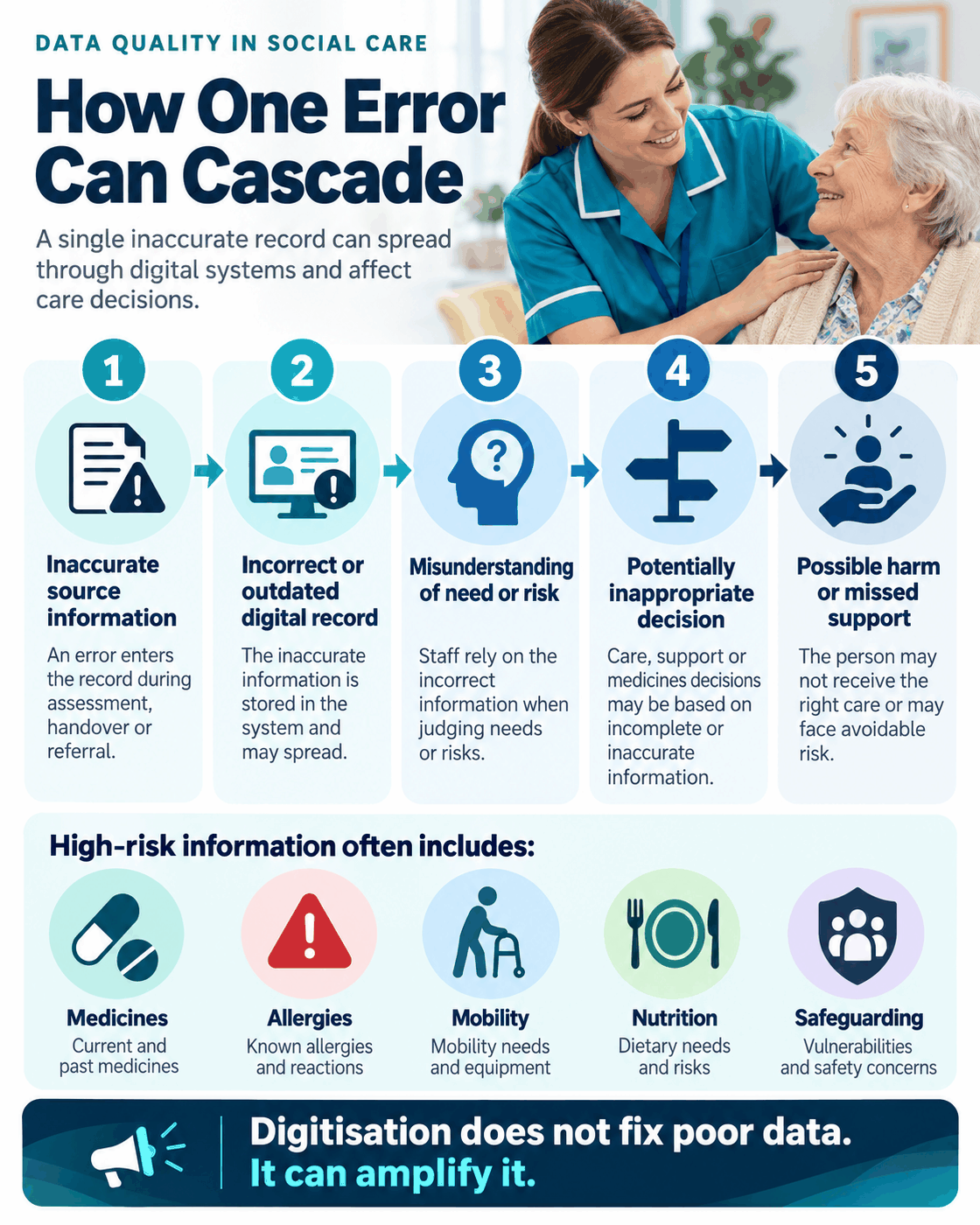
How one error can cascade
Inaccurate source information → Incorrect or outdated digital record → Misunderstanding of need or risk → Potentially inappropriate decision → Possible harm or missed support
For example, a management report might show an apparent increase or decrease in falls, medicines errors or staffing risks because records use inconsistent definitions or duplicate the same event. Leaders could then direct attention, resources or training to the wrong issue. The lesson is straightforward: better connectivity makes data quality more important, not less.
Person-centred care depends on trustworthy information
Good records should describe the person receiving care: their preferences, routines, abilities, relationships, communication needs, goals and what matters to them. Person-centred care depends on staff having enough current and meaningful information to understand that individual.
When digital records become dominated by generic statements, copied text or old assessments, the care plan can drift away from the person it is meant to support. The system may end up describing a theoretical “service user” rather than someone with their own needs, choices and circumstances.
Technology should make care more personal, not more generic. That requires staff to recognise when records no longer match what they observe, to listen to the person and their representatives, and to make updates through the organisation’s appropriate assessment and review processes.
Staff training and the importance of defensible digital documentation
The effectiveness of any digital care system depends not only on the technology itself, but on the knowledge, confidence and competence of the staff using it. It is essential that comprehensive training is prioritised to ensure that staff understand and utilise the full functionality of the software, rather than simply duplicating existing paper-based recording habits into a digital environment. Equally important is the quality of the information being entered. Care notes must be accurate, factual, person-centred and detailed enough to provide a clear account of the care delivered, any changes identified and the actions taken in response. Generic statements such as “all care given” or “resident settled” provide limited evidence of what actually occurred and may offer little protection when care is investigated or challenged. Detailed, defensible documentation should enable another care professional, manager, regulator or investigator to understand what happened, why decisions were made and whether the appropriate action, relevant to the service user, was taken. This requires ongoing training, clear documentation standards, regular auditing and constructive feedback to staff. Ultimately, a digital care system is only as effective as the people using it and the quality of the information they record; good software supports good practice, but it cannot replace professional accountability or sound clinical judgement.
How to improve data quality before migrating care records
Moving records is an opportunity to challenge them. The aim is not to delay digitisation indefinitely. It is to focus verification effort where inaccurate information would create the greatest practical risk.
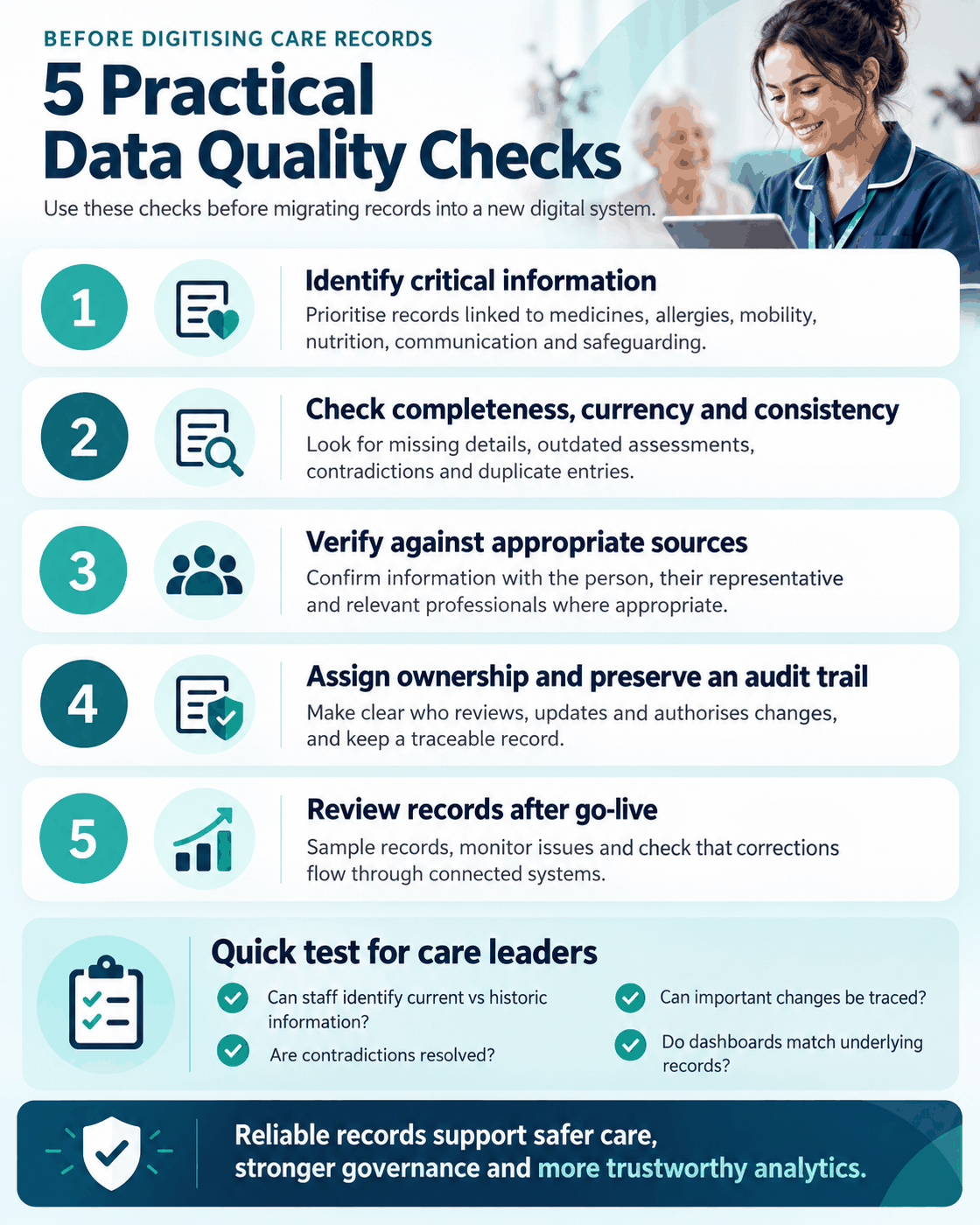
1. Identify information that is critical to safe care
Prioritise records that staff rely on for medicines, allergies, moving and handling, nutrition, communication, safeguarding and other individual risks. Decide what must be checked before migration or before a record is used operationally, taking account of the service and people supported.
2. Check completeness, currency and consistency
Ask whether the record contains the required details, reflects the current situation and agrees with other relevant documents. Look for repeated entries, contradictions, missing assessments, unclear abbreviations and historic instructions that still appear to be active.
3. Verify against appropriate sources
Where appropriate, confirm information with the person receiving care, their representative and relevant professionals. Record where the information came from, when it was confirmed and who reviewed it. Distinguish professional opinion and historic information from current verified facts.
4. Assign ownership and preserve an audit trail
Make it clear who resolves conflicting information, who authorises changes and how amendments are recorded. Avoid simply overwriting a disputed detail without a trace of the correction. The ICO advises organisations to record sources and handle challenges to personal-data accuracy appropriately.
5. Review records after go-live
Data quality is not a one-off pre-migration task. Sample records, review staff feedback, monitor missing or inconsistent fields and respond when practice reveals that information is wrong. Check that relevant corrections flow through connected systems and that earlier versions cannot quietly continue influencing care.
A practical data quality checklist for care leaders
Before your next migration, system integration or governance review, use the following questions to test whether records are trustworthy enough for their intended purpose.
- Are high-risk care records checked against current assessments and professional advice?
- Can staff distinguish historic information from the current care plan?
- Have duplicated, incomplete and contradictory entries been identified?
- Are important terms and definitions used consistently across teams and systems?
- Is there a clear route for residents, representatives and staff to challenge inaccuracies?
- Can the source, date, reviewer and reason for significant changes be traced?
- Are access permissions and information-sharing arrangements appropriate?
- Do leaders periodically test whether dashboard figures match the underlying records?
- Are data-quality problems assigned to an owner and followed through to resolution?
- Does the organisation check whether corrections are reflected across connected systems?
If several answers are unclear, treat that as a reason for a focused review. A care data quality programme does not need to begin with a huge new technology purchase. It may begin with better questions, clearer ownership and more reliable recording practice.
From reliable records to reliable care intelligence
Once records are more trustworthy, digital tools can make good information easier to find, connect and act upon. Dashboards and analytics can help reveal patterns, support oversight and prompt better questions about quality, workforce pressures and operational performance.
But no analytics platform should be treated as a substitute for accurate source records, professional judgement or appropriate governance. The value of intelligence depends on the reliability of the information from which it is produced.
For a broader look at connected systems and organisational digitisation, read Delphi’s guide to digital transformation in care homes. For the governance arrangements that help leaders turn evidence into action, see the care home governance guide. Roda BI is Delphi Care Solutions’ care intelligence platform, intended to support clearer oversight across care operations.
For practical support reviewing governance, audit systems and quality assurance, see Delphi’s Quality Audits & Policies service.
Frequently asked questions
Why is data quality important in social care?
Care teams and leaders use records to understand needs, identify risks and plan support. Incomplete, outdated or inaccurate information can undermine those decisions even when it is displayed in a modern digital system.
Does moving to digital care records solve inaccurate documentation?
No. Digital systems can improve access, legibility and consistency, but errors can remain if information is imported or entered without suitable checks. Verification, review and clear ownership are still necessary.
What should a care provider check before migrating records?
Start with the information most relevant to safe care. Check accuracy, completeness, currency and consistency; confirm sources where appropriate; resolve contradictions; assign responsibility; and plan how corrections will be tracked after go-live.
Does CQC require accurate digital care records?
CQC’s Regulation 17 guidance requires accurate, complete and contemporaneous records for regulated services. CQC states that relevant standards apply to both paper and digital records; it does not endorse one specific care record product.
Can a dashboard be wrong even if its calculations are correct?
Yes. If records are duplicated, outdated, missing or defined inconsistently, a technically correct calculation can still produce a misleading indicator. Leaders should test data definitions and review important figures against underlying evidence.


If you would like to chat with one of our consultants, then why not book a meeting now.
We look forward to hearing from you!
Book your meeting now