20th October 2026
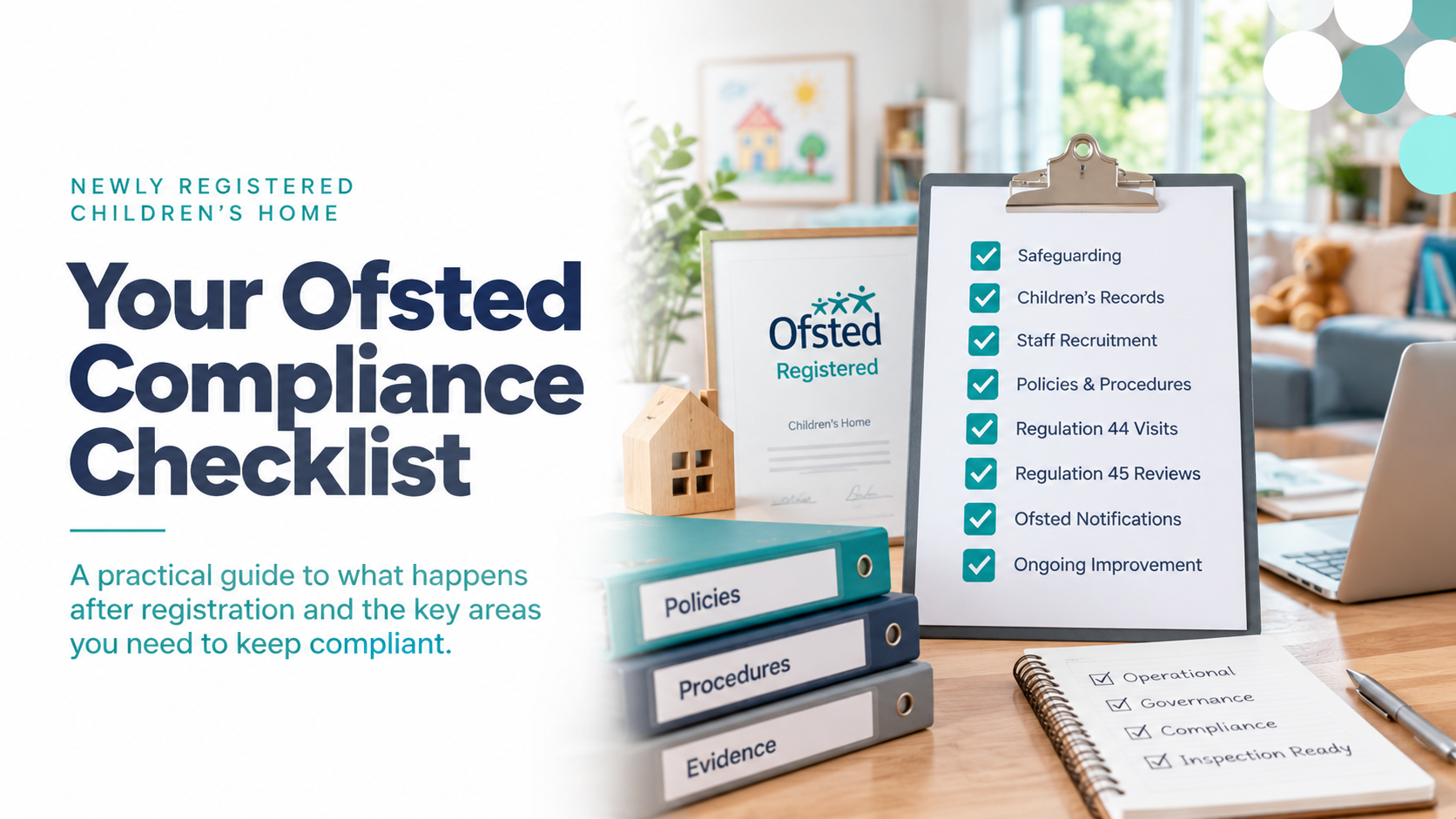
Ofsted Compliance After Registration: Children’s Home Checklist
Estimated reading time: 11 minutes
You have received your Ofsted registration certificate. The Registered Manager is in place. The Responsible Individual is appointed. Your policies have been written. Your Statement of Purpose has been approved.
So, what happens next?
For many new children’s home providers, so much time and energy goes into achieving registration that the period immediately afterwards receives far less attention.
Registration is only the beginning.
Once your home becomes operational, the focus moves from demonstrating what you intend to deliver to evidencing what you are delivering every day.
This is where ongoing Ofsted compliance becomes critical.
What happens after Ofsted registration for a children’s home?
DIRECT ANSWER
After Ofsted registration, a children’s home must turn its approved arrangements into consistent daily practice. Providers need clear safeguarding, care planning, recruitment, monitoring and governance systems, plus current records and appropriate notifications. Regulation 44 independent visits, Regulation 45 quality of care reviews and ongoing improvement form part of that operational responsibility.
Key Takeaways
- Registration is the starting point. Everyday practice and evidence must demonstrate how the home operates.
- Newly registered homes should monitor the 20 operational and governance areas outlined in this checklist.
- Regulation 44 requires monthly independent visits and Regulation 45 requires a quality of care review at least every six months.
- Registered Managers and Responsible Individuals need visible oversight, current records and evidence that concerns lead to action.
- Independent compliance audits can help identify gaps early and support practical improvement.
Table of Contents
- From Registration to Operational Compliance
- Compliance Needs to Start From Day One
- Do Not Wait for Ofsted to Find Your Gaps
- Management Oversight Needs to Be Visible
- Children’s Records Need to Tell the Story
- Your Workforce Is Part of Your Compliance
- Your Statement of Purpose Must Remain a Live Document
- What must be reported to Ofsted after registration?
- Inspection Readiness Should Be Normal Practice
- How Delphi Care Supports Newly Registered Children’s Homes
- Frequently asked questions
- Next steps
From Registration to Operational Compliance
During registration, providers spend significant time preparing policies, procedures, the Statement of Purpose, Children’s Guide, Location Assessment, workforce information, recruitment documentation and other evidence required to demonstrate readiness.
Once registered, these documents need to become part of everyday practice.
- Your policies should reflect what staff are doing.
- Your Statement of Purpose should reflect the service being delivered.
- Your risk assessments should reflect current risks.
- Your staff records should demonstrate safe recruitment and workforce development.
- Your children’s records should demonstrate their experiences, progress, safeguarding and outcomes.
- Your governance systems should provide leaders with clear oversight of the home.
Having the documents is no longer enough.
You need evidence of implementation.
Compliance Needs to Start From Day One
New providers sometimes assume they have time to establish systems before they need to think about inspection.
This approach creates unnecessary risk.
Good compliance should begin from the first day the home becomes operational.
Managers should establish clear systems for monitoring:
- Safeguarding and child protection.
- Incidents, allegations and significant events.
- Notifications and regulatory requirements.
- Children’s risk assessments and care planning.
- Education and health outcomes.
- Medication management.
- Recruitment and Schedule 2 compliance.
- Staff induction and probation.
- Training and competency.
- Supervision and appraisal.
- Health and safety.
- Fire safety.
- Complaints.
- Children’s wishes, feelings and feedback.
- Regulation 44 monitoring.
- Regulation 45 quality of care reviews.
- Workforce planning.
- Management oversight.
- Actions arising from audits, incidents and external monitoring.
- Evidence of improvement.
The aim should be simple.
If Ofsted walked into your home tomorrow, your team should already understand what is working, what requires improvement and what action is being taken.
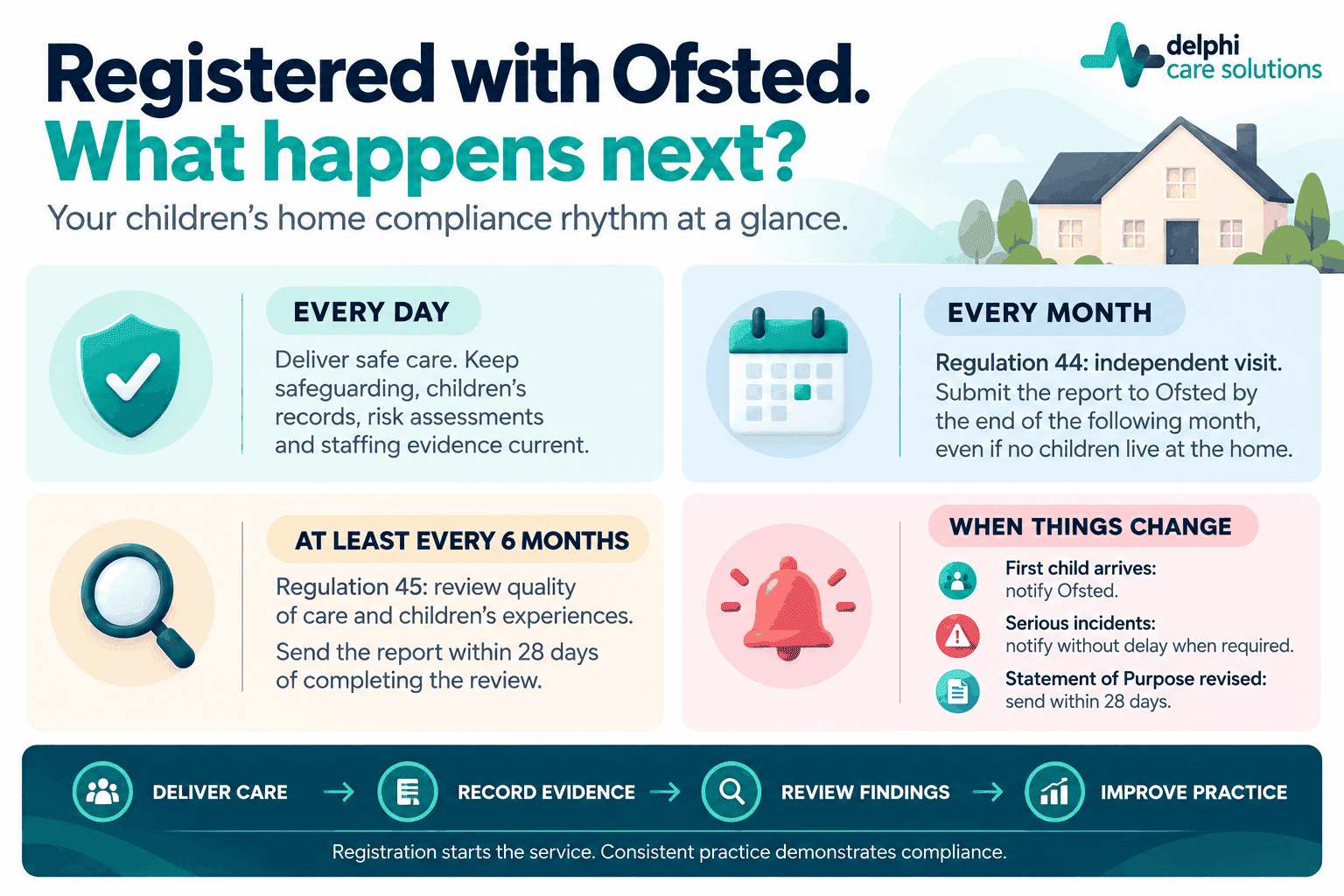
Regulation 44 and Regulation 45: ongoing monitoring and review
Under Regulation 44, an independent person must visit the children’s home at least once each month. Ofsted’s current guidance explains that the visit report must be sent by the end of the following month, including where no children are living in the home.
Regulation 45 requires the registered person to review the quality of care at least once every six months, consider relevant feedback, identify necessary actions and produce a written report. A copy of the report must be sent to Ofsted within 28 days of completing the review.
The visits and reviews serve different purposes, but their findings should feed into the same management oversight and improvement process.
Do Not Wait for Ofsted to Find Your Gaps
One of the most important parts of effective governance is knowing your weaknesses before an inspector identifies them.
Compliance auditing should therefore become part of your quality assurance structure.
A good compliance audit should go beyond checking whether documents exist.
It should ask whether those documents are accurate, current and being followed.
For example, a risk assessment might be present in the file, but does it reflect the child’s current risks?
A supervision record might exist, but does it demonstrate meaningful discussion about safeguarding, practice, performance and development?
A training matrix might show completed courses, but are staff competent to apply their learning?
An incident form might have been completed, but has the manager reviewed what happened, identified patterns and considered whether the child’s plans require updating?
This distinction matters.
Compliance is about practice and evidence working together.
Management Oversight Needs to Be Visible
Registered Managers need to demonstrate active oversight of their homes.
Senior leaders and Responsible Individuals also need systems which allow them to understand what is happening within the service.
This includes identifying patterns.
- If incidents are increasing, why?
- If staff sickness is increasing, what is contributing to it?
- If restraints are occurring repeatedly, what analysis has taken place?
- If a child is regularly missing education, what action has been taken?
- If actions from Regulation 44 reports remain outstanding, who is accountable for completing them?
- If staff supervision is overdue, why has this happened?
- If safeguarding concerns have occurred, what has the organisation learned?
Strong governance means information leads to action.
Your audit systems, management meetings, Regulation 44 visits, Regulation 45 reviews, supervision systems and senior leadership oversight should work together.
Children’s Records Need to Tell the Story
Inspectors should be able to follow a child’s journey through your records.
Their placement plan, risk assessments, behaviour support strategies, health information, education records, key work, professional meetings, incidents and safeguarding records should connect.
When something changes, the relevant documentation should change with it.
- If an incident identifies a new risk, review the risk assessment.
- If a professional makes a recommendation, evidence what happened afterwards.
- If a child raises a concern, record how it was responded to.
- If a strategy is not working, demonstrate how the team reviewed it.
Good recording should help demonstrate the quality of care being provided rather than simply create paperwork.
Your Workforce Is Part of Your Compliance
A home is only as effective as the people delivering the care.
Providers therefore need ongoing oversight of recruitment, induction, training, supervision, competency and performance.
Safer recruitment should remain a priority after registration.
Personnel files should demonstrate the required checks and appropriate scrutiny of employment histories, references, qualifications and suitability.
Once staff start working, the focus moves towards their development and performance.
Managers need to know whether staff understand safeguarding procedures, children’s individual needs, behaviour support, recording expectations and their responsibilities within the home.
Training should support practice.
Supervision should challenge practice.
Management oversight should identify concerns early.
Regulation 32 and Schedule 2 set requirements for recruitment, workforce suitability and the information that must be available about people seeking to work in a children’s home.
Your Statement of Purpose Must Remain a Live Document
Your Statement of Purpose should continue to accurately describe the home.
- Services change.
- Staffing changes.
- Management arrangements change.
- Children’s needs change.
- The way the home operates might develop after registration.
Providers should therefore review whether their Statement of Purpose continues to accurately reflect the service being delivered and make the required updates when changes occur.
The same principle applies to your policies, procedures, risk assessments and other governance documents.
Regulation 16 requires the registered person to keep the Statement of Purpose under review and to send Ofsted a revised copy within 28 days of making a change.
What must be reported to Ofsted after registration?
Registration creates continuing reporting responsibilities. Ofsted’s guidance for providers, updated in July 2026, sets out what must be notified, which changes need approval and how ongoing monitoring works.
- First child arrives: the provider must notify Ofsted when the home begins accommodating children for the first time.
- Serious events: events covered by Regulation 40 must be notified without delay to the relevant recipients.
- Leadership or registration changes: relevant Registered Manager, Responsible Individual or provider changes must be reported using the applicable Ofsted process.
- Statement of Purpose changes: the revised document must be supplied to Ofsted within 28 days of the revision.
Clear ownership, an up to date notification log and regular review of current guidance can help managers avoid gaps between the home’s operational position and the information held by Ofsted.
Inspection Readiness Should Be Normal Practice
Providers should not suddenly become compliant because an inspection is approaching.
Inspection readiness should form part of everyday operations.
A home that is managed well should already have:
- Clear management oversight.
- Current children’s records.
- Current risk assessments.
- Strong safeguarding systems.
- Safe recruitment records.
- An accurate training matrix.
- Regular staff supervision.
- Clear action plans.
- Effective Regulation 44 oversight.
- Meaningful Regulation 45 reviews.
- Evidence of children’s progress and experiences.
- Records demonstrating learning following incidents.
- Clear senior leadership oversight.
- Evidence showing how identified weaknesses have been addressed.
When these systems operate consistently, preparing for inspection becomes far more manageable.
For a deeper guide to what inspectors may explore, use our Ofsted inspection checklist for children’s homes alongside your everyday compliance processes.
How Delphi Care Supports Newly Registered Children’s Homes
Our work does not stop once a provider receives their Ofsted registration.
We support children’s homes with the next stage, moving from registration into sustainable operational compliance.
Our Ofsted compliance audits provide an independent review of how your home is operating and where regulatory or practice gaps need attention.
The purpose is to identify concerns before they become inspection findings.
Depending on the needs of the service, this includes reviewing areas such as safeguarding, children’s records, risk assessments, care planning, incidents, notifications, safer recruitment, staff files, training, supervision, management oversight, Regulation 44 actions, Regulation 45 processes, policies, Statement of Purpose compliance, health and safety and wider governance arrangements.
You receive clear findings and practical actions.
We focus on what needs fixing, why it matters and what needs to happen next.
Ongoing Ofsted Consultancy Support
Some providers need more than a single audit.
Our ongoing Ofsted consultancy support provides continued compliance oversight and practical support to Registered Managers, Responsible Individuals and providers.
This includes reviewing compliance systems, supporting managers with identified gaps, reviewing documentation, strengthening governance arrangements, preparing for inspection, supporting improvement planning and providing independent challenge where required.
For newly registered providers, this support is particularly useful during the first months of operation.
It provides another layer of oversight while your systems become embedded and your management team develops the evidence required to demonstrate consistent practice.
Frequently asked questions
Does Ofsted compliance start as soon as a children’s home is registered?
Registration brings continuing obligations. Providers should establish effective oversight and relevant monitoring arrangements before the home starts accommodating children. Some requirements, including monthly independent visits, still apply when no children live in the home.
Do newly registered children’s homes need Regulation 44 visits before the first placement?
Yes. Regulation 44 requires an independent person to visit a registered children’s home at least once each month. Ofsted’s provider guidance says the visit report must be supplied even when the home has no children living in it.
How often must a Regulation 45 quality of care review be completed?
The registered person must complete a quality of care review at least once every six months, write a report and provide Ofsted with a copy within 28 days of the review being completed.
Does Ofsted need to know when the first child arrives?
Yes. Ofsted’s guidance says providers must notify it when they begin accommodating children for the first time.
When should a Statement of Purpose be updated?
It must remain accurate and consistent with the service delivered. When it is revised, the provider must notify Ofsted and supply the revised document within 28 days.
Is an independent compliance audit the same as an Ofsted inspection?
No. An independent audit helps providers examine practice, records, governance and actions. It does not replace an official Ofsted inspection or determine an inspection judgement.

If you would like to chat with one of our consultants, then why not book a meeting now.
We look forward to hearing from you!
Book your meeting now