
Ken Buxton /
2nd September 2026
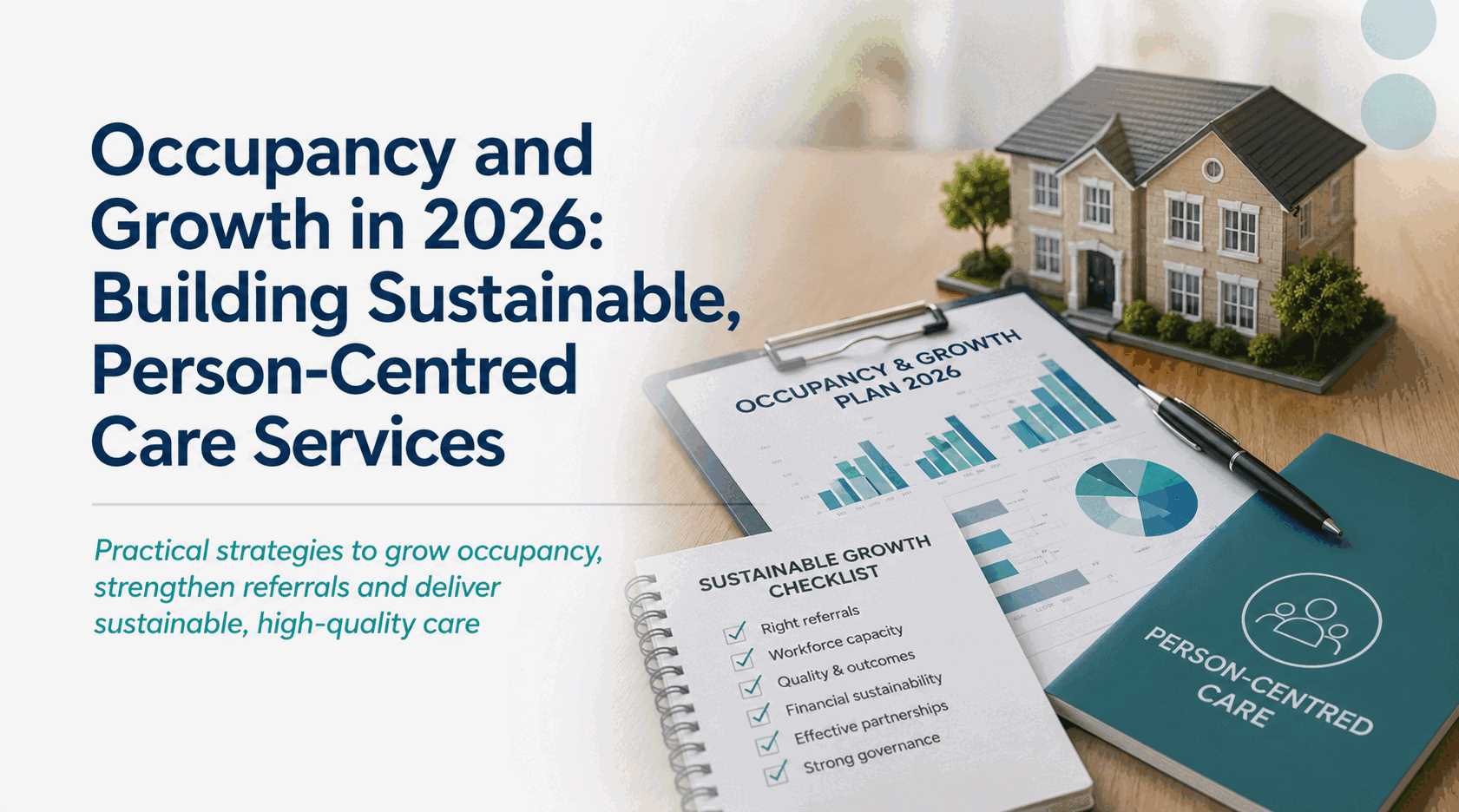
Occupancy and Growth in 2026: Building Sustainable, Person-Centred Care Services
Estimated reading time: 1 minute
For care providers, occupancy pressure can look like a simple commercial problem: there are available beds or placements, so the priority is to fill them. In practice, sustainable occupancy growth is more complex. A service can only grow safely when the people being referred are a good fit for what the service can genuinely provide, the workforce can meet their needs, the environment is suitable, and governance remains strong as activity increases.
That matters particularly in 2026. Policy in England is placing greater emphasis on prevention, neighbourhood health, independence, care closer to home and better coordination between health and social care. At the same time, providers continue to face workforce pressures, rising complexity of need, financial constraints and significant local variation in demand.
This guide explains how care providers can approach occupancy and growth as a whole-service discipline. It covers referral pathways, local commissioning, service positioning, workforce capacity, data, digital systems and governance, with a practical focus on growing in a way that remains person-centred, credible and sustainable.
Direct Answer
Sustainable occupancy growth means increasing appropriate, supportable activity rather than simply filling every available bed or placement. Providers need to understand local demand, define clearly which needs they can meet, respond quickly to suitable referrals, maintain the workforce and operational capacity required for safe care, and track outcomes alongside occupancy. The strongest growth strategy connects commercial activity with quality, governance and person-centred admission decisions.
| By | Ken Buxton, Director of Strategic Occupancy & Growth |
| Experience | With over 20 years’ experience in health and social care. |
| Sources | See Sources and further reading |
About the author
With over 20 years’ experience in health and social care, Ken has worked across brain injury, mental health, residential, inpatient and elderly care services. His career has progressed from Carer to Registered Manager, with roles spanning Quality Assurance & Innovation, Care Management and senior leadership. As Quality Assurance & Innovations Lead, he contributed to achieving CQC Outstanding ratings across all key areas on two consecutive occasions and later maintained a Good rating as a Registered Manager. Ken holds a Level 5 qualification in Leadership and Management and brings extensive experience in leadership, compliance, service development and innovation, with a strong focus on quality, continuous improvement and outcomes for the people supported.
Key takeaways
- National occupancy data is useful context, not a target for an individual service. Local demand, service type, workforce availability and suitability of referrals matter more.
- The policy direction towards neighbourhood health and prevention changes the opportunity: providers need to show where they fit within local care pathways, not simply advertise available capacity.
- A clear, evidence-based service position helps referrers understand who the service can support, what professional input is available and when a referral is appropriate.
- Operational capacity is different from physical capacity. Empty rooms or placements do not automatically mean a service can safely accept additional people.
- Referral and enquiry data should be reviewed alongside workforce, safeguarding, complaints, quality and outcomes so growth decisions are not made in isolation.
- Technology can improve referral tracking and coordination, but it should support professional judgement, consent, information governance and person-centred assessment rather than replace them.
Table of contents
- Key takeaways
- Why occupancy and growth matter in 2026
- What does sustainable occupancy growth mean?
- How the 2026 policy and commissioning environment is changing
- Five opportunities for sustainable occupancy growth
- 1. Strengthen referral pathway development
- 2. Become a credible neighbourhood health partner
- 3. Differentiate the service clearly and honestly
- A useful service-positioning statement should explain
- 4. Use referral data and market intelligence better
- 5. Improve digital capability and enquiry responsiveness
- Four barriers that can make growth unsustainable
- Ten practical priorities for care providers in 2026
- How Delphi Occupancy & Growth Support can help
- Frequently asked questions
- Sources and further reading
- Conclusion: grow from service fit, not capacity alone
- Next steps
Why occupancy and growth matter in 2026
The latest available Department of Health and Social Care provider statistics show that 86.1% of total care home beds in England were occupied in the week ending 14 May 2026. The same publication shows meaningful regional variation, from 82.5% occupancy in the East Midlands to 90.6% in London. Those figures are useful for understanding the national picture, but they should not be treated as a universal benchmark for what an individual home ought to achieve. Official statistics
Occupancy at service level is shaped by local population need, commissioning patterns, service specialism, workforce availability, funding arrangements, competition, reputation and the suitability of the physical environment. A provider may have accommodation available but still be unable to accept a particular referral safely because the person’s clinical, behavioural, environmental or staffing needs cannot be met. Equally, a specialist service with a clear offer and strong outcomes may maintain a stable referral pipeline despite wider market volatility.
Demand is changing as well. CQC’s State of Care 2024/25 reported that new requests for local authority-funded social care were 4% higher in 2023/24 than the previous year and 8% higher than in 2019/20. It also highlighted stronger growth in demand among working-age adults. This reinforces the need to understand demand by population and need, rather than relying on a single national occupancy number. CQC State of Care 2024/25
Three questions every growth plan should answer
- What needs exist in the local population?
- Which of those needs is the service genuinely equipped to meet?
- Can additional activity be supported safely and consistently over time?
What does sustainable occupancy growth mean?
Sustainable occupancy growth is growth that a service can support safely, consistently and financially while continuing to meet people’s assessed needs. It is not simply a higher percentage on an occupancy dashboard.
This distinction is important because physical capacity and operational capacity are not the same thing. Physical capacity is the number of rooms, beds or placements that could theoretically be used. Operational capacity is the number of people the service can support well with the workforce, competencies, environment, leadership and professional input currently available.
A sustainable approach therefore treats occupancy as an outcome of several connected factors: trusted relationships, appropriate referrals, responsive enquiry handling, clear service positioning, positive experiences, consistent quality and effective governance. If one of those elements weakens, growth can create additional risk instead of resilience.

How the 2026 policy and commissioning environment is changing
The Neighbourhood health framework, published on 17 March 2026 and applying to England, places greater emphasis on coordinating health and care around defined local populations. It prioritises prevention, care closer to home and stronger neighbourhood working. Among its goals are reducing avoidable hospital and care home admissions, improving outcomes for people with frailty, care home residents, housebound people and those receiving end-of-life care, and strengthening coordination of urgent and community care. Neighbourhood health framework
For residential and nursing providers, a policy objective to reduce avoidable care home admissions should not be read as meaning there is no role for care homes. It makes appropriate placement and pathway fit more important. Growth is likely to depend less on general availability and more on demonstrating why a particular service is the right setting for an assessed need, what outcomes it can support and how it contributes to a coordinated local pathway.
The Better Care Fund framework for 2026 to 2027 takes a similar direction. It asks integrated care boards and local authorities to align plans more closely with neighbourhood health, develop appropriate community urgent response and intermediate care capacity, support timely discharge and focus on integrated, preventative care for people with more complex needs. Better Care Fund framework 2026 to 2027
These changes create both pressure and opportunity. Providers should not assume that hospital discharge activity automatically translates into permanent placements. Depending on local need and the provider’s capabilities, opportunities may instead include short-term rehabilitation and recovery, step-up or step-down support, nursing support for complex needs, respite, dementia and frailty pathways, end-of-life care, homecare, supported living or specialist accommodation.
The commercial shift
The stronger proposition is not simply “we have capacity”. It is “this is the defined need we can meet, this is the pathway we support, and this is how we monitor whether the placement remains appropriate and effective”.
Five opportunities for sustainable occupancy growth
1. Strengthen referral pathway development
Providers that understand how suitable referrals move through their local system can respond more effectively. Relevant relationships may include local authority brokerage teams, hospital discharge teams, integrated care board commissioning teams, NHS Continuing Healthcare teams, primary care, community nursing, social workers and voluntary-sector partners.
The National Framework for NHS Continuing Healthcare reinforces two useful principles for providers. Eligibility should be assessed through a person-centred process, and eligibility is not determined by the setting in which care is provided. Integrated care boards retain responsibility for NHS Continuing Healthcare within their local health and social care economy. National Framework for NHS Continuing Healthcare
From a provider perspective, the practical implication is to make appropriate matching easier. Keep service information accurate, acceptance criteria clear, capacity information current and referral responses prompt. At the same time, every admission decision should remain based on whether the service can safely and appropriately meet the person’s assessed needs.
2. Become a credible neighbourhood health partner
Neighbourhood health creates opportunities for social care providers to participate more visibly in integrated local delivery. Providers can strengthen their position by mapping how their service contributes to local priorities, such as preventing deterioration, supporting timely clinical input, enabling discharge, reducing avoidable hospital conveyance or helping people remain connected to their community.
This is a stronger basis for commissioner engagement than a generic message about empty beds. It gives the provider a clearer story about the need it can meet and the role it can play within the wider system.
3. Differentiate the service clearly and honestly
A clear service identity makes appropriate matching easier for families, professionals and commissioners. Differentiation may come from workforce competencies, nursing capability, dementia support, rehabilitation expertise, environmental design, communication approaches or experience supporting particular conditions or levels of complexity.
Specialisation should be demonstrable rather than promotional. Service descriptions, staff competencies, governance arrangements and the physical environment should align with the claims being made. Providers should avoid describing expertise, outcomes or accreditations they cannot evidence.
A useful service-positioning statement should explain
- who the service is designed to support
- which needs can and cannot be met
- what professional input is available
- how admission decisions are made
- how families and professionals are involved
- which outcomes are monitored
4. Use referral data and market intelligence better
The Adult Social Care Commissioning Self Evaluation Framework from Partners in Care and Health describes commissioning as a cycle of analysing need and demand, planning with intelligence, working with the market, and reviewing whether care meets needs and delivers quality outcomes. Providers can apply the same discipline internally. ASC Commissioning Self Evaluation Framework
Useful measures include referral source, enquiry response time, reasons for declined referrals, suitable enquiries, admissions, discharges, length of stay, workforce availability and conversion from suitable enquiry to admission. The point is not to create a bigger dashboard. It is to understand where the pathway is working, where appropriate demand is being lost and where operational constraints are limiting growth.
Declined referrals can be particularly informative. Patterns may point to unmet local need, but they can also expose premises limitations, workforce gaps or misunderstandings about what the service provides. A recurring pattern should trigger investigation, not an automatic decision to expand the service.
5. Improve digital capability and enquiry responsiveness
Digital systems can improve referral tracking, capacity reporting, document control and communication. The latest Department of Health and Social Care statistics estimate that 83.7% of CQC-registered adult social care provider locations had a digital social care record as of March 2026, up from 76.8% in March 2025. DHSC provider statistics
For occupancy and growth, the value of technology is not simply digitising records. A good referral management process should help teams record enquiries, identify missing information, coordinate assessments, track decisions and maintain an auditable trail. It should reduce duplication and make it easier to respond consistently.
Technology should still support, not replace, professional judgement, consent, information governance and person-centred assessment. Providers should be especially careful not to let the pressure to respond quickly turn admission decisions into a purely commercial process.
Four barriers that can make growth unsustainable
1. Workforce capacity and capability
Sustainable growth cannot outpace safe staffing. CQC reported that adult social care vacancy rates remained around three times higher than the wider job market in its 2024/25 State of Care report, despite vacancy and turnover rates improving from their pandemic-era peaks. Skills for Care’s 2026 size and structure report continues to track filled posts, vacant posts and workforce projections to 2040. CQC State of Care 2024/25 and Skills for Care 2026
Providers should test growth plans against recruitment lead times, skill mix, management capacity, supervision, training, sickness cover and retention. Available accommodation is not the same as operational capacity.
2. Rising complexity of need
People entering care may have multiple long-term conditions, frailty, dementia, mobility needs, mental health needs, complex medicines or communication requirements. Growth can increase risk when pre-admission information is incomplete or staffing assumptions are unrealistic.
A robust assessment should consider the person’s clinical needs, behaviour, cognition, mobility, nutrition, continence, communication, environment, relationships, safeguarding and preferences. Relevant professional input should be sought when it is needed to make a safe and informed decision.
3. Financial pressure and fee sustainability
Occupancy does not automatically equal financial sustainability. Providers need to understand the real cost of meeting different levels of need, including staffing, agency cover, utilities, food, insurance, maintenance, training, clinical equipment and regulatory requirements.
Where growth depends on public-sector arrangements, providers should understand the service specification, contract duration, quality requirements, reporting obligations and payment terms. A high-occupancy service can still be under financial pressure if the fee does not reflect the cost of delivering the required care safely.
4. Safeguarding and governance pressure
Growth increases the amount of activity leaders need to oversee. Before expanding capacity or actively promoting availability, providers should review safeguarding systems, incident learning, complaints, medicines management, audit cycles, quality assurance and management spans of control.
The core principle is simple: growth should not make it harder for leaders to know what is happening in the service. If governance becomes slower, less visible or more reactive as occupancy rises, the growth model needs attention.
Ten practical priorities for care providers in 2026
- Develop a local market map covering population need, commissioner priorities, competitors, workforce conditions and referral routes.
- Define the service offer precisely, including acceptance criteria, exclusions and the professional support needed to meet different levels of need.
- Create a referral response standard with named ownership, clear response expectations and escalation arrangements.
- Track referral quality and outcomes, not merely the number of enquiries received.
- Compare operational capacity with accommodation capacity before promoting availability.
- Engage constructively with commissioners and neighbourhood partners around outcomes and local need.
- Strengthen family and community confidence through accurate information, transparent communication and no-pressure enquiry handling.
- Link growth decisions to governance review, including workforce, safeguarding, premises and clinical or operational risk.
- Use digital tools proportionately to improve coordination, responsiveness and auditability.
- Review the growth plan regularly and adapt it when local demand, commissioning arrangements, workforce conditions or the service’s own capabilities change.
How Delphi Occupancy & Growth Support can help
Delphi Care Solutions’ Occupancy & Growth Support service is designed for providers that want to improve how their service is positioned and understood while keeping quality, credibility and operational readiness central to growth.
Support can include a market-facing service review, reputation and messaging support, occupancy-focused guidance, commissioner and stakeholder awareness, service positioning, growth planning and practical next-step planning. The purpose is not growth at any cost. It is to help providers communicate their value clearly, improve confidence in the service and pursue growth that reflects what they can genuinely deliver well.
For providers reviewing occupancy, local profile or referral performance, the most useful starting point is often an evidence-based review of current demand, service capability, referral pathways and the reasons suitable enquiries are converting or being lost. Explore Delphi Occupancy & Growth Support
Frequently asked questions
What is a good occupancy rate for a care home?
There is no single occupancy percentage that is automatically ‘good’ for every care home. National data can provide context, but the right level for an individual service depends on its cost base, service type, local demand, staffing, admissions profile and ability to meet people’s needs safely. In May 2026, national care home occupancy was 86.1%, but regional occupancy ranged from 82.5% to 90.6%. Providers should therefore assess performance against their own sustainable operating model as well as local market conditions.
How can a care home increase occupancy sustainably?
A care home can increase occupancy sustainably by understanding local demand, defining clearly which needs it can meet, strengthening appropriate referral relationships, responding quickly to suitable enquiries, improving service positioning and ensuring workforce and governance capacity can support growth. The objective is to improve access to suitable care, not to maximise admissions regardless of fit.
What is the difference between available beds and operational capacity?
Available beds describe physical accommodation that is not occupied. Operational capacity describes how many people the service can safely support with its current staffing, competencies, environment, leadership and professional input. A service can therefore have empty rooms while having limited operational capacity for a particular type of referral.
Why do referral pathways matter for occupancy?
Referral pathways determine how people, families, commissioners and professionals identify and access suitable services. Clear service information, accurate acceptance criteria, prompt responses and good relationships with relevant local partners make appropriate matching easier and reduce avoidable friction between enquiry and admission.
Sources and further reading
- Department of Health and Social Care: Adult social care provider statistics, England, quarterly update to May 2026
- Department of Health and Social Care and NHS England: Neighbourhood health framework
- Department of Health and Social Care: Better Care Fund framework 2026 to 2027
- Care Quality Commission: The state of health care and adult social care in England 2024/25, Adult social care
- Department of Health and Social Care: National framework for NHS continuing healthcare and NHS-funded nursing care
- Partners in Care and Health / Local Government Association: ASC Commissioning Self Evaluation Framework
- Skills for Care: The size and structure of the adult social care sector and workforce in England 2026
Conclusion: grow from service fit, not capacity alone
Occupancy growth in 2026 should be treated as an operational, clinical, commercial and governance issue at the same time. National policy is moving further towards prevention, neighbourhood delivery and care closer to home, while providers are balancing workforce pressure, rising complexity and uneven local demand.
The providers best placed to grow sustainably will be those that understand their local market, communicate their service offer accurately, respond well to appropriate referrals and know where their true operational capacity sits. Growth is strongest when the referral is right for the person, the service can meet the need consistently and leaders can continue to see and manage quality clearly as activity increases.
Next steps
Review your occupancy and growth position
Reviewing occupancy, referral pathways or service positioning? Delphi can help assess your current position and identify practical priorities.



If you would like to chat with one of our consultants, then why not book a meeting now.
We look forward to hearing from you!
Book your meeting now