7th November 2026
Understanding the New CQC Assessment Framework: What Independent GP Providers Need to Know
Estimated reading time: 13 minutes
The regulatory landscape is changing again. After feedback from providers and independent reviews, the Care Quality Commission (CQC) is developing a more sector-specific assessment approach. For independent GP providers, the practical questions are straightforward: what is genuinely changing, what still applies today, and how can a practice demonstrate that its governance and patient care work in reality?
The proposals affect how quality may be assessed and explained, not the importance of safe care, accountable leadership or reliable evidence. This guide separates the current requirements from the proposed model and sets out sensible preparation steps for private GP practices and other independent primary care services.
Direct answer
The CQC assessment framework for GP practices is currently based on five key questions, quality statements and published assessment guidance. CQC is developing a draft primary care and community services framework that would bring back key lines of enquiry (KLOEs), introduce sector-specific rating characteristics and remove numerical scoring in favour of structured professional judgement. As at 9 November 2026, providers should continue using the current published CQC guidance while the proposed approach is evaluated and implementation details are confirmed.
Key Takeaways
- CQC has drafted a dedicated framework for primary care and community services, but it should not be described as fully implemented.
- Safe, Effective, Caring, Responsive and Well-led remain central to CQC assessment.
- The proposed framework would replace quality statements with KLOEs, introduce rating characteristics and remove numerical scoring.
- Independent GP practices should test how they evidence clinical governance, patient safety, learning, workforce competence and patient experience.
- An independent mock inspection can identify weak evidence or governance gaps, but it is not an official CQC assessment or a promise of a rating.
Table of Contents
- Why is CQC changing the assessment framework?
- What is staying the same for independent GP providers?
- What is changing under the proposed primary care framework?
- What could these changes mean for independent GP practices?
- What evidence should an independent GP practice review now?
- How should GP providers prepare during the transition?
- How can a mock CQC inspection support readiness?
- Frequently asked questions
- Official guidance and further reading
- Practical next steps for independent GP providers
Why is CQC changing the assessment framework?
The Single Assessment Framework was introduced in stages from late 2023 and used widely during 2024. It brought assessment content for different care sectors into one structure, retaining the five key questions while using quality statements to describe what good care looks like. The intention was greater consistency, but implementation did not work equally well for every type of provider.
Independent reviews and feedback from providers raised concerns about complexity, the consistency of judgements and the practical operation of scoring. CQC responded by consulting on a revised model intended to make regulatory expectations clearer and better matched to the services being assessed. Its March 2026 update confirmed four draft sector-specific frameworks, including one for primary care and community services.
For independent GP providers, this is an important shift in emphasis. A framework written with primary care in mind could make the expectations around clinical pathways, continuity, patient safety and leadership easier to interpret. It does not, however, remove the need to meet existing regulations, and the draft proposals should not be treated as a final inspection checklist.
Official source: CQC: Our March 2026 update
What is staying the same for independent GP providers?
The fundamentals of regulation do not disappear because the assessment method changes. CQC has said that the five key questions remain at the centre of its approach:
- Safe: How the service protects patients from avoidable harm and manages risks.
- Effective: Whether care and treatment are evidence-based, coordinated and evaluated.
- Caring: Whether patients are treated with compassion, dignity and respect.
- Responsive: Whether people can access care that reflects their needs and circumstances.
- Well-led: Whether leaders maintain effective oversight, accountability and a culture of improvement.
The fundamental standards of care also remain applicable to regulated services. Clinical safety, safeguarding, staffing, consent, complaints handling and good governance are not optional or future-facing requirements. The CQC retains its statutory powers to act where the relevant regulations are not met.
For a private GP clinic, that means preparing the evidence behind daily practice, not waiting for a revised framework to be announced. A policy may describe what should happen; a safe, well-led service should be able to show that the policy is understood, used, checked and improved when necessary.
What is changing under the proposed primary care framework?
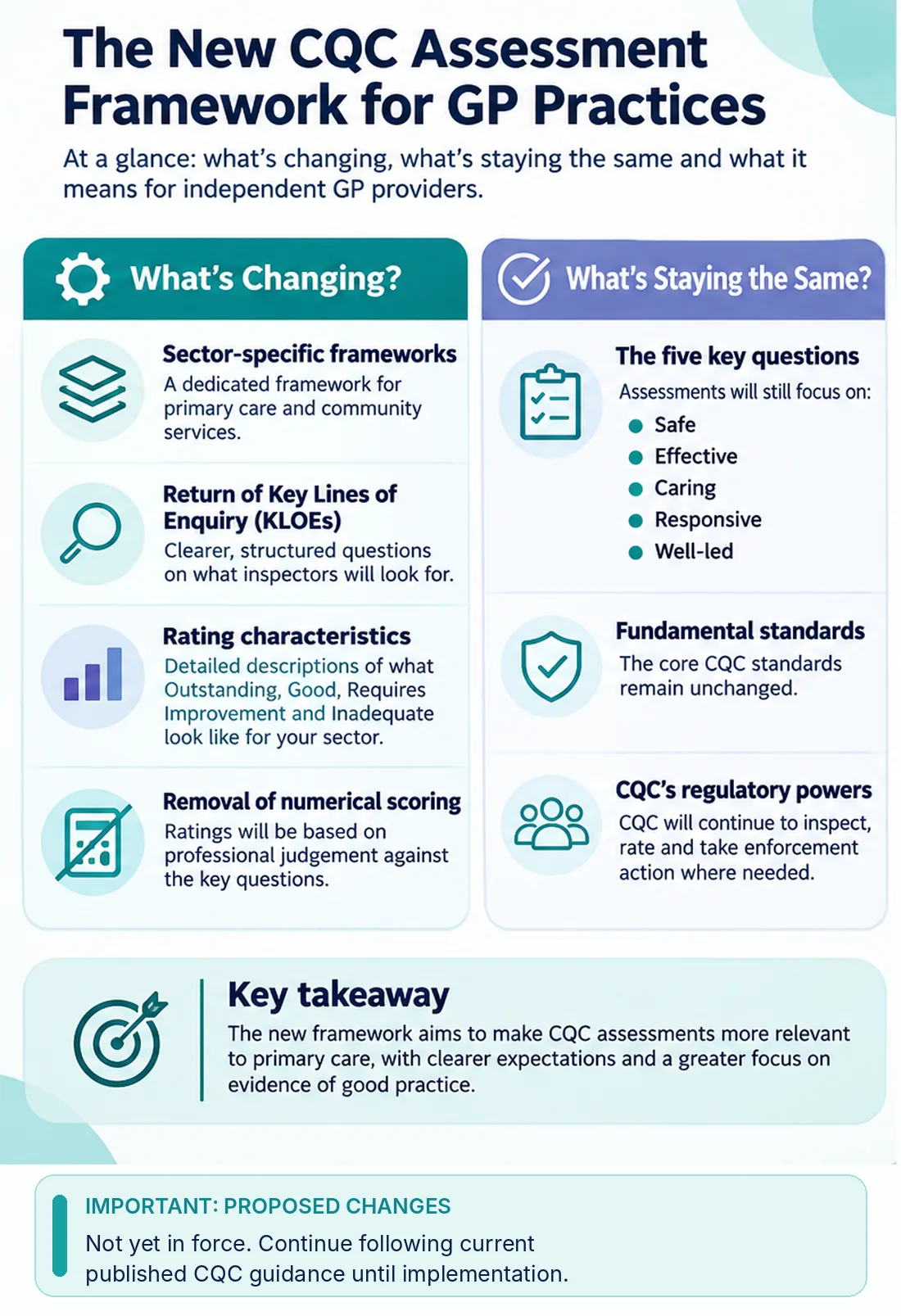
The proposals change the way CQC would organise assessments and explain its judgements. Four elements matter most to GP leaders.
A framework that reflects primary care
Instead of one broad framework applying to every sector, CQC has prepared four draft frameworks for adult social care, mental health care, primary care and community services, and hospitals. The primary care draft is intended to make assessment expectations more relevant to services such as GP practices and community-based healthcare.
Key lines of enquiry (KLOEs) would return
The draft approach proposes replacing today’s quality statements with structured key lines of enquiry. These are questions indicating what assessment teams will examine within each of the five key questions. The practical benefit, if implemented as proposed, is a clearer route from the question being asked to the evidence a provider should be ready to discuss.
Rating characteristics would explain each level
The proposed frameworks include rating characteristics describing what Outstanding, Good, Requires Improvement and Inadequate care looks like in each sector. These are designed to support more transparent and consistent judgements. Practices should not assume that examples in a draft framework are already binding requirements.
Numerical scoring would be removed
CQC has proposed moving away from numerical scoring and making rating decisions at key-question level using professional judgement, the available evidence and the published rating characteristics. This is a planned change. CQC’s current assessment guidance still explains scoring at quality-statement level, so providers must not assume that scoring has already been withdrawn.
| Area | Current published approach | Proposed approach |
|---|---|---|
| Framework | Single Assessment Framework across sectors | Separate frameworks, including primary care and community services |
| Questions | Five key questions with quality statements | Same five questions supported by KLOEs |
| Rating detail | Quality statements and current ratings guidance | Sector-specific rating characteristics |
| Scoring | Scores used in reaching ratings where applicable | Holistic professional judgement; scoring removed |
| Status | Published approach currently in use | Drafts, testing and evaluation; start date to be confirmed |
CQC said its pilot programme would run from June to October 2026, with final evaluation in November. Pilots run alongside existing inspections and participation is voluntary. Its August update confirmed continuing development of the frameworks, supporting guidance and regulatory methods. Any precise adoption date should be checked against the latest CQC announcement rather than inferred from earlier planning targets.
Official sources: CQC pilot programme | CQC assessment guidance | August progress update
What could these changes mean for independent GP practices?
Independent GP services must bring together clinical safety, professional oversight and a clear patient experience. The proposed direction reinforces the need to demonstrate outcomes and learning, rather than presenting a large volume of paperwork without a clear explanation of what it achieves.
Clinical governance and leadership oversight
Practice leaders should be able to explain who is accountable for clinical quality, how risks are escalated and how quality concerns lead to decisions. Useful evidence may include governance meeting records, clinical audit findings, action owners, follow-up reviews and examples of changes to care pathways. The key question is not only “Do we have a governance policy?” but “What has this governance system found and improved?”
Prescribing, medicines and patient safety
Independent GP providers may operate different service models, but relevant risks still require active oversight. Depending on the service, examples include medicines alerts, prescribing audits, test-result tracking, referral follow-up, infection prevention and incident review. Good evidence traces a concern from identification through action and checks that the change has worked. CQC’s GP guidance specifically discusses prescribing performance, significant events and clinical audit as governance information.
Staff competence, locums and learning
A provider should understand whether its clinicians and other staff have the skills, support and supervision appropriate to their roles. Record checks are useful, but leaders also need to understand whether training translates into practice and whether learning from incidents, complaints or feedback is shared. For practices using sessional clinicians or external partners, clear accountability and safe information-sharing arrangements are particularly important.
Patient access, responsiveness and effectiveness
CQC may consider how people experience services and whether care is responsive to individual needs. GP practices can review how they receive and act on patient feedback, manage complaints, make information accessible and identify barriers to timely follow-up. Where services make changes, they should record what was monitored and whether patients experienced an improvement. These are practical evidence examples, not a new checklist of mandatory documents.
What evidence should an independent GP practice review now?
An evidence review is most useful when it connects policy to everyday delivery. Independent GP providers can start with a concise, risk-based self-assessment rather than creating another large folder solely for an inspection.
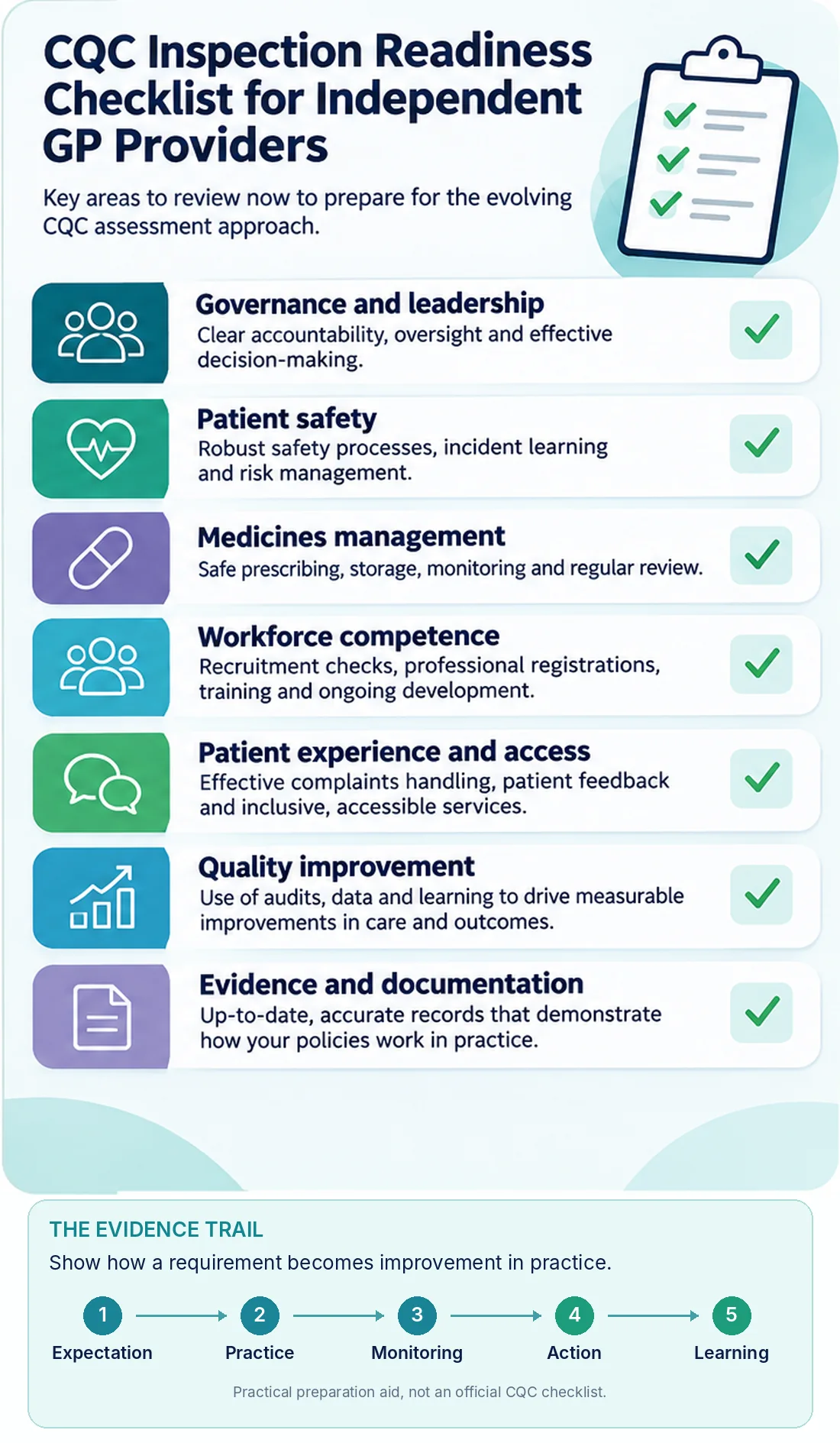
- Leadership and accountability: A current organisation chart, named clinical and operational responsibilities, governance minutes and actions followed through.
- Clinical effectiveness: Recent audit results, identified variations, agreed improvements and a follow-up showing whether practice changed.
- Safety and medicines: Risk assessments, relevant medicines alerts, safeguarding arrangements, significant-event learning and test-result or referral follow-up processes.
- People and competence: Appropriate recruitment and professional-registration checks, induction, training, supervision and support for permanent and sessional staff.
- Patient experience: Feedback themes, complaints response and learning, accessibility adjustments and evidence that patient concerns inform decisions.
- Policies used in practice: A small sample of policies tested against records, staff understanding and observed day-to-day processes.
- Continuous improvement: A manageable action log with ownership, timescales, evidence of completion and review of impact.
A useful evidence trail: expectation or risk → what happens in practice → how it is monitored → what changed → what the practice learned.
This type of evidence is more persuasive than documentation volume alone. If a clinical audit identified variation in a pathway, for example, leaders should be able to describe the response and whether a repeat check demonstrated improvement. If a complaint highlighted access problems, it should be possible to show how the concern informed action and review.
How should GP providers prepare during the transition?
Preparation should begin with the guidance currently in force while leaving enough flexibility to respond when CQC confirms its final sector framework. The following sequence keeps the work proportionate:
- 1. Start with current obligations. Use CQC’s live assessment guidance and the regulations relevant to your registered activities. Do not treat draft KLOEs as operational requirements.
- 2. Read the draft through a primary-care lens. Compare the proposed areas with your practice’s actual patient pathways, professional groups, technology and referral arrangements. Identify where the wording is likely to prompt new questions.
- 3. Test the quality of evidence. Select a small sample across governance, patient safety, medicines, complaints and improvement. Ask whether a reviewer could follow the story from risk to action.
- 4. Clarify leadership ownership. Ensure relevant managers and clinical leads know which risks they monitor, where evidence is held and how overdue actions are escalated.
- 5. Close gaps and check impact. Prioritise material patient-safety or governance weaknesses, give each action an owner and review whether the change is working.
- 6. Monitor official CQC communications. Check the final framework, guidance and implementation notices before changing internal templates or training materials. Keep the transition under review.
In practice, the strongest preparation is not a last-minute document refresh. It is a routine rhythm of reviewing risks, learning from what happens and being able to explain the evidence clearly to staff, patients and assessors.
How can a mock CQC inspection support readiness?
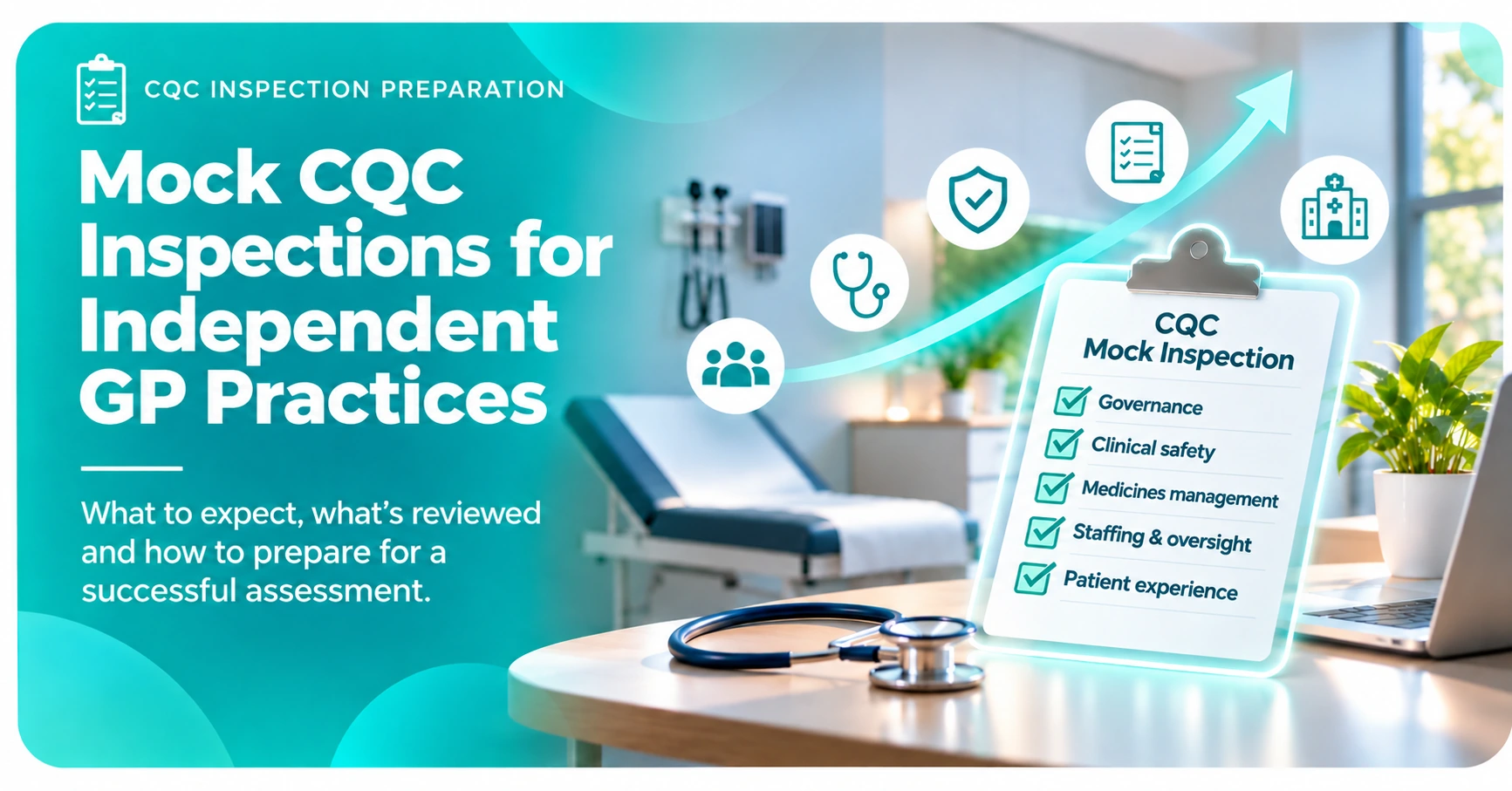
A mock CQC inspection provides a structured, independent view of how a service may stand up to regulatory scrutiny. It can test governance arrangements, agreed evidence, staff understanding and the way processes operate in practice. Its value is in identifying gaps early and turning findings into a workable improvement plan, not in predicting a regulator’s final rating.
For an independent GP provider, an appropriately scoped review can:
- Benchmark practice against relevant current regulations and published CQC expectations.
- Challenge whether clinical governance and safety arrangements are understood and evidenced.
- Identify unclear responsibilities, missing follow-up or weak evidence of learning.
- Help leaders prioritise realistic improvement actions and check readiness for future change.
Delphi Care Solutions offers independent mock CQC inspections with a scope agreed to the service. Reviews can include evidence and records, leadership and governance, relevant practice observations, structured findings and prioritised recommendations. A mock inspection is not an official CQC assessment, and neither Delphi nor any independent reviewer can guarantee a future regulatory judgement.
Explore Delphi’s Mock CQC Inspections service
Frequently asked questions
Has the new CQC assessment framework already replaced the Single Assessment Framework?
Not in the published guidance reviewed on 9 November 2026. CQC has developed and piloted draft sector-specific frameworks, but providers should continue to follow the current published assessment approach until CQC confirms the transition.
Will the five CQC key questions change?
No. CQC has said Safe, Effective, Caring, Responsive and Well-led will remain the central questions in the proposed sector-specific frameworks.
Are Key Lines of Enquiry (KLOEs) returning?
Yes, that is the proposal. Draft supporting KLOEs would replace current quality statements and describe more clearly what assessment teams would examine.
Is CQC removing numerical scoring?
CQC plans to remove scoring as part of its revised methodology. The existing published guidance still explains scoring, so practices must distinguish this proposal from the approach currently in use.
Will the revised framework apply to private GP practices?
CQC’s draft primary care and community services framework is relevant to independent GP providers within CQC’s regulatory remit. The final scope and service-specific guidance should be checked when issued.
What should a GP practice do before implementation?
Maintain compliance with current regulations, review evidence of clinical governance and improvement, identify gaps early, and monitor official CQC updates. A proportionate independent readiness review can provide useful additional challenge.
Official guidance and further reading
The following official materials explain the current position and the proposed direction. Because the framework is evolving, review the CQC pages again before relying on the article for an operational decision:
- CQC: Current assessment framework and quality statements
- CQC: Assessing quality and performance
- CQC: Draft sector-specific frameworks
- CQC: March 2026 explanation of the proposals
- CQC: Piloting, testing and evaluation
- CQC: Guidance on effective clinical governance in GP practices
For further background on the earlier framework, see Delphi’s explainer of the Single Assessment Framework. For practical improvement help beyond a mock review, see our CQC Readiness & Improvement service.
The CQC’s Single Assessment Framework Explained | CQC Readiness & Improvement



If you would like to chat with one of our consultants, then why not book a meeting now.
We look forward to hearing from you!
Book your meeting now