
2nd March 2026
Ofsted Inspection for Children’s Homes: Complete Compliance & Preparation Guide

Estimated reading time: 31 minutes
Ofsted inspections for children’s homes are normally unannounced, which means inspectors see everyday practice, not a polished “inspection folder”. This guide is for providers, Registered Managers and Responsible Individuals who want a clear, inspection-ready approach under the SCCIF, with practical guidance on what inspectors focus on and which evidence carries the most weight.
It shows how to stay ready all year through live safeguarding records, strong leadership oversight, and a simple quality improvement loop using Regulation 44 and Regulation 45. If you want a quick, practical tool to check readiness and prioritise what to fix first, start with our Ofsted Inspection Checklist for Children’s Homes: What You Need Before the Visit.
| By | Sophie Lawrence, Ofsted Registrations & Compliance Manager (Ofsted projects), Delphi Care Solutions |
| Last updated | March 2026 |
| Experience | Former Children’s Home Manager (High-risk and complex-needs), BA (Hons) Youth Justice (NTU) |
| Editorial note | Updated when Ofsted guidance or forms change to keep this guide inspection-ready. |
| Sources | Based on Ofsted SCCIF guidance, Children’s Homes (England) Regulations 2015, Quality Standards, and current Annex A forms. |
About the author
Sophie Lawrence is the Ofsted Registrations and Compliance Manager (Ofsted projects) at Delphi Care Solutions, supporting regulated services across social care to prepare for inspection, strengthen governance, and embed inspection-led improvement.
Sophie brings frontline and leadership experience in children’s services, including nearly five years managing a high risk, complex-needs children’s home, where she led on regulatory compliance, safeguarding, and service stability. She holds a BA (Hons) in Youth Justice from Nottingham Trent University.
Key Takeaways
- Ofsted inspections for children’s homes are unannounced and focus on daily practice, so be consistently prepared.
- The Ofsted inspection checklist covers children’s safety, progress, and strong leadership under the SCCIF framework.
- Keep operational and safeguarding records live all year to ensure accurate and consistent inspection data.
- Have a coherent evidence pack demonstrating safeguarding journeys, children’s outcomes, and robust management oversight.
- Utilise mock inspections and regular check-ins to stay inspection-ready and identify common risk areas before inspectors arrive.
Quick Ofsted readiness test (10 minutes)
If Ofsted arrived today, you need to be able to show, quickly and confidently, that children are safe, making progress and well led under the SCCIF for children’s homes. Run this quick test every month and whenever you sense inspection risk rising:
- Inspections are unannounced: Ofsted inspectors focus on daily practice, not staged folders. Your goal is to prove children are consistently kept safe, making progress, and the home has strong leadership under the SCCIF.
- Know the 3 judgement areas: Children’s experiences & progress · How well children are helped & protected · Effectiveness of Leadership and Management.
- Keep safeguarding and operational records live all year: The Annex A should be continuously updated and QA’d so inspection data is accurate, consistent and always ready. (incidents, sanctions, restraints, missing, staffing, notifications).
- Safeguarding can cap your outcome: if “helped & protected” is weak, the overall judgement is restricted and if safeguarding is judged Inadequate, the overall outcome is likely to be Inadequate, regardless of strengths elsewhere.
- Build a real evidence pack mapped to the SCCIF + regulations: safeguarding trail, training/supervision, incidents + trend analysis, risk assessments + reviews, care planning + outcomes, complaints/learning loop, robust Reg 44 + Reg 45 monitoring.
- Evidence the whole safeguarding journey: concern → decision → referral → outcome, with clear chronologies, thresholds, multi-agency notes, and continuous learning (policy/risk assessment/training updates).
- Leadership must show grip: RM and RI should clearly explain current risks, themes, actions, and impact using real data, audits, Reg 44/45 intelligence, and case examples.
- Be inspection ready every day: with defined responsibilities, up-to-date information, well-organised evidence, and staff who can speak confidently and honestly about practice.
- Mock inspections reduce risk: they stress-test evidence, culture, and leadership with SCCIF-style case tracking and produce an Ofsted-style report + risk-rated action plan.
- Quality improvement is actions → outcomes: not just completed tasks, showing how identified risks lead to action and measurable improvements in safeguarding and outcomes for children.
- Common risk areas: Inconsistent Annex A data, safeguarding that’s on paper but not evidenced in practice, weak leadership oversight, management vacancies, and limited evidence of impact in new homes.
- Next steps: download the readiness checklist, request an evidence pack review, or book a SCCIF-aligned mock inspection + action plan (urgent if inspection is likely approaching).
Who this guide is for (and what’s updated for 2026)
This guide is written for providers, Registered Managers, Responsible Individuals and operational leaders in children’s homes in England who need a practical, inspection ready approach to Ofsted visits. It is designed for both established homes and new providers whether preparing for registration, inspection, or maintaining continuous readiness, under the Social Care Common Inspection Framework (SCCIF) for children’s homes.
The focus is to help you be fully prepared for an Ofsted inspection without last-minute preparation or reactive paperwork. Rather than creating evidence solely for inspection, this guide shows you how to maintain a live, day-to-day evidence base that clearly demonstrates children’s experiences, progress, and safety.
The content reflects the current SCCIF guidance for children’s homes and the latest inspection documents. It also reflects Ofsted’s updated post inspection and complaints process announced in November 2023, which clarified how factual accuracy checks and formal complaints interact.
If your Ofsted inspection is approaching, you should use this guide to prioritise inspection ready evidence, strong safeguarding oversight, and effective leadership and management. For services seeking additional assurance or responding to requirements, recommendations or complaints, a structured mock inspection and action plan aligned with the SCCIF can provide clarity and confidence.
Table of contents
- Who this guide is for (and what’s updated for 2026)
- What an Ofsted inspection looks like for a children’s home (plain English)
- Readiness & evidence: how to stay “always ready” (mock inspections and packs)
- Safeguarding & Leadership Standards
- Quality improvement: actions → outcomes (Reg 44/45 + action plans)
- Common risk areas that impact inspections (and how to prevent them)
- FAQs: Ofsted inspection checklist for children’s homes
- Case example (anonymised): issue → intervention → outcome
What an Ofsted inspection looks like for a children’s home (plain English)
Every Ofsted inspection of a children’s home is normally unannounced so inspectors can see typical daily practice. Inspectors usually arrive during normal operating hours, show identification, and explain the scope and purpose of the inspection to the senior person in charge, usually the Registered Manager or the most senior person on duty.
From that point, inspectors focus on the child’s lived experiences: they read records, observe interactions, and talk to children, staff, managers and professionals to understand what it is like to live in the home. Their central questions are whether children are safe, whether they make progress, and whether leadership and management drive good quality, stable care over time.
Inspectors gather evidence through:
• Case tracking (looking at specific children’s experiences in depth).
• Sampling records (care plans, risk assessments, incidents, complaints, health and education records).
• Observation (routines, boundaries, relationships, and how staff respond).
• Discussions (with children, staff, the Registered Manager, Responsible Individual and placing authorities).

At the end, they use SCCIF evaluation criteria to make graded judgements that become your published inspection outcome.
The Ofsted inspection framework (SCCIF): what it means in practice
The Social Care Common Inspection Framework (SCCIF) for children’s homes sets out how Ofsted inspects, what evidence inspectors collect and how they reach judgements. The SCCIF emphasises that inspections focus on what makes the most difference to children’s lives and apply consistent expectations across providers.
For children’s homes, the SCCIF uses three key judgement areas:
• The overall experiences and progress of children and young people.
• How well children and young people are helped and protected.
• The effectiveness of leadership and management.
Important: “Helped & protected” carries disproportionate weight. If safeguarding is not secure and consistently evidenced, it can limit the overall judgement even where other areas are stronger.
These judgements are expressed on a four-point scale (Outstanding, Good, Requires Improvement to be Good, Inadequate), with the SCCIF explicitly stating that “helped and protected” and “leadership and management” can limit the overall grade. Homes are also inspected with reference to the Children’s Homes Regulations 2015 and the Quality Standards.
The Ofsted inspection framework (SCCIF): what it means in practice
| Aspect | Full inspection | Assurance inspection | Monitoring inspection |
| Main purpose | Full graded evaluation under SCCIF. | Check that children are safe, leaders are effective, and the home is improving. | Check safety, oversight, and progress against required actions. |
| Judgements given | Yes – graded on 4point scale (overall and key areas). | May contribute to risk assessment and future grading. | No new graded judgement; focuses on improvement and risk. |
| Typical trigger | Routine cycle and risk-based scheduling | Concerns, previous shortfalls, or key lines of enquiry. | Inadequate judgement, serious safeguarding concerns, or verification of urgent actions. |
| Notice | Normally unannounced. | Normally unannounced. | Normally unannounced. |
| Focus of inspector activity | Full range: children’s experiences, safeguarding, leadership. | Children’s safety and progress since last inspection. | Specific failings, urgent risks and action progress. |
| Impact on enforcement / next steps | Drives main published judgement and may trigger enforcement. | Informs whether further enforcement or monitoring is needed. | Can lead to further enforcement or restrictions. |
Inspection timeline: before, during, after (step-by-step)
Although full inspections are unannounced, there is still a predictable structure before, during and after the visit. Understanding this helps you plan evidence, staff briefings and leadership availability.
Before inspection
• Ofsted schedules inspections based on previous judgement, notifications, Regulation 44/45 intelligence and risk.
• Internally, you should treat every day as an “inspection day”: documentation should be current, and children’s records coherent.
During inspection
• Inspectors arrive, explain the scope, agree practical arrangements and begin evidence gathering (case tracking, observations, reading records, speaking to children and staff).
• Key information is requested, covering areas such as children’s experiences, staffing, incidents, restraints, behaviour management processes, missing from care and notifications.
• Inspectors triangulate what they see and read with what they hear from children and professionals, testing whether leadership truly understands its service.
After inspection – including factual accuracy
• Feedback: inspectors provide verbal feedback at the end of the visit, outlining likely judgements and key findings.
• Draft report: Ofsted sends you a draft report and invites you to raise minor points of clarity or factual accuracy within a short timescale (typically around five working days), or to lodge a formal complaint under its updated post inspection process.
• Ofsted considers factual accuracy comments and any early process concerns before finalising the report.
• Final report and publication: once comments or complaints are considered, Ofsted publishes the final report on GOV.UK.
Annex A: what it is, when you submit it, how inspectors use it
Annex A is Ofsted’s standard “request for information” for children’s homes; it sets out the data and documents inspectors require for inspections, including lists of children, staffing information, incidents, restraints, behaviour management processes, missing from care occurrences and notifications. Ofsted published updated Annex A forms for children’s homes and secure children’s homes for use from 4 April 2025.
Providers should keep the Annex A as a live document so that it is ready to be sent when Ofsted requests it in connection with inspection activity (usually at the start of the full inspection). Inspectors use the Annex A to select case samples; identify key lines of enquiry and cross check the accuracy of what leaders say against recorded incidents and notifications.
Three common Annex A mistakes
- Inconsistency – numbers that do not match internal records, such as different totals for physical restraints or missing from care episodes across logs, notifications and Annex A.
- Missing data – incomplete sections (for example, missing information on staff, behaviour management or complaints), which raises questions about oversight and data quality.
- Unclear risk narrative – lists of incidents without explanation of patterns, actions or learning, leaving inspectors to infer the level of risk and leadership grip.
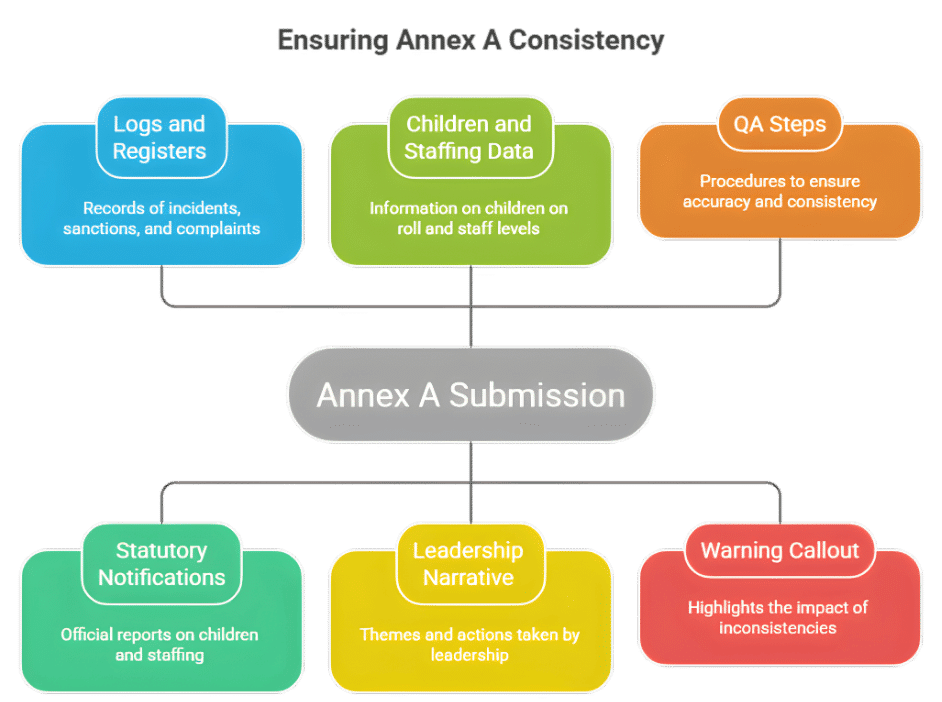
Be blunt about this internally: contradictions between Annex A, logs and notifications are one of the fastest ways inspector confidence drops and it often triggers direct questions about leadership grip and governance.
Maintaining a “live Annex A” throughout the year helps you respond quickly, accurately and confidently when Ofsted requests it.
Readiness & evidence: how to stay “always ready” (mock inspections and packs)
Because Ofsted inspections of children’s homes are normally unannounced, preparation cannot be a one week exercise before a predicted visit. Homes that rely on last minute tidy ups typically expose deeper problems – out of date records, untested safeguarding systems, and leadership that does not understand everyday practice.
The “always ready” principle means that:
• Core records are maintained in real time, not retrospectively.
• Annex A type data is accurate and routinely quality assured.
• Evidence of impact is generated as part of ordinary work, not as a parallel “inspection file”.
Most importantly, you stop thinking in terms of documents and start thinking in terms of evidence of impact: what changes for children because of what you do, and how you know.
Your evidence pack: what to have ready at all times
You can reduce inspection risk by maintaining a structured evidence pack that reflects Ofsted’s focus under the SCCIF and the regulations. This is not a separate library of paperwork but a way of organising existing records so inspectors – and your own leaders – can see the story clearly.
A children’s home evidence pack should map directly onto the SCCIF judgement areas and regulatory requirements, including the children’s home Quality Standards. For example, Regulation 44 and Regulation 45 outputs should be readily accessible because Ofsted uses both to monitor quality and risk between inspections.
Template – Children’s homes Ofsted evidence pack
- Safeguarding evidence trail
• Safeguarding policy aligned to statutory guidance and local procedures.
• Chronologies for each child showing concerns, decisions, referrals, and outcomes.
• Records of strategy discussions, child protection conferences and multi-agency meetings.
• Staff confidently understand the safeguarding procedures and can follow them in practice.
- Staff training and supervision
• Training matrix showing mandatory, role specific and refresher training.
• Supervision schedules and agendas that evidence reflective practice.
• Induction records and competency sign offs.
- Incidents, sanctions, restraints and missing from care
• Clear logs of incidents, sanctions, restraints, and missing from care occurrences that match notifications.
• Analysis of patterns and themes (who, what, when, where, triggers).
• Evidence of actions taken (care plan changes, staff training, environmental adjustments).
- Risk assessments and reviews
• Individual risk assessments for key risks (self-harm, going missing, exploitation, behaviour, peer relationships).
• Regular review records showing updates in response to incidents and changes.
• Location risk assessment aligned to statutory guidance and local intelligence.
- Care planning and outcomes tracking
• Care plans that reflect children’s views, needs and goals.
• Education, health and placement plans integrated with local authority plans.
• Outcomes tracking tools that show progress over time (qualitative and quantitative).
- Complaints, compliments and the learning loop
• Complaints log with clear recording of issues, responses, timescales and outcomes.
• Evidence of how learning from complaints and compliments informs practice and policy.
- Regulation 44 and Regulation 45 outputs and action closure
• Regulation 44 reports with clear recommendations and provider responses.
• Regulation 45 reports that summarise themes, evaluate impact and lead to an action plan.
• Evidence that actions have been completed and sustained (minutes, audits, practice changes).
The Always Ready Approach
Sometimes, intelligence such as sector patterns, recent events, notifications, or the time since your last inspection can make it feel likely that Ofsted will visit soon. However, you cannot rely on prediction. The safest approach is to operate on an always-ready basis, so that if an inspector arrives unannounced, your day-to-day practice already aligns with the SCCIF and the Children’s Homes Regulations.
Always-ready does not mean constant panic. It means clear roles, live inspection information, organised evidence, and staff who can speak confidently and honestly about practice.
Roles (who does what)
- Registered Manager: coordinates inspection readiness, maintains oversight of staffing and practice, and ensures evidence is accurate, current and easy to access.
- Responsible Individual: provides governance and challenge, reviews Regulation 44 and 45 findings, and tracks high-risk actions through to completion with clear evidence of impact.
- Senior staff: maintain accurate records, ensure the environment remains safe and suitable, and support consistent communication and practice across the team.
Accurate, live inspection information
Keep key inspection data current and consistent across all systems, including children, staffing, safeguarding events, sanctions, missing episodes and notifications. Address gaps or inconsistencies promptly through regular quality assurance, so inspection information can be produced quickly and confidently when requested.
Organised, accessible evidence
Maintain clear, well-structured records that demonstrate safeguarding oversight, leadership monitoring and children’s progress over time. Ensure essential documents are easy to locate at any time, including Regulation 44 and 45 reports, complaints learning, staffing overviews, and key audit outputs.
Confident and informed staff
Staff should understand their roles, follow safeguarding and escalation procedures, and speak honestly about what they do in practice. Conversations with inspectors should reflect everyday routines and children’s lived experiences, not rehearsed answers or guesswork.
Clear, accessible records
Well-organised records support effective leadership and oversight. Information should be easy to locate accurate and up to date, enabling leaders to understand children’s journeys, risks and outcomes at any time – not just during inspection. Confusing, duplicated or incomplete records signal lack of control and can undermine otherwise good practice.
Key principles include:
- Logical structure: organise information in clear categories (e.g. children’s records, staffing, safeguarding, complaints, Regulation 44 and 45 monitoring) so it reflected how the service operates day to day.
- Single source of truth: maintain ne authoritative version of each key document to avoid duplication or conflicting information.
- Version control: use consistent naming and record updates so changes are transparent and auditable. 0115”) and record who updated them and why.
Mock inspections: what they test (and what you gain)
A well-designed mock inspection for a children’s home mirrors Ofsted’s SCCIF approach and tests your evidence, culture and leadership under realistic conditions. It should include time on site, case tracking, observation of day-to-day practice, and structured discussions with leaders and staff (and with children where appropriate and safe). The aim is not to produce more paperwork, but to stress-test whether your practice and oversight would stand up to an unannounced inspection.
Mock inspections help you:
- Spot limiting judgement risks early, particularly safeguarding and leadership weaknesses that can cap the overall outcome.
- Test leadership grip by checking whether the Registered Manager and Responsible Individual can clearly explain current risks, themes, actions and impact using real evidence.
- Strengthen staff confidence and consistency by identifying where practice varies, where recording is weak, or where staff are unclear on thresholds and escalation routes.
- Quality-check your inspection information by reviewing Annex A-type data, notifications and logs for contradictions that undermine inspector confidence.
- Turn evidence into inspection-ready narrative by aligning records to SCCIF lines of enquiry and making impact easy to demonstrate.
A useful mock inspection output includes:
- An Ofsted-style report with indicative judgements against the SCCIF headings and clear evidence-based findings.
- A risk-prioritised action plan using the structure: risk → action → owner → deadline → evidence → impact.
- Clear links between recommended actions and the inspection lines of enquiry most likely to be tested, so leaders know what to fix first and why.
Safeguarding & Leadership Standards
Under the SCCIF, the judgement on how well children and young people are helped and protected is central. Serious weaknesses in safeguarding can limit the overall judgement, even where other areas are stronger. Inspectors expect safeguarding to be evidenced through clear, consistent records that show the full journey from identification to decision to action to outcome, supported by multi-agency documentation where relevant.
In practice, inspectors will cross-check what leaders and staff say against the evidence. They will triangulate case records, statutory notifications, Annex A information, and local authority feedback to test whether safeguarding practice aligns with statutory guidance and local procedures, not just internal policy documents. They will also look for a visible learning loop. Incidents, complaints and near misses should lead to clear learning, and that learning should show up in supervision, training, updated risk assessments, and changes to practice or policy, with evidence that improvements are sustained over time.
Worked example (redacted): Safeguarding concern to decision to referral to outcome
Scenario (redacted)
A staff member notices Child X returning from an off-site activity withdrawn and tearful, with a new bruise on their arm. Child X discloses that an older peer pushed them against a wall during an argument.
Concern
Staff identify a potential safeguarding incident involving peer-on-peer harm and record the child’s disclosure using the child’s own words where possible.
Immediate action
- Staff complete a body map and record the injury and disclosure promptly.
- The on-call manager is informed immediately.
- An interim safety plan is put in place to reduce risk, including supervision arrangements and separation from the peer where appropriate.
Decision
The manager reviews Child X’s history, recent peer conflict, and any relevant risk assessments. Based on thresholds and local safeguarding procedures, the manager determines that external consultation is required and documents:
- why the threshold is met
- what immediate protective actions are in place
- what information will be shared and with whom
Referral
A same-day referral is made to children’s social care (and other agencies as required by local procedures). The referral is supported by:
- a clear chronology of relevant events
- the body map
- a factual account of what was seen, heard and reported
Advice received and agreed actions are recorded, implemented and communicated to the staff team.
Outcome and learning
Child X reports feeling safer and supported. Risk reduces following social worker involvement and restorative work. Risk assessments and the child’s plan are updated, and learning is embedded through supervision and team discussion, including any practice changes needed to prevent recurrence.
Evidence trail (what inspectors expect to see)
Safeguarding log, child chronology, body map, manager decision record, referral record, professional advice, updated risk assessments/care plan, and supervision notes. Together, these create a clear end-to-end record of action, oversight and impact.
This is the type of safeguarding evidence that stands up in inspection because it shows the full journey from concern to action to outcome, not just a policy on paper..
Registered Manager: what you must demonstrate in inspection
As a Registered Manager, you are a central figure in any Ofsted inspection; inspectors assess your fitness, oversight and leadership under both the regulations and the SCCIF. They consider how you ensure safe, stable care, how well you know your home’s strengths and weaknesses, and how you respond to emerging risks.
You should be able to demonstrate:
- Operational control and oversight rhythm – how you monitor children’s experiences daily, weekly and monthly, using data, observations and feedback.
- Supervision quality – how you use supervision to build practice, challenge poor performance and support staff wellbeing.
- Consistency between policy and practice – examples where you identified a gap between what should happen and what does happen, and the action you took.
- How you “know” what is happening – walkarounds, direct work with children, engagement with families and professionals.
Inspectors will usually ask the Registered Manager questions about individual children’s progress, staffing stability, training, notifications, learning from Regulation 44/45, and how they respond to complaints and allegations.
Responsible Individual: how to prove real oversight
The Responsible Individual (RI) is accountable under the Children’s Homes Regulations 2015 for providing effective governance, oversight and assurance. Ofsted expects RIs to be visible in the life of the home, understand risks, and support and challenge the Registered Manager appropriately.
To evidence real oversight, the Responsible Individual should be able to show:
- Governance grip – structured visits, records of findings, and evidence that issues raised are followed up and resolved.
- Monitoring, audits, and action closure – documented audit programmes linked to the SCCIF and regulations, with tracked actions and demonstrable impact.
- Strategic decision making – examples where the RI has intervened on staffing, resources, referrals or placement matching to protect children and improve quality.making – examples where the RI has intervened on staffing, resources, referrals or placement matching to protect children and improve quality.
Where an RI appears “hands-off”, inspectors may see gaps between what the provider believes is happening and what children experience, often linked to missed risks or slow responses to known problems.
Manager absence or vacancy: how to stay compliant
Periods without a substantive Registered Manager are inherently risky and attract regulatory attention. Ofsted’s guidance on providers’ responsibilities makes clear that children’s homes must maintain effective management and notify Ofsted promptly about absences, changes and vacancies in line with the regulations.
To remain compliant during a vacancy or extended absence:
- Put interim management arrangements in place promptly (for example, an experienced deputy or interim manager) with clearly documented delegation and oversight.
- Make all required notifications to Ofsted and, where relevant, to placing authorities, explaining your interim plan and timescales for permanent appointment.
- Maintain a “vacancy plan” checklist covering governance, supervision, decision-making thresholds and communication, so leadership gaps do not leave children at risk.
- Lock decision-making thresholds in writing: who can approve admissions/matching, escalate safeguarding, authorise sanctions/restraints, and sign off risk assessments and notifications. Vacancies typically fail through threshold drift and slow erosion of oversight, not one missed task.
Homes typically fall into non-compliance when interim arrangements are unclear, decision-making thresholds drift, and crucial tasks (such as Regulation 44 responses, notifications or supervision) are delayed or managed inconsistently.
Quality improvement: actions → outcomes (Reg 44/45 + action plans)
Ofsted expects providers not just to identify shortfalls but to show how they improve and sustain better practice over time. Completing actions on a list is not enough; inspectors look for a quality improvement loop where actions lead to measurable outcomes for children and the service.
A credible loop typically includes:
- Systematic gathering of evidence (Regulation 44, Regulation 45, audits, feedback, incidents).
- Clear analysis of themes and risks.
- Focused, timebound actions with named owners.
- Review of impact, with adjustments where change is not achieved.
When this loop is clearly documented and understood by leaders and staff, inspectors are more likely to trust that the home can sustain improvements and respond effectively to future challenges.
Regulation 44: turning visits into inspection proof
Regulation 44 of The Children’s Homes Regulations 2015 requires an independent person to visit each children’s home at least once a month and to provide a written thematic report on the home. The independent person must form an opinion on whether children are effectively safeguarded, and the conduct of the home promotes their wellbeing, and the report must be sent to Ofsted and the registered provider.being, and the report must be sent to Ofsted and the registered provider.
Ofsted reads Regulation 44 reports as part of its ongoing monitoring and uses them alongside notifications and other intelligence when deciding the timing and focus of inspections. Turning Regulation 44 findings into actions, and evidencing follow through, strengthens your inspection position through, strengthens your inspection position.
Regulation 45: the format Ofsted expects (and common mistakes)
Regulation 45 requires the registered person to review the quality of care provided in the children’s home at least once every six months and to prepare a report setting out what the review has found and the actions intended to improve or maintain quality. The system must monitor and evaluate the quality of care, feedback from children, parents and placing authorities, and the actions required for continuous improvement.
An effective Regulation 45 review:
- Organises content around key themes (safeguarding, staffing, children’s experiences and outcomes, education, health, complaints, notifications, environment, compliance).
- Uses quantitative and qualitative evidence (data, case examples, feedback) to evaluate each theme.
- Sets out a focused action plan with priorities, timescales and owners, linked back to evidence.
Common mistakes include descriptive reports with little evaluation or analysis, weak links between evidence, conclusions and actions, and repeating the same actions every cycle without demonstrating impact. Ofsted uses Regulation 45 reports to judge how well leaders know their service and whether they drive improvement between inspections.
A purely descriptive Regulation 45 reads as weak leadership oversight: it shows activity, but not whether leaders understand risk, prioritise effectively, or drive measurable improvement.
Action plans that actually improve outcomes (risk → impact)
After an Ofsted inspection, your report will contain requirements (linked to regulations) and recommendations (linked to improvement), with clear wording about what must change. Inspectors will expect to see credible progress at subsequent visits, and weak responses can quickly become limiting judgements, particularly for safeguarding and leadership.
A practical action plan formula is:
risk → action → owner → deadline → evidence → impact
- Risk – The safeguarding, welfare, or progress risk being addressed.
- Action – The specific change to practice, systems or environment.
- Owner – A clearly identified individual responsible for delivery.
- Deadline – Realistic but purposeful timescales.
- Evidence – How implementation will be demonstrated (records, data, feedback, observation).
- Impact – How improved outcomes will be measured (e.g. reduced incidents, improved attendance, stronger feedback, clearer oversight).
Reporting progress means returning to this structure, demonstrating not only that actions are complete, but what difference they have made while being transparent where further improvement is required.
Common risk areas that impact inspections (and how to prevent them)
The SCCIF safeguarding and leadership carry particular weight. The judgment for how well children is helped and protected carries particular weight. If the safeguarding judgment is inadequate, the home cannot achieve a positive inspection outcome overall. Similarly, weaknesses in leadership and management can restrict the overall grade, as inspectors look for strong oversight and the capacity to improve and sustain good practice.
Typical limiting judgement traps include:judgement traps include:
- Inconsistent practice (good work for some children, weak or unsafe practice for others).
- Weak safeguarding evidence trails (decisions not clearly recorded or followed through).
- Leadership instability (manager vacancies, frequent changes, unclear accountability).
- Poor oversight and action closure (Regulation 44 and Regulation 45 issues identified but not addressed).
Understanding these traps allows you to focus improvement efforts on the areas most likely to affect your overall inspection outcome.
Fail point #1: Inconsistent inspection information (how to prevent them)
Concerns arise when the information you provide during inspection does not align with the interna records or leadership oversight. For example, differing figures across incident logs, sanctions, restraints, notifications, or staffing data can quickly undermine confidence in governance and control.
A simple quality assurance routine to prevent this:
- Assign clear responsibility for maintaining inspection information.
- Regularly cross-check key datasets (incidents, sanctions, missing episodes, staffing, and notifications)check Annex A entries against core logs (incidents, sanctions, missing episodes, staffing) before submission.
- Keep records live and updated throughout the year rather than reconstructing information at short notice.
Fail point #2: Safeguarding that exists on paper but isn’t consistent in practice
Some homes have well-written safeguarding policies but inconsistent day-to-day implementation. Inspectors test this by tracking real cases and checking whether actions, timescales and multi-agency working align with statutory guidance, local procedures and children’s lives experiences. looking safeguarding policies but weak implementation; inspectors probe the gap between paper and practice by tracking specific cases against procedures and statutory guidance. They test whether actions taken, timescales met and multiagency work align with local arrangements and
Strengthening practice typically involves:
- Re-briefing staff on key procedures and escalation routes.
- Improving recording so decisions, actions and outcomes are clearly evidenced.
- Ensuring timely follow-up on safeguarding concerns.
- Using supervision, audits, and learning reviews to identify patterns and prevent repeat issues.
- Embedding learning into training, risk assessments and everyday practice.
The strongest services demonstrate not just compliance with policy, but clear evidence that safeguarding actions lead to safer outcomes for children.
Fail point #3: Weak leadership oversight (RM/RI not showing control)
Weak leadership oversight is evident when the Registered Manager and Responsible Individual cannot articulate current risks, themes and improvement priorities convincingly. Inspectors notice when leaders are surprised by information in children’s records, or Regulation 44 reports, or when there is little evidence of challenge in practice.
Strong oversight involves regular, structured governance meetings that reference real data, regulation 44 findings and Regulation 45 themes, with clear actions and follow through. Both RM and RI should be able to describe, with examples, how they have intervened to address concerns and support staff, drawing on audit evidence and children’s feedback through. Both RM and RI should be able to describe, with examples, how they have intervened to address concerns and support staff, drawing on audit evidence and children’s feedback.
Fail point #4: First inspection challenges (why new homes get caught out)
First full inspections of new children’s homes often surface early-stage weaknesses that providers underestimate. Systems may look fine on paper but are not yet embedded, staff teams may be inexperienced or unstable, and evidence of impact may still be developing.
Even with low occupancy, inspectors will judge you hard on leadership grip and safeguarding rhythm: the consistency of recording, decision-making thresholds, escalation, oversight and learning. If systems aren’t embedded from day one, the inspection will expose it.
Common gaps include incomplete or inconsistent care plans and risk assessments, limited evidence that learning from incidents and complaints is being used to refine practice, and over-reliance on a small number of key individuals with fragile cover arrangements.
New providers should treat the period from registration onwards as live inspection readiness, using Regulation 44 visits and internal audits to stress-test systems well before Ofsted arrives and to evidence that leaders understand risk, take action quickly, and can sustain safe, stable practice over time.
FAQs: Ofsted inspection checklist for children’s homes
What is an Ofsted inspection for a children’s home?
An Ofsted inspection is an independent evaluation of how well a children’s homes keep children safe, promote their welfare and help them make progress, carried out under the SCCIF and relevant regulations. Inspectors look at children’s experiences, safeguarding and leadership, and give graded judgements that are published on GOV.UK.
Are Ofsted inspections for children’s homes unannounced?
Yes, inspections of children’s homes are normally unannounced so inspectors can see typical daily practice rather than a staged version. Providers should therefore operate on an “always ready” basis, maintaining up to date records and a live understanding of risk.ready” basis, maintaining up to date records and a live understanding of risk.
What is the Ofsted inspection framework for children’s homes (SCCIF)?
The Ofsted inspection framework for children’s homes is the Social Care Common Inspection Framework (SCCIF), which sets out inspection processes, evaluation criteria and judgement structures. It focuses on children’s experiences and progress, how well they are helped and protected, and the effectiveness of leaders and managers.
Where can I find the Ofsted inspection handbook for children’s homes?
The detailed inspection approach is described in Ofsted’s SCCIF guidance and associated documents for children’s homes, available on GOV.UK. Many providers also use specialist handbooks and resources that summarise what inspectors look for and how evidence is weighed.
What is the Annex A and when do we submit it?
It means inspectors test whether the same story holds true across:u003cbru003echildren’s experiences and voice, 2) records and data, and 3) leadership oversight (audits, monitoring, actions closed).
How often are children’s homes inspected by Ofsted?
Children’s homes normally receive at least one full inspection each inspection year (1 April to 31 March), with further inspections depending on risk and previous judgements. Homes judged less than good are more likely to receive additional monitoring or assurance inspections.
How long does an Ofsted inspection usually last?
A full inspection is typically carried out by a social care inspector with up two days on site, though duration and team size can vary for complex homes or those with education provision. Monitoring or assurance visits may be shorter and more focused on specific concerns.
What will inspectors ask the Registered Manager during an Ofsted inspection
Inspectors usually ask the Registered Manager about children’s progress, safeguarding incidents, staffing, training, notifications, learning from Regulation 44/45, and how they know what is happening in the home. They will test whether the manager has a rigorous, evidence based understanding of strengths and weaknesses based understanding of strengths and weaknesses.
What does the Responsible Individual need to demonstrate to Ofsted
The Responsible Individual must show effective oversight, governance and challenge, including regular engagement with the home, use of Regulation 44 and Regulation 45 findings, and timely action on risks. Inspectors will consider whether the RI helps sustain safe, stable care rather than only appearing reactively.
What happens if there is no Registered Manager in post
If there is no Registered Manager, Ofsted expects clear interim management arrangements and prompt notifications in line with regulatory requirements. Persistent vacancies, unclear leadership or weak interim cover can lead to enforcement and negative judgements.
What are Regulation 44 and Regulation 45, and why do they matter for inspection?
Regulation 44 requires independent monthly visits and reports on the conduct of the home, while Regulation 45 requires six monthly provider reviews and a report on the quality of care. Ofsted uses these to assess how well providers monitor themselves and drive improvement between inspections.monthly provider reviews and a report on the quality of care. Ofsted uses these to assess how well providers monitor themselves and drive improvement between inspections.
How do Ofsted judgements work for children’s homes (and what causes a ‘limiting judgement’)?
Judgements are made on a four point scale (Outstanding, Good, Requires Improvement to be Good, Inadequate) using the SCCIF criteria. Significant weaknesses in safeguarding or leadership can act as limiting judgements that prevent higher overall grades even where some aspects are stronger point scale (Outstanding, Good, Requires Improvement to be Good, Inadequate) using SCCIF criteria. Significant weaknesses in safeguarding or leadership can act as limiting judgements that prevent higher overall grades even where some aspects are stronger.
How long after inspection is the report published?
After the inspection, Ofsted issues a draft report for factual accuracy, then publishes the final version on GOV.UK once any factual corrections are considered. Timescales can vary but reports are normally published within several weeks.
Can we challenge the report if we disagree (factual accuracy vs complaint)?
Providers can submit comments during the factual accuracy process if they believe there are errors or omissions in the draft report. If concerns remain after publication, providers can use Ofsted’s complaints process, which has its own stages and timescales.
Case example (anonymised): issue → intervention → outcome
Issue
A small children’s home had a recent inspection outcome of “Requires Improvement to be Good”. Ofsted’s concerns centred on three high-risk areas that often limit overall judgement:
- Safeguarding evidence was weak. Decisions, actions and outcomes were not consistently traceable through chronologies and case records.
- Regulation 44 learning was not being closed. Recommendations were logged, but follow-through and impact were not clearly evidenced.
- Regulation 45 was descriptive, not evaluative. The report summarised activity but did not analyse themes, risk, impact or improvement priorities.
As a result, Ofsted scheduled a monitoring visit within the following months to check progress and risk.
Intervention
Delphi Care delivered a SCCIF-aligned mock inspection and a focused readiness programme designed to strengthen safeguarding grip and leadership oversight before the monitoring visit. This included:
- Mock inspection with case tracking to mirror how inspectors test lived experience, safeguarding thresholds, and leadership knowledge.
- Desktop review of Annex A-type data to identify contradictions across logs, notifications and inspection information.
- Targeted audit of Regulation 44 and Regulation 45 to assess whether oversight, challenge and improvement were working in practice.
Working with the home’s leaders, we then co-produced a simple but robust quality loop:
- A restructured evidence pack mapped to SCCIF judgement areas, making key proof easy to locate and explain.
- A revised Regulation 45 format that prioritised evaluation, themes, risk and measurable impact, not description.
- An action tracking system linking Regulation 44 recommendations and inspection requirements to named owners, deadlines, evidence and impact.
Outcome
At the subsequent Ofsted monitoring visit, inspectors noted clear improvements in:
- Recording and analysis of safeguarding concerns, including stronger chronologies and decision trails.
- Clearer links between Regulation 44 findings and action, with evidence of closure and follow-through.
- A more analytical Regulation 45 report, demonstrating leadership grip on themes, risks and improvement priorities.
No further immediate enforcement action was taken, and the home was given time to embed improvements ahead of the next full inspection.
Timeframe
The core Delphi intervention ran for six weeks, from scoping to a final action plan. This was followed by a further six-week internal implementation period before the monitoring visit, focused on embedding changes in daily practice and oversight routines.
Next steps: checklist, evidence review, mock inspection
If you are responsible for a children’s home and want to move from reactive inspection panic to confident, evidence-led readiness, here are three practical next steps. Choose the option that best matches your inspection risk and how much support you need.
Option 1: Download the Children’s Homes Inspection Readiness Checklist
A concise, Ofsted-aligned checklist covering safeguarding, leadership oversight, quality improvement and records. Designed for Registered Managers and Responsible Individuals to use monthly, so inspection readiness becomes routine rather than a last-minute scramble.
Option 2: Request an Evidence Pack Review
Ask Delphi Care to review your current evidence pack, including inspection information, safeguarding trails, Regulation 44 and 45 outputs, and action plans. We will identify your highest-risk gaps, flag any inconsistencies that could undermine inspector confidence, and provide clear priorities for what to fix first.
Option 3: Book a Mock Ofsted Inspection plus Action Plan
Commission a full SCCIF-aligned mock inspection delivered in an Ofsted style, including case tracking and leadership interviews. You will receive indicative judgements and a practical, risk-rated action plan you can begin implementing immediately, with clear owners, deadlines and evidence expectations.









If you would like to chat with one of our consultants, then why not book a meeting now.
We look forward to hearing from you!
Book your meeting now